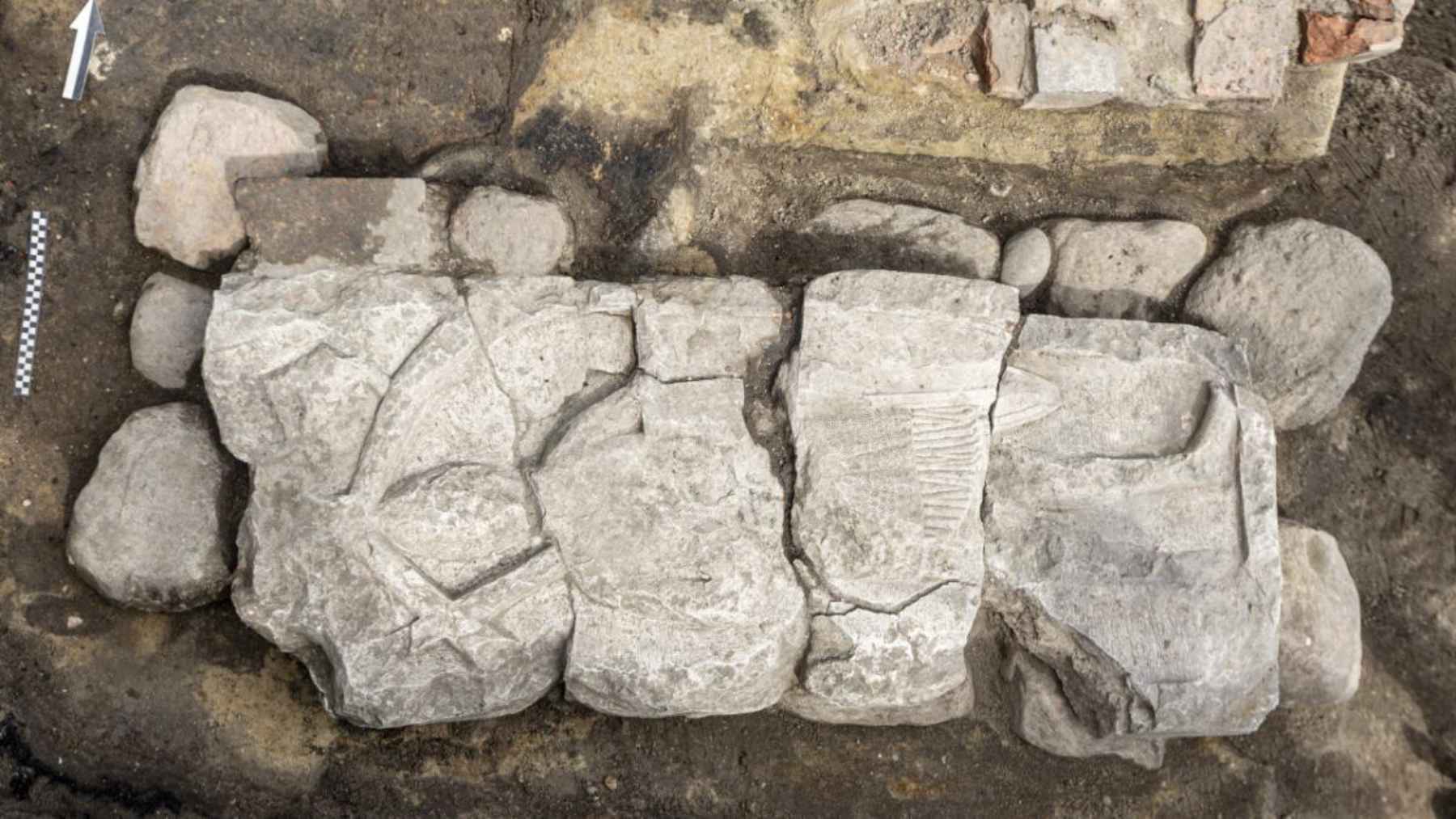
For years, people in Gdańsk walked into the Miś ice cream parlor for scoops and summer lines, with no reason to think a medieval cemetery sat under their feet. Then a redevelopment project opened the ground, and archaeologists found a carved limestone tombstone showing a knight with a sword, shield, helmet, and chain mail.
The discovery is more than a strange twist in an old shopping spot. Beneath the former parlor, researchers uncovered a well-preserved male skeleton and evidence that this corner of the city once joined faith, burial, trade, and political power during Gdańsk’s earliest centuries.
From ice cream to a grave
The site sits near Sukiennicza and Grodzka streets, in the historic center of Gdańsk. The old parlor had operated there from 1962, but after the plot was sold for redevelopment, archaeological work began because the ground was already known to be sensitive.
The excavation covered about 10,800 square feet, and in some places the trenches reached roughly 13 to 16 feet deep. That is a long way down from counters, freezers, and kids choosing flavors, but in a city this old, everyday places can sit on top of several lives at once.
A stone for someone powerful
The key find was a carved slab nearly 5 feet long, made from limestone linked to Gotland, the Swedish island in the Baltic Sea. The image shows a standing knight in armor, with a narrow shield in one hand and a sword held close to the chest.
Sylwia Kurzyńska, an archaeologist with ArcheoScan, told the city that the sword gesture pointed to “someone who had power.” She also described the place as where “the heart of historical Gdańsk beats,” a striking line for a site most residents once knew for ice cream.
The stone is thought to date from the late 1200s or early 1300s. Despite cracks and centuries underground, several details remain readable, including the chain mail and parts of the armor.
The skeleton below
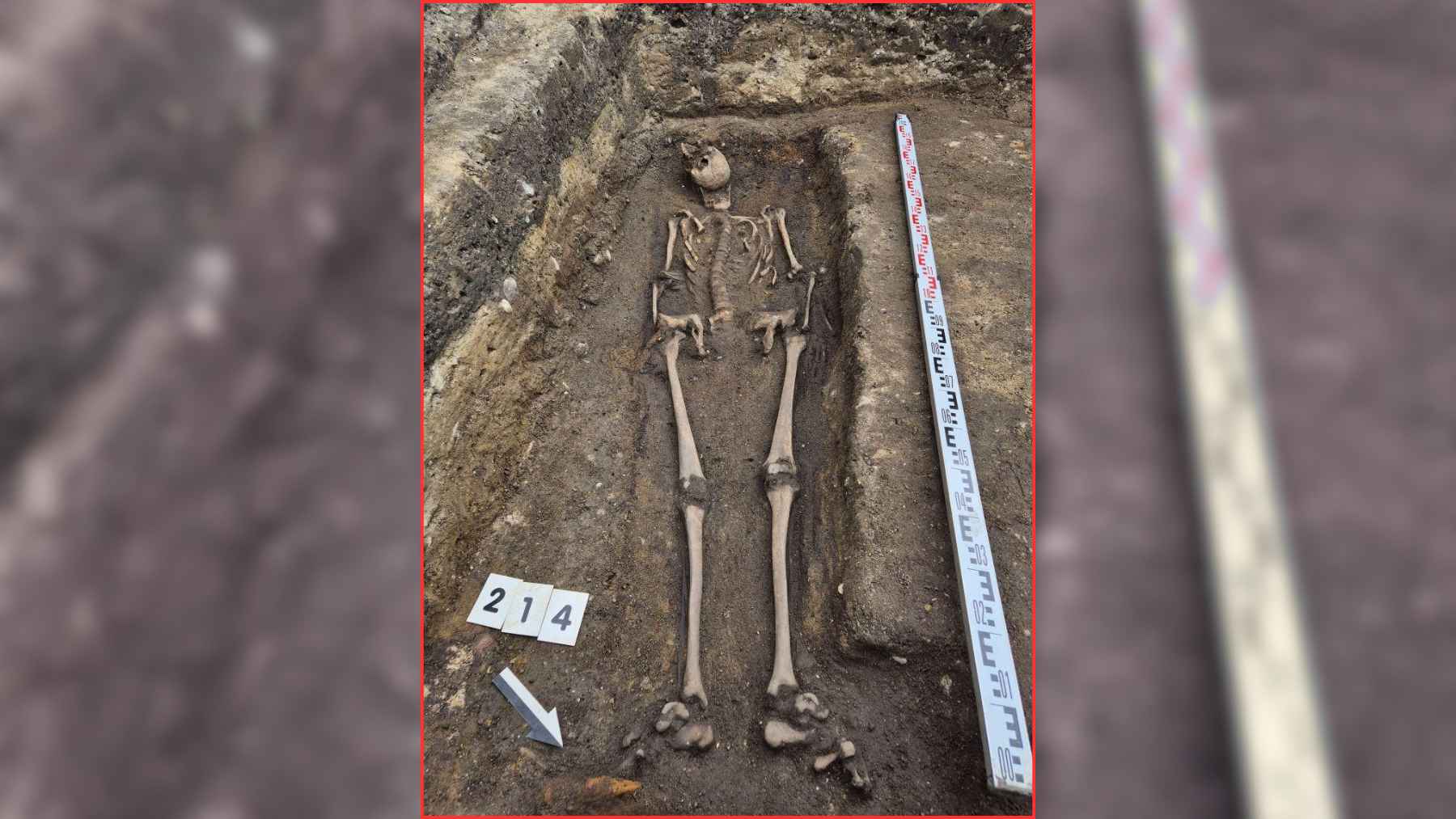
When the slab was lifted in July 2025, archaeologists found a rectangle made of 23 fieldstones below it. Under those stones was the grave itself, with coffin remains and a skeleton that had not simply been guessed at from the carving.
Aleksandra Pudło, an anthropologist at the Archaeological Museum in Gdańsk, said early examination suggested a strongly built man over 40 years old. He stood about 5 feet 7 inches, possibly a little taller, which was not unusual for a man in medieval Gdańsk.
There were no rich objects laid beside him, so the grave does not tell a simple treasure story. But the tombstone does much of the talking. A stone like this was expensive, specialized, and meant to be seen.
Cemetery and city origins
The grave was not alone. Archaeologists have recorded close to 300 graves in the broader medieval cemetery, while only eight were covered with stone tomb slabs.
That split matters because it shows that only a small group received the kind of burial marker linked to local elites. The knight’s slab stands out even within that group, because full-body images of the deceased were rare in medieval Poland.
The area was important before the knight was buried. Archaeologists working there identified remains of a large wooden building, likely a church, dated by tree-ring analysis to 1140. Tree-ring analysis means scientists study growth rings in wood to learn when the tree was cut.
Who could the knight have served?
One reason the date matters is the year 1308, when the Teutonic Knights took control of Gdańsk. If the burial came before that, the man could have been tied to the Pomeranian ducal elite. If it came later, he may have lived under a different political order.
For now, that question remains open. The armor, sword, and shield suggest a military role, but researchers have warned against jumping too far. A good mystery is not the same as proof.
Still, the find gives the city a rare human anchor. A single grave connects the old church, the cemetery, the stronghold, and the trade routes that moved goods across the Baltic. It is one man, but it is also a map.
What science may reveal
The next stage is laboratory work, not guesswork. The cracked stone was taken in several pieces for conservation, documentation, and three-dimensional scanning, which can help preserve the carving and fill in what the eye may miss.
The skeleton can answer different questions. Genetic testing may help narrow ancestry, while chemical analysis of bones and teeth can offer clues about diet, childhood, movement, and health.
Researchers also plan a facial reconstruction based on the skull. It will not be a photograph from the past, of course, but it may give visitors a research-based impression of the man whose burial hid under a familiar city landmark.
Why this discovery hits home
Archaeology often feels distant until it appears beneath a place people knew. In this case, the setting makes the story unusually easy to grasp.
A neighborhood ice cream shop gave way to a cemetery, and a cemetery led back to the origins of a city. That is why the Gdańsk find has traveled beyond local news.
The official information about the discovery has been published on the City of Gdansk’s website