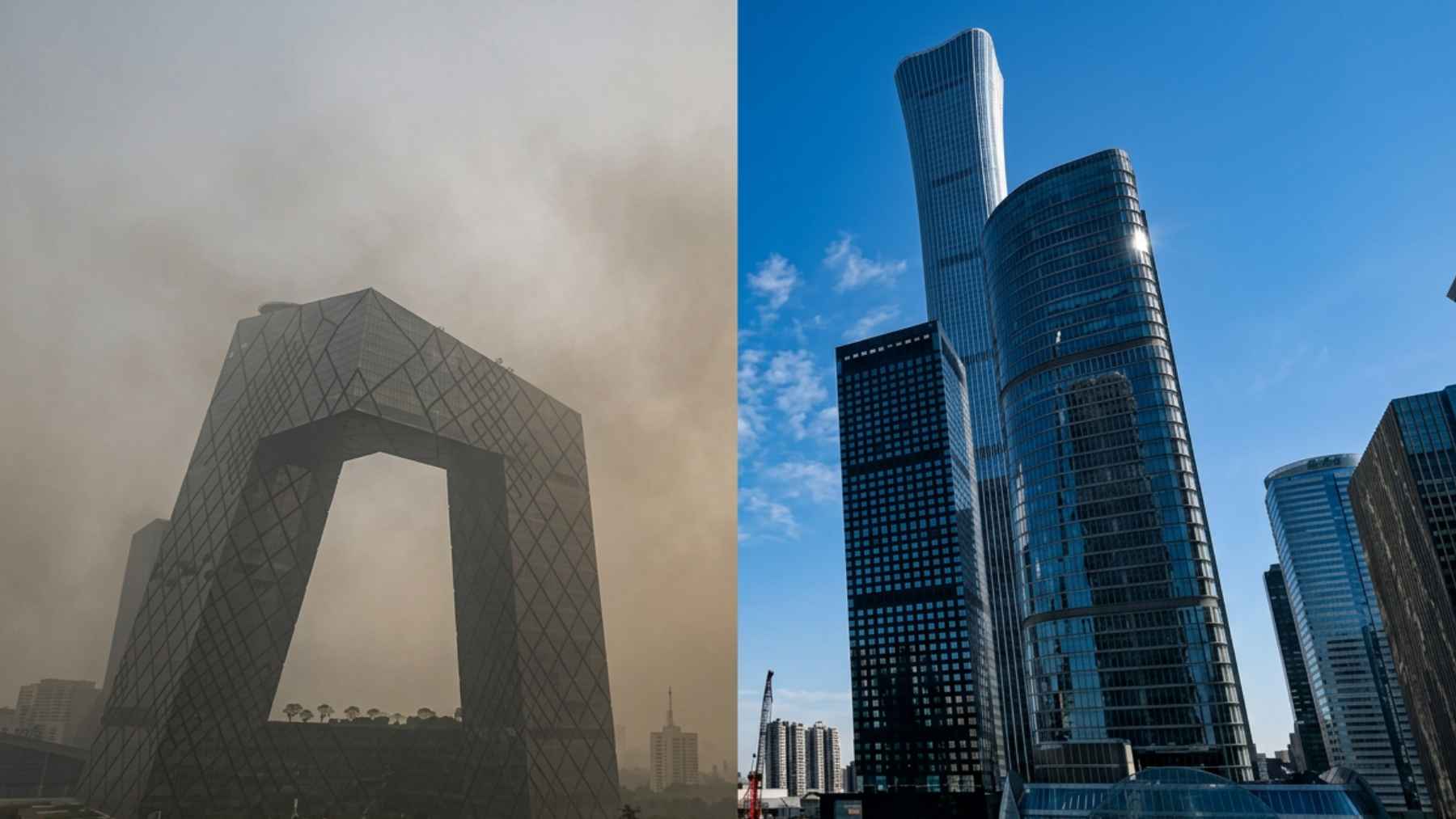
For years, Beijing’s skyline was almost shorthand for urban smog. Gray air, closed windows, face masks, and canceled outdoor plans became part of daily life in one of the world’s largest capitals.
Now the picture looks very different. In 2025, Beijing recorded just one day of heavy air pollution, compared with 58 such days in 2013, according to Xinhua, citing local environmental authorities. Its average PM2.5 level also fell to 27.0 micrograms per cubic meter, about 0.76 micrograms per cubic foot, the city’s lowest level since monitoring began.
The 98% number needs context
So did Beijing really eliminate 98% of its pollution? Not exactly. The near-98% reduction refers to heavy pollution days, not to the yearly average level of fine-particle pollution.
That distinction matters. Beijing’s annual PM2.5 concentration dropped from 89.5 micrograms per cubic meter in 2013 to 27.0 in 2025, which is about a 70% decline. That is still a dramatic fall, but it is not the same as saying nearly all pollution disappeared.
The city also logged 311 days with good or moderate air quality in 2025, equal to 85.2% of the year. For PM2.5 specifically, 348 days were rated good or moderate, or 95.3% of the year. That means many more mornings when the skyline, the commute, and even a simple walk outside felt different.
Why PM2.5 matters
PM2.5 is not just a technical air-quality label. It refers to fine inhalable particles no larger than 2.5 micrometers, or about 0.0001 inch, which is so small that the average human hair is about 30 times wider.
The U.S. Environmental Protection Agency says fine particles can get deep into the lungs, and some may even enter the bloodstream. The World Health Organization links particulate matter exposure to cardiovascular, respiratory, and stroke risks, which is why cleaner air is not just a cosmetic improvement.
Beijing’s progress is real, but the health caveat is still important. The WHO’s annual guideline for PM2.5 is 5 micrograms per cubic meter, about 0.14 micrograms per cubic foot, meaning Beijing’s 2025 level was still more than five times that benchmark.
How Beijing changed its streets
The turning point came in 2013, when China launched a national fight against dirty air and Beijing began what officials called a “blue sky defense war.” The campaign targeted mobile sources, coal burning, industrial activity, fugitive dust, and daily-life sources of pollution.
In practical terms, that means fewer dirty engines and tighter rules for what could move through the city. Anyone who has sat behind a smoky bus in traffic knows why that matters. Exhaust fumes are not just unpleasant – they build up where people breathe.
The 2025 official report says Beijing accelerated the shift toward new-energy vehicles and cleaner conventional cars. It also says new-energy vehicles and vehicles meeting China V standards or above made up more than 80% of the city’s vehicle structure.
Industry and coal were part of the fight
Cars were only one piece of the puzzle. Beijing also leaned on industrial upgrades, construction dust controls, cleaner energy, and regional cooperation with the surrounding Beijing-Tianjin-Hebei area.
The official report says Beijing became one of the first northern Chinese cities to address coal-burning pollution at a broad urban scale. It also points to measures such as “one factory, one policy” upgrades and more outside green power flowing into the city.
Still, the work is not locked in forever. Experts cited by Xinhua warned that regional emissions remain high, and stagnant fall or winter weather can still trap pollution near the ground. The trouble is, the atmosphere does not care about city borders.
Electric cars helped, but they are not magic
The rise of electric mobility helped Beijing clean up the tailpipe side of the problem. Nationally, China had 31.4 million new-energy vehicles in use by the end of 2024, and Reuters reported that China’s EV registrations reached 12.9 million in 2025.
That kind of shift can make city streets feel different. Less tailpipe smoke, less idling pollution near sidewalks, and quieter rides can all change the everyday experience of traffic jams.
But electric cars are not a magic wand. Cities still need cleaner power, better buses and subways, less congestion, and attention to dust, tires, roads, and construction. At the end of the day, cleaner air comes from many decisions working together.
The air is better, not perfect
Beijing’s numbers show one of the fastest urban air-quality turnarounds in recent memory. A city once known worldwide for thick smog now reports heavy pollution as a rare event rather than a seasonal expectation.
But the city’s own data also show why this is not the end of the story. In 2025, PM10 stood at 48 micrograms per cubic meter, nitrogen dioxide at 22, and ozone at 159, even though all three fell from the previous year.
That is the tricky part of environmental progress. Big gains can be celebrated while the remaining risks are still taken seriously. Both things can be true.
What other cities can learn
Beijing’s experience does not offer a simple recipe that every city can copy overnight. Its political system, industrial base, vehicle market, and regional planning powers are unusual, and that matters.
Still, the broader lesson is hard to ignore. Air pollution can fall when governments keep measuring it, keep pressure on dirty sources, and link traffic, energy, industry, and construction policies instead of treating them as separate problems.
The official statement was published on the Beijing Municipal Ecology and Environment Bureau’s website.