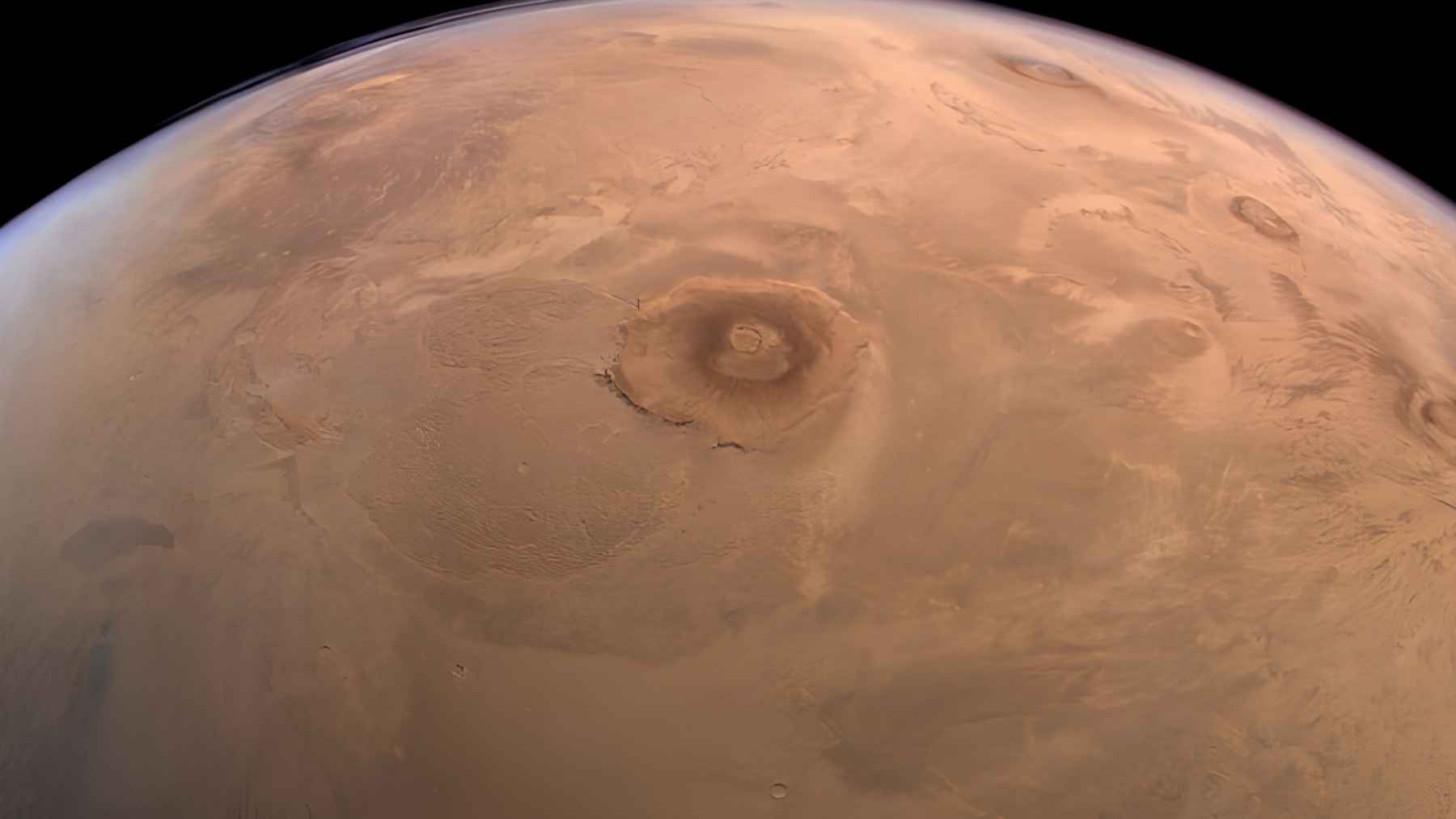
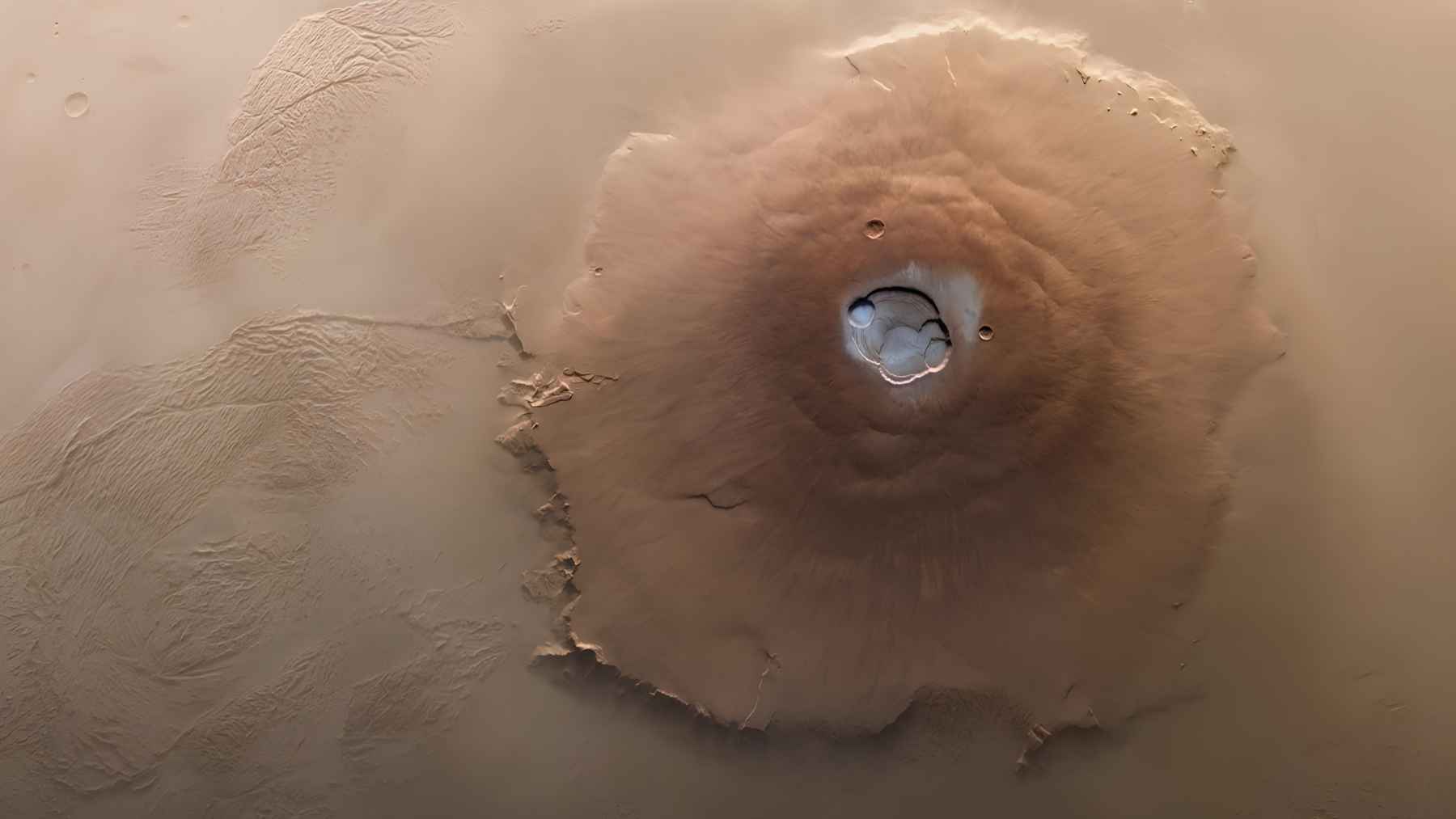
Mars is only about half the size of Earth, yet it carries a mountain that makes our tallest peak look almost ordinary. Olympus Mons, the giant shield volcano on the Red Planet, rises roughly 13.6 miles above the surrounding landscape in many measurements and spreads about 370 miles across, a footprint comparable to the state of Arizona.
That alone would be enough to make Olympus Mons a planetary celebrity. The bigger surprise, however, is what researchers have now found near the summits of Mars’s huge Tharsis volcanoes, including Olympus Mons.
Thin, temporary patches of morning water frost are appearing where scientists did not expect them, offering a new clue about how water still moves through Mars’s thin air.
The giant of Mars
Olympus Mons is not shaped like a steep, snowy mountain in the familiar Earth sense. It is a shield volcano, built by many lava flows that spread outward over time, creating a broad dome with gentle slopes.
That gentle shape hides its extreme scale. ESA says Olympus Mons has an average elevation of about 13.7 miles, while its summit caldera is about 1.9 miles deep. Imagine standing at the rim of a crater so large and high that the horizon itself starts to feel different.
NASA describes Olympus Mons as the largest volcano in the solar system, with a base covering an area as large as Arizona. Mount Everest reaches 29,029 feet above sea level, but Olympus Mons towers far beyond that when measured from its base.
Why Mars built such a monster
On Earth, plate tectonics keeps the crust moving. A volcanic hotspot may feed several volcanoes over time as a tectonic plate slowly drifts over it, much like a conveyor belt passing over a flame.
Mars works differently, at least to a large extent. Its crust does not recycle itself through moving plates in the same familiar way, so lava could pile up in one region for far longer. That is one reason the Tharsis area became a volcanic heavyweight.
The result is a landscape that almost feels oversized. The Tharsis Rise stretches about 3,100 miles across and holds some of the biggest volcanoes known, including Olympus Mons, Arsia Mons, Ascraeus Mons, and Pavonis Mons.
A volcano with a complicated past
Olympus Mons is ancient, but that does not mean scientists see it as a simple fossil. Mars’s volcanic history continued for a very long time, and research cited in Nature Geoscience notes lava flows in the Tharsis region that may be as young as about 2.4 million years.
That sounds recent in planetary time, even if it is far older than human history. For now, though, the careful wording matters. The same study says no current volcanic activity has been detected in Tharsis, although Mars still shows signs of geodynamic activity.
So, is Olympus Mons alive today? Not in the way people imagine when they picture glowing lava and ash clouds. The better answer is quieter and more interesting, since its enormous shape still seems to influence the local Martian environment.
Frost where it should not be
The newest twist comes from frost. An international research team reported evidence for transient morning water frost deposits on the calderas of several Tharsis volcanoes, including Olympus Mons. These deposits appear in early morning during colder Martian seasons, then vanish by afternoon.
Why is that surprising? Olympus Mons sits near Mars’s equatorial region, where sunlight and the planet’s thin atmosphere were expected to make surface frost difficult to preserve. Dr. Adomas Valantinas of Brown University said, “We thought it was improbable for frost to form around Mars’ equator.”
The frost is not a thick white blanket. The researchers estimate it is extremely thin, likely around the width of a human hair or less in many places, but it spreads across vast summit areas during the right season. Small details can matter on another planet.
How the frost was found
The team used high-resolution color images from CaSSIS, the Colour and Stereo Surface Imaging System aboard ESA’s ExoMars Trace Gas Orbiter. The finding was also supported by spectral observations and independent imagery from ESA’s Mars Express orbiter.
The spacecraft caught Mars at the right time of day. Many orbiters observe in afternoon lighting, but this frost is a morning phenomenon. Miss that early window, and the evidence can evaporate before the camera gets there.
The researchers calculated that about 330 million pounds of water ice may exchange between the surface and atmosphere each day across these volcanic calderas during cold seasons. That is not enough to turn Mars into a wet world, but it is enough to change how scientists think about local water cycling.
What it means for future Mars missions
For future explorers, water is more than a scientific curiosity. It can help explain climate history, guide landing site choices, and one day support human missions if usable sources are accessible and safe.
Nobody should picture astronauts scraping easy ice from the top of Olympus Mons just yet. The frost is brief, thin, and located in an extreme landscape. Still, the discovery does show that Mars’s water cycle is more active and more local than scientists once assumed.
That is the real lesson of Olympus Mons. The biggest volcano in the solar system is not just a frozen monument to Mars’s fiery past. It is also a giant weather machine, quietly shaping frost, air, and water at the edge of the Red Planet’s sky.
The study was published in Nature Geoscience.