For years, Mars has carried a reputation as a world that cooled off early and went quiet. But new research suggests at least one of its “young” volcanic regions kept a surprisingly busy magma system humming beneath the surface far longer than scientists assumed. Think of a stovetop that looks off but is still warm to the touch.
The work focuses on a volcanic system just south of Pavonis Mons in the Tharsis region, reconstructed using orbital images and mineral data rather than rocks in a lab. In practical terms, it means the Red Planet’s interior may have been “awake” deep down even when the surface looked calm and dusty.
That shift matters for how we read Mars’s environmental history, including when and where heat might have lingered.
A volcano that refused to be one simple eruption
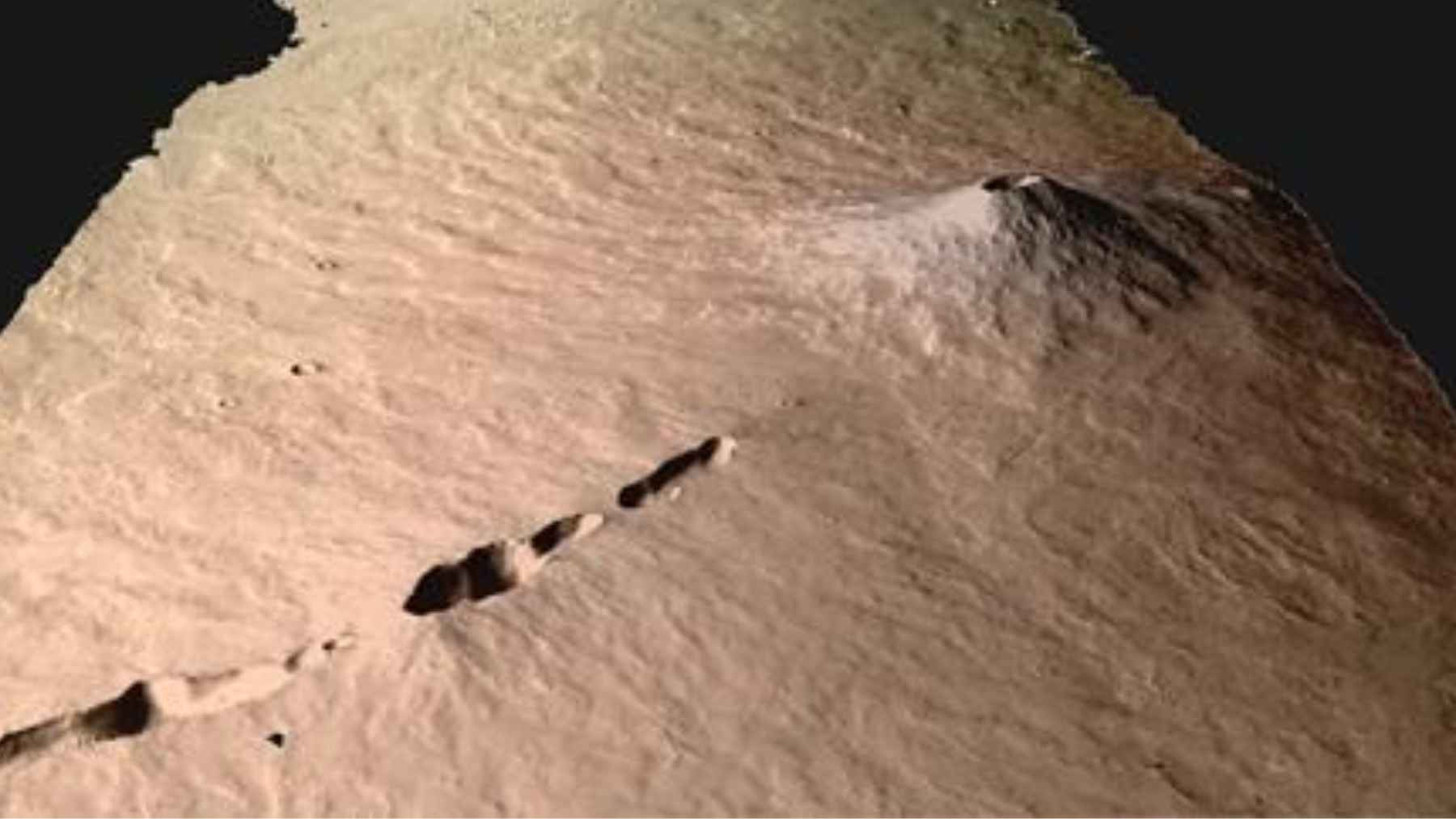
At first glance, the lava deposits near Pavonis Mons can look like the leftovers of a single event. The new analysis argues that appearance is misleading, with evidence for multiple eruptive phases fed by the same underlying plumbing system.
Researchers describe a long-lived setup where magma moved, changed chemically, and reappeared at the surface in different ways over time. That kind of evolution is familiar on Earth, but seeing it so clearly on Mars is the headline here.
From fissures to cone-building vents
The team found that early activity spread lava out through long cracks in the ground, a style known as fissure-fed eruptions. Later on, eruptions became more focused and built cone-shaped vents, even though the older flows and the younger cones are linked to the same deep source.
One key detail is the timescale. Based on the mapping and age constraints referenced in the paper, this progression likely played out over at least 9 million years, which is a long time for a planet so often labeled “inactive.” When people talk about Mars like it is frozen in time, this is the kind of evidence that complicates the story.
The mineral fingerprints that gave the game away
On Earth, geologists can walk up to a lava flow, chip off a sample, and run it through instruments. On Mars, scientists have to do something closer to detective work with light, using the way minerals absorb and reflect certain wavelengths to infer composition.
In this case, visible and near-infrared measurements from the Compact Reconnaissance Imaging Spectrometer for Mars, known as CRISM, were central to the argument. The study notes that the team leaned on lower-resolution hyperspectral mapping at about 200 meters per pixel, which is roughly 650 feet per pixel, because detailed targeted coverage is limited.
What changed inside the magma system
The lava that spread from fissures showed spectral signatures consistent with olivine, a mineral often associated with deeper-sourced magma. Younger, finger-shaped lava flows tied to the cone were dominated by high-calcium pyroxenes, pointing to a more evolved magma source.
Those differences are not just academic. As lead author Bartosz Pieterek put it, “these mineral differences tell us that the magma itself was evolving,” which likely reflects changes in how deep the magma originated and how long it was stored underground before erupting. In other words, the plumbing was not a single pipe — it was a system that matured.
Why a warmer interior matters for a colder planet
Volcanoes are more than fireworks. They are one of the main ways a rocky planet moves heat and chemicals from its interior to its surface, shaping landscapes and, over long periods, influencing the makeup of an atmosphere.
That is why the finding lands beyond planetary geology. If Mars could maintain complex, evolving magma systems late into its history, it nudges researchers to revisit how long local heat sources may have persisted and how they might have affected the planet’s broader environment.
It is also a useful reminder for our own planet. The U.S. Geological Survey notes that modern volcanic CO2 has never caused detectable global warming, and that global volcanoes emit less than 1% of the carbon dioxide released by human activities today.
In 2010, human activity was about 35 billion metric tons of CO2, roughly 39 billion short tons, a scale volcanoes simply do not match.
The power and limits of looking from orbit
Because scientists still cannot bring Martian volcanic rocks back to Earth, orbital studies do a lot of heavy lifting. By pairing surface mapping with mineral data gathered from orbiting spacecraft, the team reconstructed a subsurface story that would otherwise stay hidden.
Still, there is a catch that is easy to forget. Orbital instruments read the planet’s outer skin, and dust, weathering, and resolution limits can blur the picture, so conclusions have to be built from multiple lines of evidence rather than one perfect measurement.
It is a bit like trying to guess what is inside a loaf of bread by only looking at the crust.
What comes next for Mars science
So, what should we watch for next? More work that combines high-resolution mapping, mineral spectroscopy, and improved age estimates could reveal whether this kind of long-lived plumbing is common across Mars’s younger volcanic fields or a special case.
As NASA and other agencies plan future missions, volcanic terrains like this remain tempting targets for remote sensing and, eventually, sampling. That is where a story about ancient lava suddenly connects to a very modern goal — understanding how rocky worlds work and where they might be habitable.
The study was published in Geology.