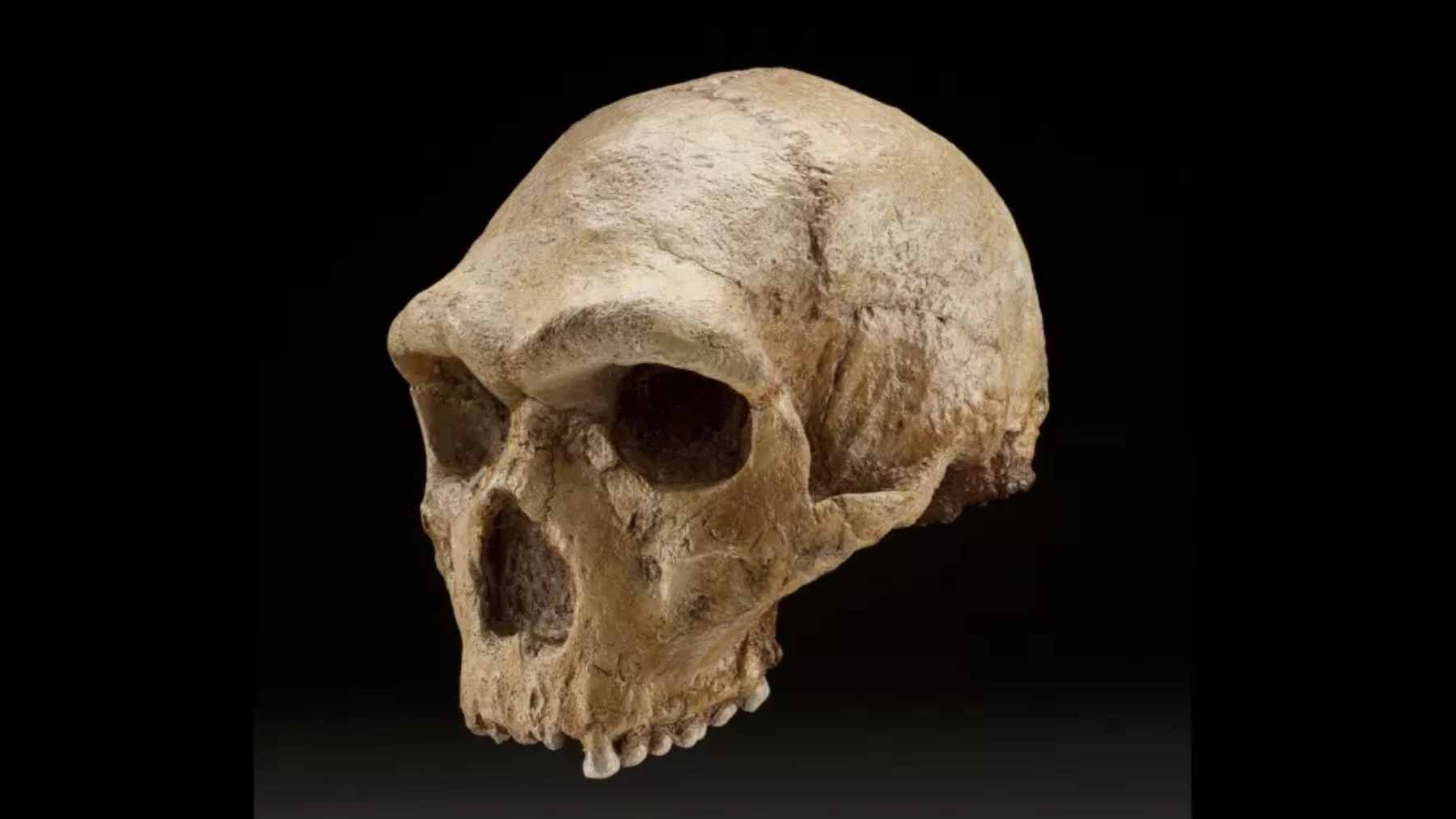
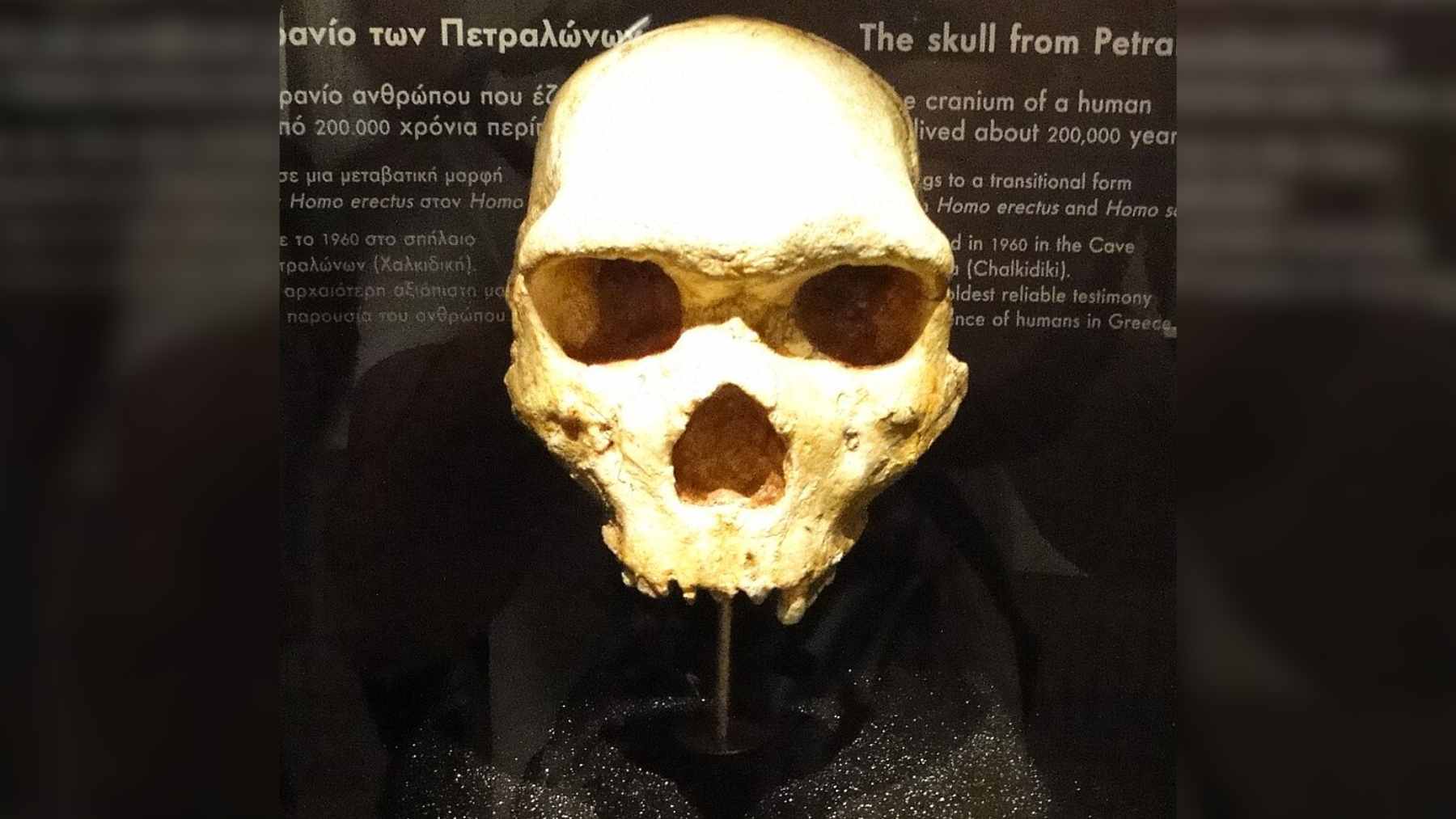
A nearly complete skull found in a Greek cave has spent more than six decades in scientific limbo. Now, a fresh dating study says the Petralona cranium is at least 286,000 years old, placing it deep in the Middle Pleistocene and back at the center of Europe’s human evolution story.
That matters because the skull does not neatly fit into the usual boxes. It is not clearly Homo sapiens. It is not clearly Neanderthal either. Instead, the new work suggests Europe may have been home to a more tangled mix of ancient human relatives than a simple family tree would lead us to believe.
A skull without a clear home
The Petralona cranium was discovered in 1960 inside Petralona Cave in northern Greece, about 31 miles from Thessaloniki. The cave is famous for slow-growing mineral formations, but the skull itself was found without reliable sediment layers around it, which made dating it extremely difficult.
That missing context created a long-running problem. Earlier estimates placed the skull anywhere from about 170,000 to 700,000 years old, a range so wide that it left researchers debating where the fossil belonged in the human story. Was it close to early Neanderthals, related to another group, or something more unusual?
The new study, led by Christophe Falguères of the Institute of Human Paleontology at France’s National Museum of Natural History, focused on the calcite that formed directly on the bone. In practical terms, the rock coating became the clock.
The cave clock
So, how can a mineral crust tell time? In caves, dripping water can carry uranium into growing layers of calcite. Over time, that uranium decays into thorium, and the ratio between the two elements can help scientists estimate when the mineral layer formed.
This method is known as uranium-series dating. It works especially well when the calcite behaves like a closed system after it forms, meaning outside material has not disturbed the chemical clock too much. That is why careful sampling matters so much.
The team dated the white internal calcite layer that grew directly on the Petralona skull. Their result gave a finite minimum age of 286,000 years, with a margin of about 9,000 years. In other words, the skull must be at least that old, and it could be older.
Why this date matters
The new date does not solve every mystery. It does, however, remove one major obstacle. Scientists can now discuss the skull’s anatomy with a firmer timeline instead of wrestling with estimates that swing across hundreds of thousands of years.
The study also compared the skull’s coating with other mineral formations inside the cave. The researchers found that the calcite on the cranium was not from the same generation as the calcite on the nearby cave wall, despite earlier assumptions. That small detail changes how the fossil’s history can be reconstructed.
Depending on whether the skull was ever attached to the wall, the broader possible age range may still vary. But the key point is simpler. The Petralona cranium now has a solid minimum age, and that minimum places it in a period when Europe was anything but empty.
Not modern, not Neanderthal
From its shape, the Petralona skull appears human-like but more primitive than both Homo sapiens and Neanderthals. The authors describe it as part of a distinct group, one that may have lived alongside the evolving Neanderthal lineage in Europe.
That idea fits a growing view of the Middle Pleistocene. Human evolution was not a clean relay race where one species handed the baton to the next. It looked more like several branches growing at once, sometimes near each other, sometimes overlapping.
Think of it less like a straight road and more like a busy map. Some paths led toward Neanderthals. Others may have ended without descendants we can clearly trace today. The Petralona skull seems to sit on one of those more mysterious routes.
A crowded ancient Europe
Other fossil work has pointed in the same direction. In Spain, fossils from Sima de los Huesos have been linked to the Neanderthal evolutionary line, showing that Neanderthal-related groups were already present roughly 400,000 years ago.
That makes Petralona especially interesting. If the skull represents a more primitive population living around the same broad period, then Europe may have held multiple hominin groups at once. That is a very different picture from the old idea of one dominant human form slowly replacing another.
A similar pattern has appeared outside Europe, too. The Broken Hill skull from Zambia, also known as Kabwe, was directly dated to about 299,000 years old, much younger than many researchers once believed. The Natural History Museum said that date added to evidence that several human lineages may have coexisted around that time.
The mystery is smaller now
The Petralona skull still has no simple label. That may sound frustrating, but in science, narrowing the question is often a major step forward. The new date gives researchers a clearer frame for future anatomical work and, possibly, more refined dating of materials attached to the fossil.
There is also a practical lesson here. Fossils are not just bones. They are tiny archives of everything that happened around them, from cave humidity to mineral growth to the damage caused by being found without clear sediment layers.
For now, the skull remains one of Europe’s most intriguing prehistoric finds. It no longer floats in time. It belongs, at minimum, to a world 286,000 years old, when different kinds of humans may have shared the continent.
The study was published in the Journal of Human Evolution.