Evidence that water exists on Saturn’s Titan moon is strong, but not in the way an Earthling may think of it. So what is flowing through the rivers and filling up Titan’s lakes in temperatures that turn surface water into hard rock?
Water behaves like rock
Titan circles the Sun with Saturn at about 9.5 times Earth’s distance. Sunlight takes roughly 80 minutes to arrive and is about 100 times fainter than it is here, according to the official Titan facts page. The average surface temperature is close to -290°F.
At that temperature, familiar materials swap jobs. Water forms much of the crust, pebbles, and bedrock, while methane can condense into liquid and ethane can remain liquid, too. On Earth, methane may feed a stove, but on Titan it can fall from the sky.
Huygens found river country
Titan’s orange haze once hid its surface from ordinary cameras. That changed when the Cassini-Huygens mission reached Saturn in 2004 and the European Space Agency’s Huygens probe descended on Jan. 14, 2005.
How can a moon nearly 886 million miles from the Sun have clouds, rain, rivers, lakes, and seas without using liquid water? Titan, Saturn’s largest moon, pulls it off because its surface liquids are dominated by methane and ethane, hydrocarbons that are usually gases on Earth. It is the only known world besides Earth with stable bodies of liquid on its surface. During a descent lasting two hours and 28 minutes, it photographed bright highlands cut by branching channels leading toward dark lowlands.
The Huygens landing record describes landforms shaped by erosion and flowing liquid. The probe came down on damp, sandy ground scattered with rounded pebbles whose measurements matched “dirty water ice.” Heat from the craft also caused methane to boil out of nearby material, supporting the idea that hydrocarbon rain and floods had worked the landscape.
Methane runs the weather
Titan’s methane cycle looks familiar at first. Methane evaporates from seas and damp ground, rises, condenses into clouds, falls as rain, runs downhill, and collects again. A cloud only needs a vapor that can cool and form droplets, not water specifically.
Titan is not a perfect copy of Earth, however. Its largest seas cluster near the north pole, while broad equatorial regions are dry enough to hold enormous dunes made from carbon-rich particles. Each season lasts more than seven Earth years, so a channel may remain dry for a long time before a powerful storm sends liquid through it.
Methane and ethane also play different roles. Methane drives much of the active exchange between the ground and atmosphere, while ethane forms as sunlight and energetic particles break methane apart. Over time, that ethane can build up in surface liquids.
Cassini mapped deep lakes
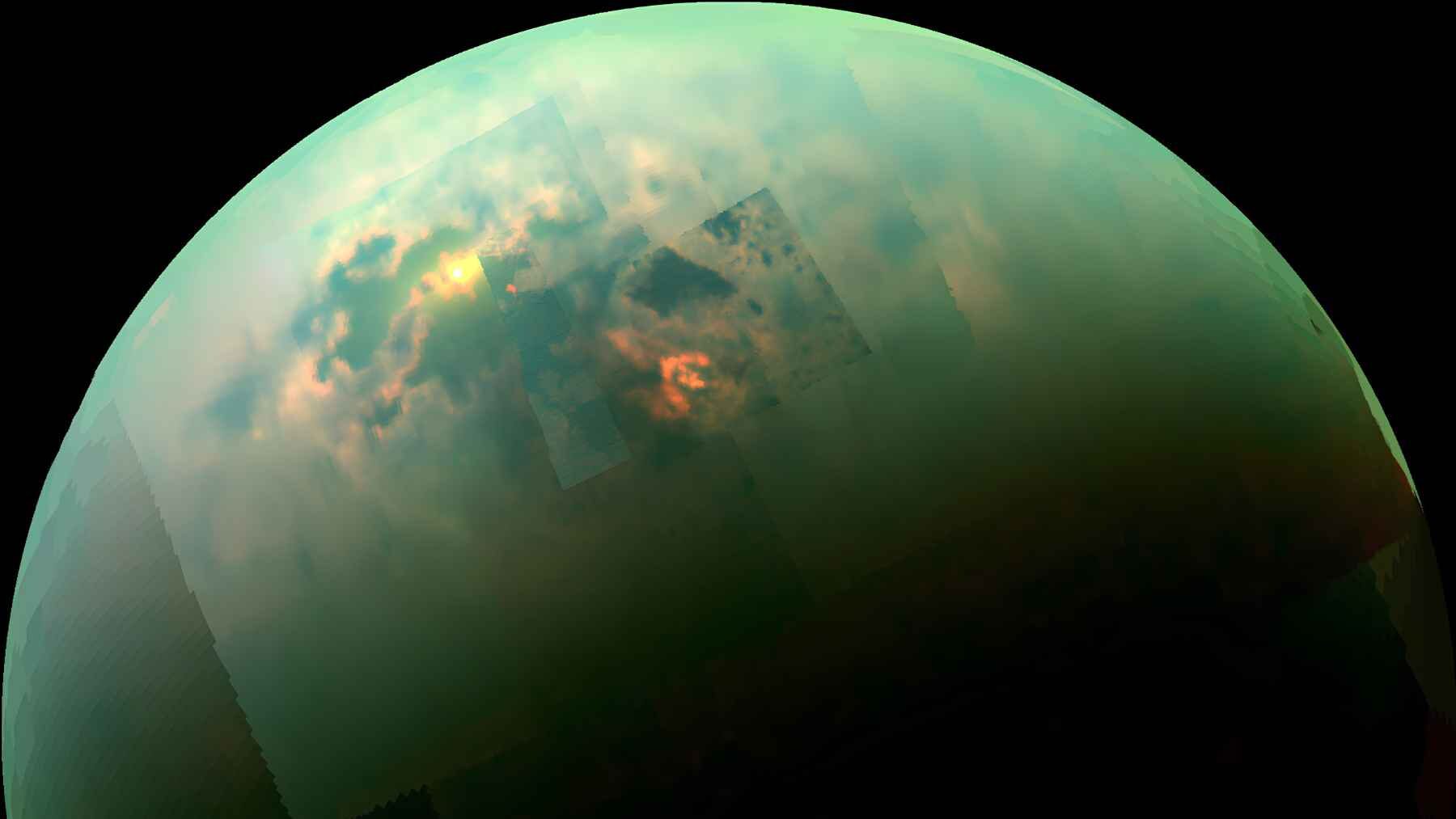
Cassini detected liquids with radar, which could see through Titan’s haze. Flat liquid surfaces returned little radar energy and appeared dark, while shorelines, islands, channels, and changing levels strengthened the interpretation. The spacecraft later caught sunlight glinting from a northern sea, a direct sign of a smooth liquid surface.
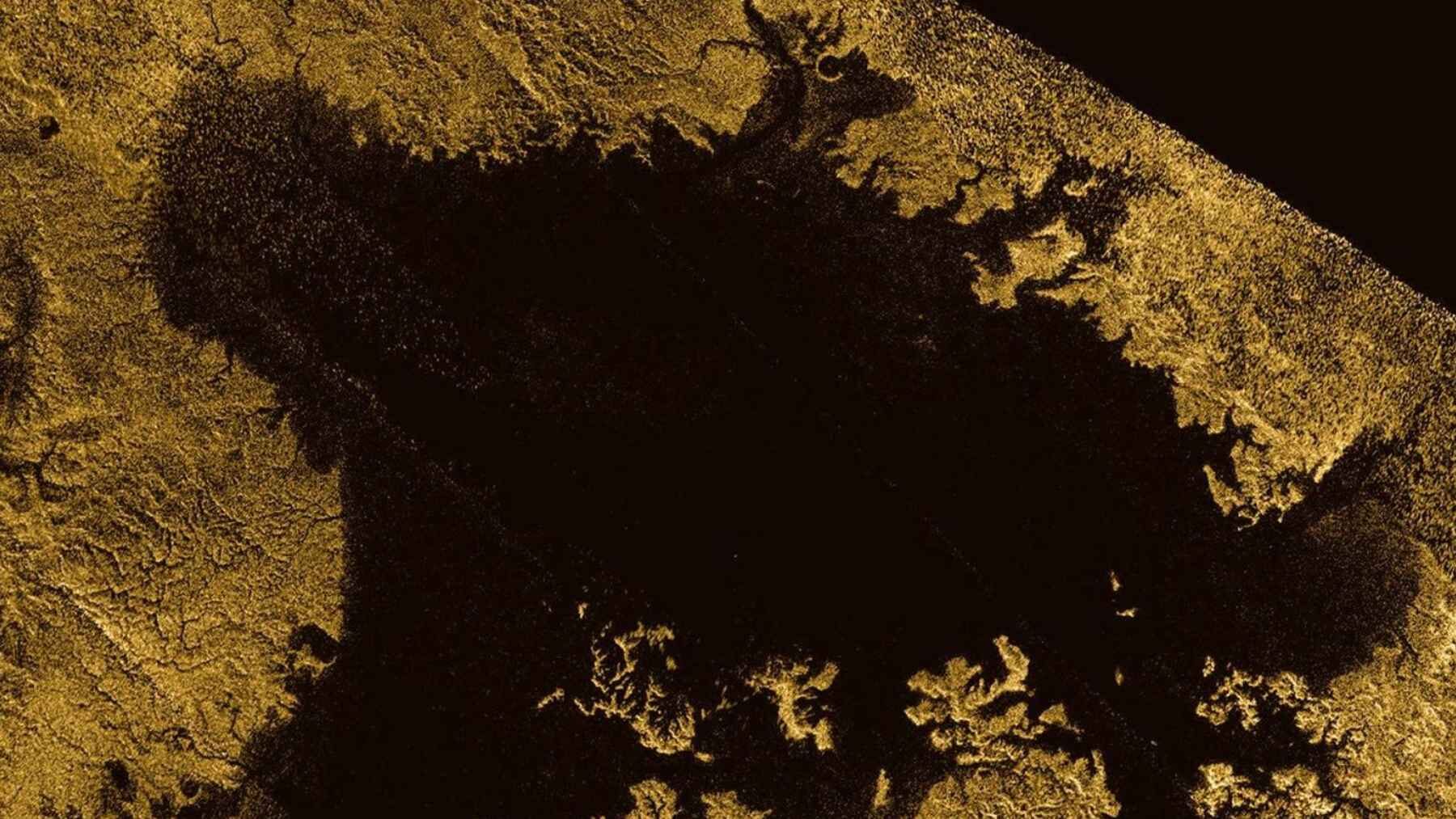
A study led by Marco Mastrogiuseppe of the California Institute of Technology found that some small northern lakes are more than 300 ft. deep, sit high on hills and plateaus, and are dominated by methane. Cassini mapped more than 620,000 square miles of lakes and seas overall. Ontario Lacus in the south appeared to contain a more even mixture of methane and ethane.
Some lakes may drain into porous ground or evaporate as seasons change. Others remain filled. The scenery can resemble a lake district on Earth, but the chemistry makes it an alien version of something we think we know.
Titan may hide a water ocean
Titan is not waterless. Gravity measurements and radio data support a global ocean rich in water, salts, and possibly ammonia about 35 to 50 miles below the icy surface. That gives the moon two different liquid settings, with hydrocarbons under open skies and water sealed deep underground.
Could either environment support life? Researchers consider the buried ocean a possible setting for life as we know it, while the surface lakes offer a test of chemistry that might work very differently. Still, no evidence of life has been found, and “habitable” only means conditions might be suitable.
There is another puzzle. Sunlight and energetic particles continually destroy atmospheric methane, creating ethane, orange haze, and heavier carbon-rich material that settles into dunes. The methane should eventually run down, so something may be replenishing it from inside Titan, but the evidence has not settled how.
Dragonfly will explore the dry side
The next major mission will not float on a methane sea. Dragonfly is a nuclear-powered rotorcraft designed to fly between organic-rich dunes and the Selk impact crater, where an ancient collision may once have mixed liquid water with carbon-rich surface material. The current mission schedule lists launch no earlier than July 2028 and arrival in late 2034.
Zibi Turtle, the mission’s principal investigator at the Johns Hopkins Applied Physics Laboratory, has stressed that “Dragonfly isn’t a mission to detect life.” Its instruments will instead study surface materials, habitability, and prebiotic chemistry, meaning chemical steps that can happen before biology. That distinction is key.
The rain is real
Titan’s rivers and rain are not metaphors. A river only needs a fluid moving downhill, and rain only needs droplets heavy enough to fall. Change the temperature and pressure, and the same physical rules can build a world that feels familiar until you inspect the ingredients.
That is why Titan matters when scientists discuss habitable worlds. It shows that weather, erosion, and liquid cycles can exist with a chemical toolkit unlike Earth’s.
The Cassini lake-depth study was published in Nature Astronomy, and the official Titan and Dragonfly information has been published by NASA.