A borehole drilled 4,160 ft. into the Atlantic seafloor has uncovered deep, rock-altered water that may help feed the Lost City hydrothermal field. The chemistry indicates that the water once reacted with mantle-derived peridotite and gabbroic rocks at temperatures of at least 300°C (572°F), making it a possible source for the chemical energy reaching one of Earth’s strangest deep-sea ecosystems.
There is an important caveat: scientists did not drop a thermometer into a 572°F underground reservoir, but instead reconstructed that high-temperature history from dissolved elements and isotopes in the water, making this a chemical fingerprint rather than a direct temperature reading.
A record-setting hole in ocean rock
During International Ocean Discovery Program Expedition 399, researchers aboard the JOIDES Resolution drilled Hole U1601C to 4,160 ft. below the seafloor at the Atlantis Massif. The site sits about 800 meters (2,625 ft.) north of Lost City and winds through mostly serpentinized peridotite, with substantial layers of gabbro.
Up until now, five decades of scientific ocean drilling have produced only six holes that penetrate more than 700 meters into oceanic rock, but U1601C is the first to pass mainly through ultramafic material associated with Earth’s mantle. That rare access gave the team an opportunity to sample not only rock cores, but water flowing through the massif’s fractured interior.
Four waters in one borehole
The samples were not pristine water from one underground source. Researchers encountered a four-way mixture of surface seawater used during drilling, freshwater pumped in before logging, bottom seawater that entered afterward, and natural “formation water” flowing into the deepest part of the hole.
Above about 465 meters, the drilling-related waters were more abundant. Deeper down, formation water became increasingly important and comprised as much as 80% of the deepest samples, where it contained almost no magnesium and unusually high calcium.
The 572°F chemical fingerprint
Instruments measured 101°C to 105°C (214°F to 221°F) near a depth of 1,060 meters, while researchers estimated that rock at the completed hole’s base would equilibrate at roughly 110°C to 140°C (230°F to 284°F). So, where do they get the much hotter figure?
The answer is in the chemical “memory” of the water. Concentrations of calcium, lithium, rubidium, cesium and strontium, along with isotope evidence, indicate that the formation water had reacted with gabbro and peridotite at temperatures of at least 300°C before cooling and entering the borehole.
Gabbro enters the picture
Lost City is usually described through serpentinization, the heat-producing reaction that begins when seawater meets olivine-rich peridotite. A new look at the evidence suggests that gabbroic rocks also play a major role, especially because gabbro becomes more common below 640 meters and dominates much of the borehole below 950 meters.
That suggests a multi-stage journey. Seawater may descend, react with hot mafic and ultramafic rocks, lose magnesium, gain other dissolved elements, cool during its rise and mix again with colder seawater before emerging through Lost City’s towers.
Why Lost City is so unusual
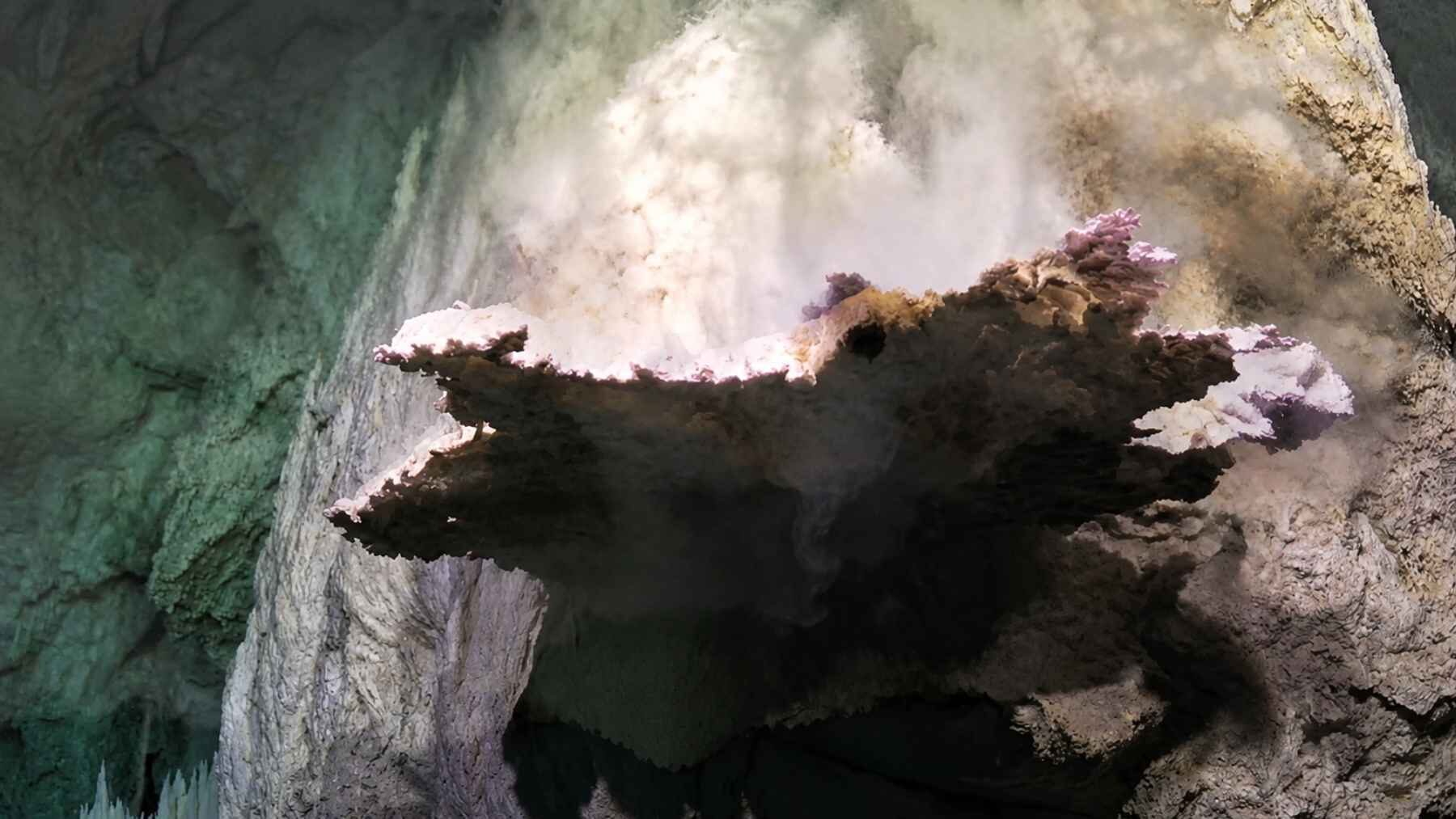
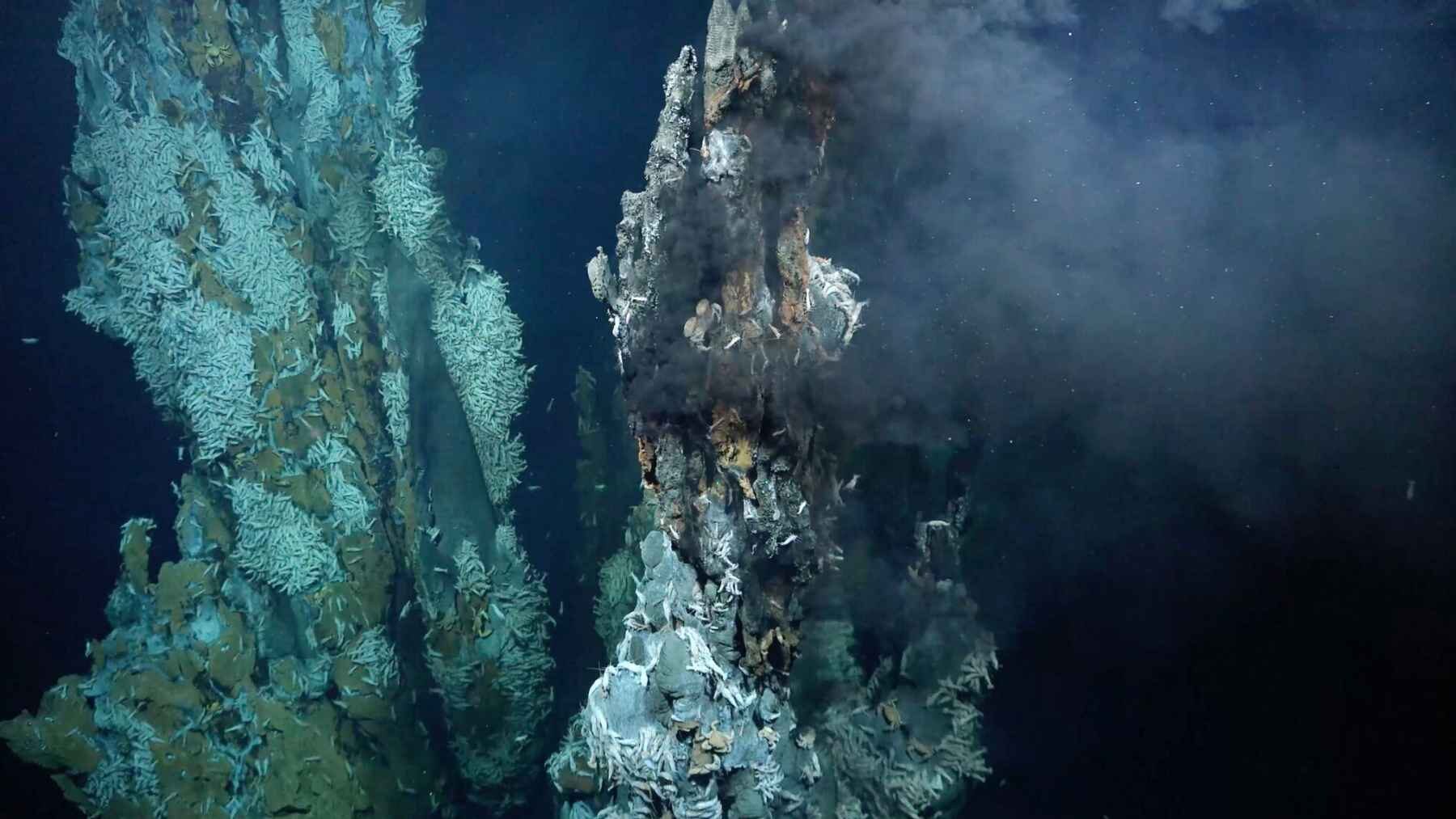
Lost City is not a classic “black smoker” field fueled mainly by volcanic heat. Its alkaline fluids have a pH above 10 and emerge at temperatures above 70°C (158°F) through carbonate and brucite chimneys that rise to about 100 to 200 ft. above the seafloor.
It is less like a volcanic kettle and more like a slow chemical battery. Serpentinization releases heat and produces hydrogen, while related reactions produce methane and small organic compounds that can provide fuel for microbes dwelling far beyond the reach of sunlight.
A promising link, not a proven pipeline
The chemistry of the deep formation water resembles models for the hidden fluid that ultimately discharges at Lost City. The authors present their results as the first direct evidence of deep, high-temperature circulation through gabbroic and ultramafic rocks beneath the Atlantis Massif, but they have not traced a continuous pipe from U1601C to the vent field.
That caveat matters. Drilling disturbed the hole, and every sample contained some combination of introduced freshwater and seawater, so the team says future sampling is needed after the borehole has had more time to return to normal.
A clue for life beyond Earth
Hydrogen-rich water flowing through dark ocean rock is important because it can carry usable chemical energy without sunlight. The researchers say the process “transports chemical energy to shallower environments, potentially supporting microbial life.”
NASA scientists have long studied Lost City as a possible sister city for water-rock reactions beneath the oceans of Saturn’s moon Enceladus and Jupiter’s moon Europa. The new result does not definitively prove that life began at alkaline vents or exists on those moons, but it strengthens the case that rocky interiors can supply energy to hidden oceans.
What scientists will test next
Hole U1601C was left open with a reentry system for subsequent work. Fresh samples collected with gas-tight equipment could clarify the water’s pH, trace metals, hydrogen content, dissolved organic compounds and the relative influence of gabbro and peridotite.
For now, the study fills in a major missing piece of Lost City’s plumbing while leaving the final connection open.
The study was published online on July 12, 2026, in Geochemistry, Geophysics, Geosystems.