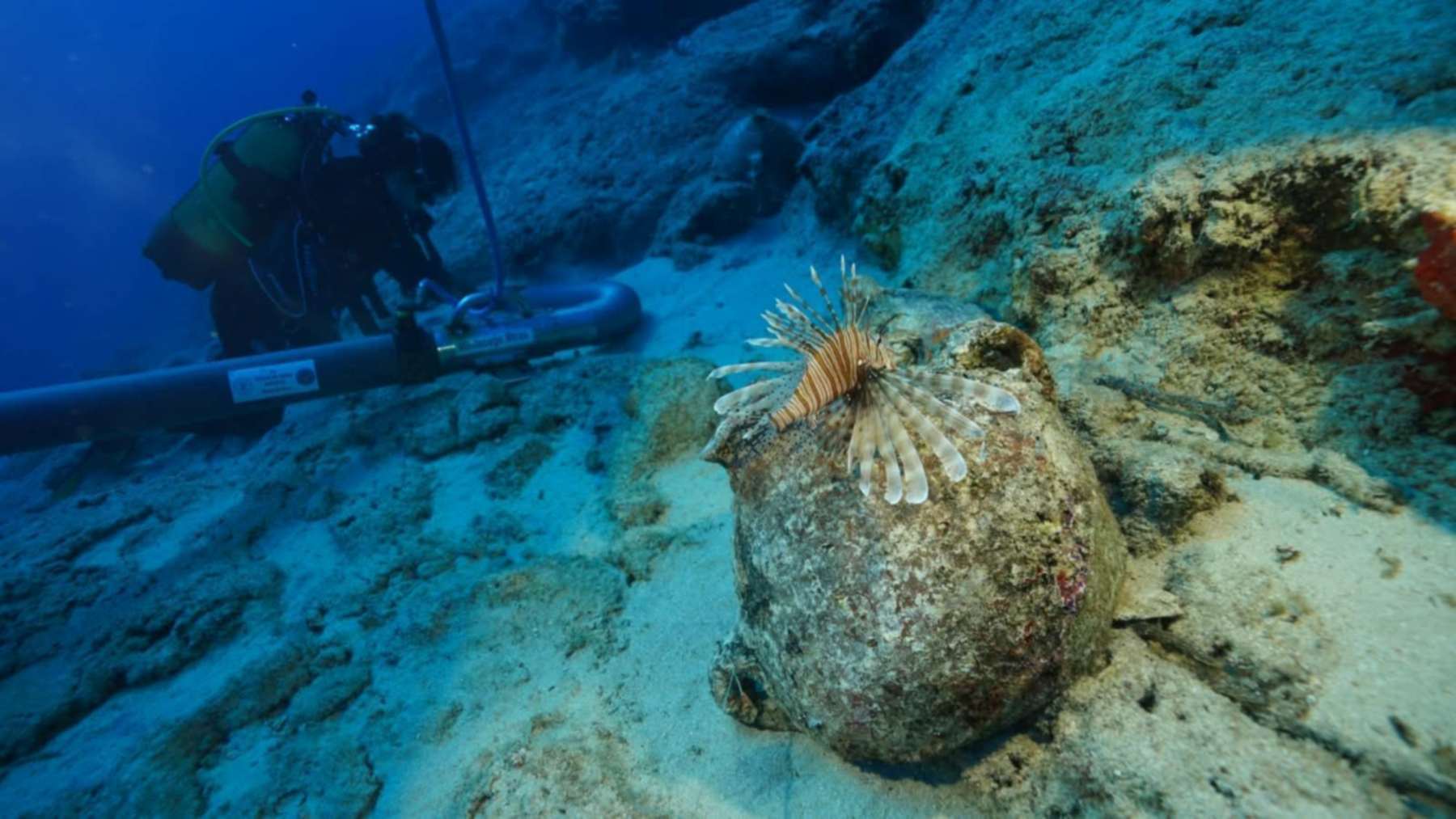
Off Kekova Island in southern Turkey, about 100 feet (30 meters) down, divers have been bringing up clay jars from a wreck that archaeologists say is the oldest known shipwreck in the world. They put its age at between 4,400 and 4,700 years, so the ship went down in the Early Bronze Age, at roughly the time Egypt’s Great Pyramid was going up.
“The shipwreck is a time capsule at the bottom of the sea,” Hakan Öniz, an associate professor at Akdeniz University in Antalya who led the Mediterranean Archaeology Association expedition, told BBC News. Türkiye’s Ministry of Culture and Tourism lists him as the scientist in charge of the dig.
The ministry says the excavation started in 2026, run by the Antalya Museum with its permission, after Akdeniz University surveys found the wreck in earlier years, and the wreck itself is ministry property.
Jars and anchors on a steep slope
The site is a short way off Kekova Island, in the Demre district of Antalya. Its artifacts are spread down an underwater slope, and at that depth each diver had just 30 minutes per dive to look around, according to the BBC.
None of the ship’s wood is left, but on the seabed the divers found three large stone anchors along with more than 30 amphorae, the big two-handled clay jars that ancient ships used to move oil, wine and other goods. Its discoverers say the vessel was roughly 33 feet (10 meters) long and worked as a merchant ship, hauling cargo around the Mediterranean.
In their preliminary report, Öniz and co-author Ceyda Öztosun describe “two three-holed stone anchors and one single-holed stone anchor” lying “at different distances around the wreck.” They add that “it is not yet known which, if any, of these anchors belong to the wreck.”
Kekova sits in a crowded stretch of sea. Earlier this month, Daily Sabah reported Öniz as saying his team had located and recorded more than 430 wrecks on the Mediterranean side of Türkiye alone. “This is an amazing number of documented shipwrecks all over the world, not only for Türkiye,” he said. He went further in remarks to Anadolu Agency quoted in the same article: “In a way, Türkiye is the birthplace of underwater archaeology.”
Dating a ship that left no wood
With no timber, radiocarbon dating was out, because that method reads a type of carbon in once-living material such as wood. So the team looked at the shape of the jars, since the way potters made them shifted over the centuries and a given style can usually be tied to a certain period.
Öniz compared the Kekova jars, which have a flat base, two handles and a ridge in the middle, with amphorae from Egypt and the Middle East that had already been dated to 4,400 to 4,700 years ago, and he is in no doubt about the result. “Comparing the decoration techniques… we can definitely say our wreck is Early Bronze Age. This is 100%,” he told the BBC.
The report’s abstract, which covers the 2024 and 2025 work, says the jars are “generally similar to Early Bronze Age Levantine types, featuring side handles and flat bases.” Levantine refers to the eastern Mediterranean coast. It also notes that the two jars raised in 2024 and 2025 differ in their “technical characteristics, clay composition, and intended uses.”
Residue still inside the jars
Karin Sowada, an archaeologist at Macquarie University in Australia, got to examine the amphorae once they were out of the water. Some had survived in one piece, and what surprised her was that a thick, shiny residue was still inside them.
“I looked inside and nearly fainted. I could not believe how much [residue] was visible. It wasn’t just like spots… a lot of this material was still remaining,” she said.
What it was is still an open question. “It could be olive oil, it could be wine, it could be tree resins,” Sowada said. “It’s possible that [the residue] could actually be the result of reuse of the jars. I mean, these jars are huge – they’re not things that you just ship away and then never see again. People would have emptied these jars on arrival and potentially used them for many, many, many years.”
A route from the Levant toward Troy or Crete
The jars also hint at how goods moved in the ancient world. The archaeologists told the BBC that the ship set out from somewhere on the eastern Mediterranean coast, and they think its cargo was meant either for Troy, in today’s northwestern Turkey, or for the Minoan people on Crete.
Culture and Tourism Minister Mehmet Nuri Ersoy announced the find on social media. “Clay analyses suggest the amphorae were likely produced in workshops in the Jordan Valley. Similar examples found in Egypt, Troy and Crete are particularly important for understanding the maritime trade networks that connected different regions,” he said in the post quoted by Daily Sabah. According to the ministry, similar jars are known from Troy and Crete and from sites close to the Egyptian pyramids at Giza, Saqqara and Abusir.
“Current information suggests that the shipwreck is from a small vessel that sank while sailing east to west during the Early Bronze Age,” Öniz and Öztosun write. Travel by sea was “fraught with danger, particularly around Kekova Island, where the strong currents and winds have claimed many ships,” the BBC notes.
Tracing where cargo jars were made is a common thread in Mediterranean wreck research, as with a deep wreck off Italy carrying more than 300 amphorae.
A churn jar hints at goats on board
One jar from the excavation is unusual, Daily Sabah reported from the ministry’s account: it has nine distinct markings and two holes through its wall. Researchers think it may have been a churn amphora, used to make butter or cheese.
If so, crews on long voyages may have kept goats on the ship, milking them and making dairy products during the trip.
Öniz says that on dives to the wreck he thinks first about the people whose lives were tied to the ship. “We are the first humans who [have] touched these objects after 5,000 years,” he said, rounding the age up. “We are always thinking of the sailors… the producers of the amphora and the person who carried the amphora on their shoulders to the ship, and the women who were waiting for their husbands, and they unfortunately couldn’t go back,” he told the BBC.
Who calls it the oldest
The record claim comes from the excavation team and from Ersoy. “We are bringing traces of the world’s oldest shipwreck to light in our Blue Homeland,” the minister wrote, in words quoted by Daily Sabah, using a phrase Turkish officials apply to the country’s seas.
The BBC now ranks Kekova as the oldest shipwreck on record. The earlier record, it says, belonged to a wreck near the southern Greek island of Dokos, about 4,200 years old.
Daily Sabah, which reported the minister’s post, described the amphorae as “recovered from what may be the world’s oldest known shipwreck.” The abstract of the journal report does not use the word oldest and speaks of “a shipwreck carrying Early Bronze Age amphorae.”
In 2023, Öniz told Anadolu Agency, in an interview carried by Daily Sabah, that a ship that sank off Kumluca “approximately 3,550 to 3,600 years ago” with a cargo of copper ingots “still holds the title of the world’s oldest trade shipwreck.” He also said at the time that the Kumluca ship “was probably loaded with copper from mines in Cyprus island” and sank “during a storm on its way to the island of Crete.”
For a wreck whose timber has survived, the BBC adds, the oldest known example is in the Black Sea off Bulgaria, at about 2,400 years old.
What the team still has to learn
“Further remains of the shipwreck are likely to be uncovered during planned excavations at present and deeper points on the partially sandy, partially rocky seabed in 2026,” Öniz and Öztosun write.
The team’s next step is to work out exactly what the amphorae were carrying, the BBC reported. According to Daily Sabah earlier this month, Öniz’s team is also working at three wreck sites on the Antalya coast and uses research ships with remotely operated underwater vehicles, or ROVs, to reach the deeper ones.
The Jordan Valley origin of the clay was announced by the ministry, and the report’s abstract does not mention it.
Earlier identifications of wrecks have been revised as divers brought up more evidence, as with a Nantucket wreck that turned out not to be the 1884 Warren Sawyer or a Byzantine ship in the Adriatic whose gold changed what archaeologists thought of its passengers.
The full study, a preliminary report on the wreck, was published in the Journal of Maritime Archaeology.
Ersoy said the artifacts recovered so far will go on display at Antalya’s new Mediterranean Underwater Archaeology Museum, which is due to open in the coming months.
Photo: Türkiye’s Ministry of Culture and Tourism