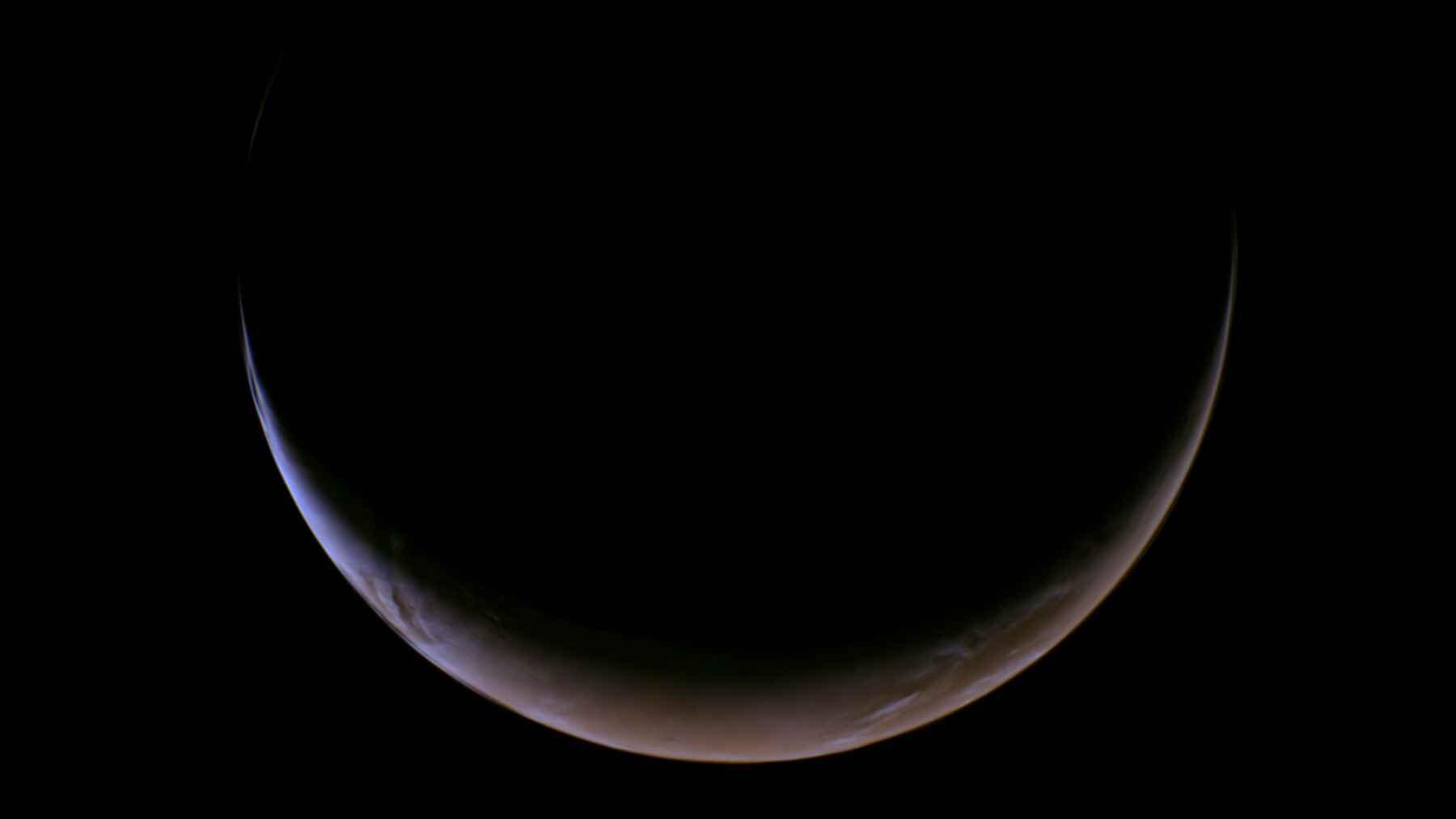
NASA’s Psyche spacecraft did more than borrow a push from Mars on May 15, 2026. It passed within 2,864 miles of the surface, gained about 1,000 miles per hour, and tilted its path around the Sun by roughly one degree.
No extra fuel needed.
The maneuver used Mars’ gravity to put Psyche on course for its main destination, the metal-rich asteroidPsyche, which it is expected to reach in 2029.
the flyby wasn’t only about navigation. Why waste a close encounter with Mars?
The mission team used the opportunity as a full-scale test of the spacecraft’s scientific instruments. Its cameras, magnetometer, and gamma-ray and neutron spectrometer all worked as planned. Psyche also captured a time-lapse showing Mars growing from a thin crescent into detailed close-up views before shrinking away again.
A gravity assist without extra fuel
So, how does a gravity assist actually work?
Think of it a little like catching a moving walkway at an airport. The spacecraft approaches a planet on a carefully planned path, falls through its gravity, and leaves with a different speed and direction.
That’s exactly what Psyche did at Mars. The maneuver saved propellant while making the precise course change needed for the long trip ahead.
Controllers confirmed the result using radio signals exchanged between Psyche and NASA’s Deep Space Network. Those signals showed that Mars had delivered the expected boost and placed the spacecraft on the right route toward the main asteroid belt between Mars and Jupiter.
Mars became the practice target
Why test asteroid instruments on Mars, a planet scientists already know so well?
That’s actually the point.
Mars works almost like a practice exam with an answer key. Scientists already have decades of measurements from orbiters and rovers, so they can compare Psyche’s readings with data they already trust.
Lindy Elkins-Tanton, the mission’s principal investigator at the University of California, Berkeley, said “all instruments delivered great results.”
The team wasn’t expecting any huge surprises from such a well-studied planet. Still, the flyby gave the instruments a real-world workout and even added observations from a viewpoint that Mars spacecraft don’t usually get.
Neutrons put one instrument to work
Psyche’s gamma-ray and neutron spectrometer will eventually help scientists figure out which chemical elements make up the asteroid’s surface.
Sounds complicated. The basic idea isn’t.
Cosmic rays constantly slam into planets and asteroids. When they hit, they can cause the surface and atmosphere to release neutrons and gamma rays at different energy levels.
Scientists measure those signals and compare them with the known signatures of different elements. Think of it as reading a chemical fingerprint from far away.
At Psyche’s flyby distance, Mars was too far away for the instrument to detect gamma rays from the planet. But it did pick up the expected increase in neutrons near closest approach.
David Lawrence of the Johns Hopkins Applied Physics Laboratory said the detector “performed excellently.”
That was the important part. The instrument recognized a real planetary signal before having to do the same job at a far less familiar world.
Mars tested the magnetometer
Psyche’s magnetometer has already spent years measuring the magnetic field carried by the solar wind.
Mars offered something different.
For the first time, the instrument detected the magnetic signature of a celestial body. As Psyche approached Mars, it recorded a sharp increase in magnetic activity at the planet’s bow shock.
What is that?
Picture water building up in front of a moving boat. Mars creates something loosely similar in space, except the “wave” comes from charged particles in the solar wind running into the planet’s magnetic environment.
Ben Weiss of the Massachusetts Institute of Technology said the encounter showed that the magnetometer could handle rapidly changing conditions.
A useful rehearsal. At asteroid Psyche, magnetic measurements could help scientists investigate whether the object contains material left over from the core of an ancient planetary building block.
Rare views of the Red Planet
The cameras got their turn too.
Psyche approached Mars from an unusual angle, so the planet initially appeared as a narrow, glowing crescent. Sunlight scattered through the dusty Martian atmosphere, making the bright edge stretch farther around the planet than might normally be expected.
Images taken from May 2 through May 15 were later combined into a time-lapse of the approach, close pass, and departure.
And once Psyche got close, the details started showing up.
Its twin cameras photographed wind-streaked craters, the water ice-rich south polar cap, and the huge double-ringed Huygens crater.
Jim Bell of Arizona State University said the imaging team also spotted Mars’ small moons, Phobos and Deimos, from far away.
That wasn’t just sightseeing. The team was practicing for a search around asteroid Psyche, where scientists will look for any tiny moons that may be hiding nearby.
Why asteroid Psyche matters
Asteroid Psyche is not your typical rocky destination.
Current estimates suggest metal makes up around 30% to 60% of its volume, mixed with rocky material. But scientists still don’t know exactly what they will find when the spacecraft gets there.
The irregular asteroid is about 173 miles wide at its broadest point.
One of the biggest questions is how it formed.
A leading idea is that Psyche may contain material from the core of a planetesimal, one of the small bodies that helped build the rocky planets early in the solar system.
If so, visiting Psyche could offer scientists something they normally can’t get.
A look at material similar to what lies deep inside planets, without having to somehow drill thousands of miles underground.
The spacecraft is expected to spend about two years mapping the asteroid, photographing its surface, studying its composition and gravity, and searching for magnetic clues.
The next leg to 2029
Psyche launched on Oct. 13, 2023. After the Mars flyby, it is now headed directly toward the asteroid belt and remains on track to rendezvous with its target in 2029.
One of the journey’s biggest navigation hurdles is done.
The flyby also gave nearly every major science instrument a chance to prove itself before the real mission begins.
Bob Mase, the project manager at NASA’s Jet Propulsion Laboratory, said “The spacecraft is in great shape.”
Psyche is scheduled to resume sustained thrusting with its solar-electric propulsion system later in 2026. That system provides a gentle but continuous push during the cruise.
Mars supplied the bigger shove.
Now comes the long trip toward one of the solar system’s strangest unexplored worlds.
The official mission update was published by NASA Science.