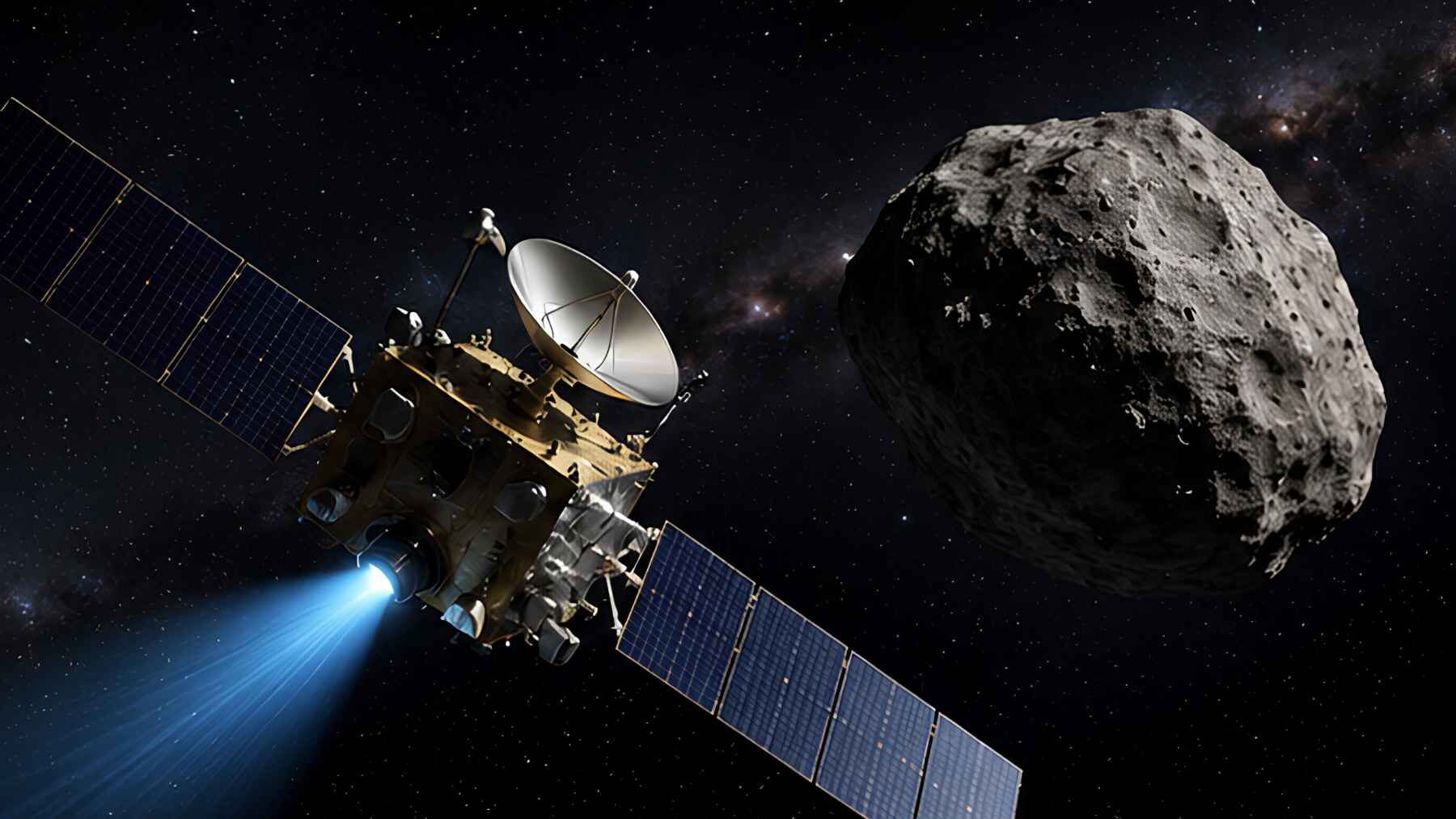
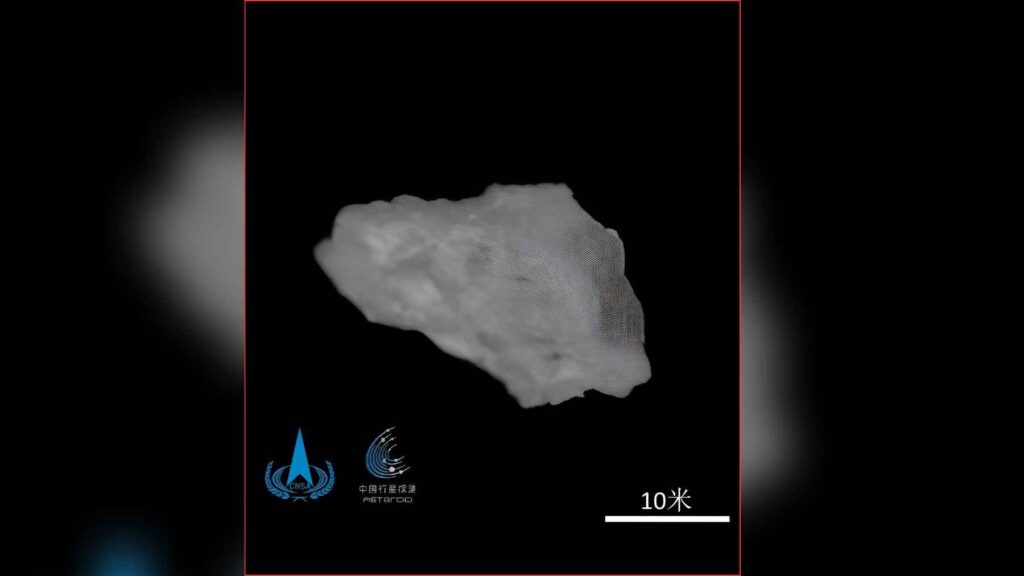
China’s Tianwen-2 spacecraft has begun close-range science operations at asteroid Kamo’oalewa, also known as 2016 HO3, after traveling for about 400 days and 621 million miles. On July 2, 2026, the probe photographed the rough, gray object from roughly 12 miles away, marking a major step in China’s first asteroid sample-return mission.
The picture is only the opening act. Tianwen-2 is expected to collect material and send it to Earth in late 2027, potentially settling whether Kamo’oalewa is a piece of the Moon or a more ordinary asteroid altered by ages of exposure to space. That small capsule could answer a surprisingly large question.
A 400-day asteroid chase
Tianwen-2 launched on May 29, 2025, and first detected Kamo’oalewa on June 6, 2026. One day later, it carried out a control maneuver from about 18,600 miles away, then closed the gap to roughly 1,240 miles by June 19. The spacecraft reached its 12-mile observation point on July 2.
The 621 million-mile figure describes the probe’s total winding route through space, not the asteroid’s straight-line distance from Earth. For the next three centuries, models place Kamo’oalewa roughly 9 million to 24 million miles from our planet as it follows a Sun-centered orbit. Think of the larger number as a road-trip odometer rather than the distance between two addresses.
Close navigation also sharpened scientists’ knowledge of the asteroid’s location. Images from the spacecraft reduced an uncertainty of more than 60 miles to roughly mile-level accuracy, giving mission controllers a much safer foundation for the delicate work ahead.
What a quasi-moon really is
So, is Kamo’oalewa actually another moon? No. A true moon is held in orbit around Earth, while this object circles the Sun and only appears to loop around our planet because the two follow similar paths.
Kamo’oalewa takes about 365.77 days to circle the Sun, compared with Earth’s 365.25 days. That near match makes it a “quasi-satellite,” a kind of orbital companion that stays close without becoming gravitationally bound to us. It is a fellow traveler, not a second Moon.
Ground observations suggest the asteroid is only a few hundred feet across and completes a spin in roughly 28 minutes. That rapid rotation turns sample collection into something like trying to touch a small, tumbling rock while both you and the rock are moving through space.
Eleven instruments move in
The spacecraft carries 11 scientific instruments, including cameras, radar, a magnetometer, and several spectrometers. A spectrometer reads how material interacts with light, helping scientists identify minerals without immediately bringing the rock into a laboratory.
Together, these tools will map Kamo’oalewa’s shape, surface materials, and internal structure. The team must learn whether the surface is solid, dusty, fractured, or loosely piled rubble before choosing a sampling site. In practical terms, that means looking carefully before reaching out.
Mission planners have prepared three possible collection approaches involving touching, hovering, or attaching to the surface. The goal is to gather at least 3.5 oz. of material, about a small handful on a kitchen scale. A separate capsule would carry that sample through Earth’s atmosphere while the main spacecraft continues onward.
The asteroid’s identity problem
A 2021 study led by Benjamin Sharkey at the University of Arizona found that light reflected from Kamo’oalewa most closely resembled weathered lunar silicates. In 2024, research led by Yifei Jiao at Tsinghua University used computer simulations to suggest the asteroid may have been blasted from the Moon’s Giordano Bruno crater several million years ago.
The case is no longer tidy, though. A 2026 study led by Pengfei Zhang at the Institute of Geochemistry of the Chinese Academy of Sciences recreated the effects of “space weathering,” the slow damage caused by solar particles and tiny impacts, on meteorite powder. The results instead pointed toward an asteroid from the Flora family in the main belt between Mars and Jupiter.
Which explanation is right? Returned grains could provide the tie-breaker because laboratories can compare their minerals and chemical fingerprints directly with lunar rocks, meteorites, and material from other asteroids. Remote observations can suggest an identity, but a sample can test it.
Why bringing rocks home matters
Spacecraft cameras and sensors are powerful, but Earth laboratories can examine grains with larger, more sensitive machines and repeat tests for decades. Japan’s JAXA proved the value of that approach with the Hayabusa and Hayabusa2 missions, while NASA returned material from asteroid Bennu with OSIRIS-REx in 2023.
China also demonstrated sample-return capability when Chang’e-6 brought back the first material from the Moon’s far side in June 2024. Kamo’oalewa presents a different challenge, however, because its weak gravity, small size, and fast spin leave little room for error. A gentle contact could stir dust or push the spacecraft away.
“It is highly likely to contain primordial information from the early days of the solar system’s formation,” mission spokesperson Han Siyuan said. For scientists, those grains may preserve clues that larger worlds erased through heat, pressure, volcanoes, and billions of years of geological change.
What happens next
Tianwen-2 will now move through progressively more detailed observations before selecting a safe sampling area and method. The process will be cautious because the probe is working around a body that is poorly mapped and barely holds material to its surface. Even a small tap can send dust drifting.
After collecting the sample, the spacecraft is scheduled to release its return capsule near Earth by the end of 2027. The main probe will then use Earth’s gravity for a boost and begin a journey of about seven years toward the unusual main-belt comet 311P.
The first close-range image shows that Tianwen-2 has reached its target, but the mission’s most important evidence is still waiting on the surface.
The official mission update has been published by the China National Space Administration.