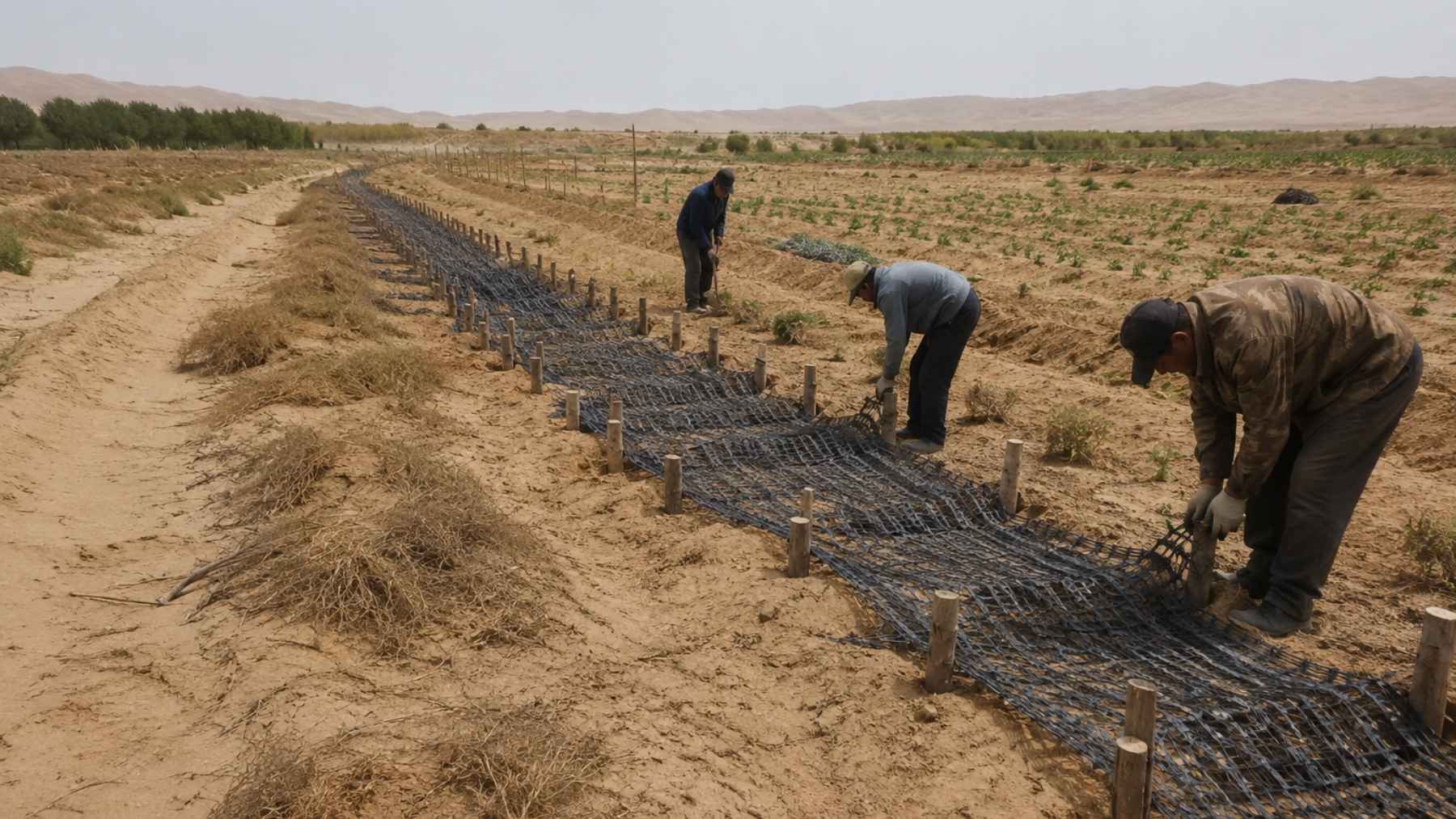
China is turning a material linked to lunar exploration into a tool for protecting farmland on Earth. In Xinjiang, researchers are using basalt fiber, a tough thread made from volcanic rock, as part of new projects meant to slow moving sand, reduce soil damage, and protect fields near the Taklamakan Desert.
It sounds like space technology, and in one sense it is, but the goal is painfully ordinary. Keep sand from swallowing productive land, keep salt from ruining soil, and give crops a better chance in one of China’s driest regions.
Space material goes to sand
Basalt fiber is made by heating basalt rock until it melts, then drawing it into thin strands. The result is a material that can handle heat, cold, and harsh sunlight better than many common fibers, which is why it drew attention during China’s Chang’e 6 Moon mission.
A basalt-fiber flag developed by Wuhan Textile University and China Space Sanjiang Group was unfurled by the Chang’e 6 lander on the far side of the Moon in June 2024. Xu Weilin, president of the university, described it as a “stone version” fabric flag built to survive the lunar environment.
China’s return capsule landed in Inner Mongolia on June 25, 2024, carrying the first samples ever collected from the far side of the Moon, according to the China National Space Administration. In the desert, the point is less glamorous, but still important. Similar fiber-based materials may help hold sand in place and reinforce barriers.
Why Xinjiang needs it
The Taklamakan Desert is China’s largest desert and one of the world’s largest drifting deserts. It covers about 130,350 square miles, and its outer edge stretches roughly 1,893 miles around desert, oasis, roads, and farmland.
China has spent decades trying to hold that line through the Three-North Shelterbelt Forest Program, often described as a Great Green Wall. The program began in 1978 and is scheduled to run until 2050, and official figures say it has helped protect about 74 million acres of farmland.
Desertification is the slow loss of healthy land as wind, drought, farming pressure, and climate stress strip away vegetation and soil. In everyday terms, it means harder farming, damaging dust storms, and more sand in the air, on roads, and sometimes inside homes.
New tools for old problems
The latest work is being led by the Xinjiang Institute of Ecology and Geography, part of the Chinese Academy of Sciences. Three major regional science projects launched in Urumqi in April 2026 are meant to build a full protection chain from the desert front to oasis farmland.
Pei Liang, chief scientist for the new materials and equipment project, said the plan includes six environmentally friendly sand-control materials. They include basalt-fiber-based materials, recycled fly ash from coal power plants, and microbial seed coatings, along with modular equipment that can lay the materials more efficiently.
By the project team’s estimates, the approach could raise sand-control construction efficiency by 50% and cut costs by 30%. The basalt and related materials are also expected to be promoted across about 4,900 acres along the southern edge of the Taklamakan.
Salt is not a side issue
“Farmland cannot only fight sand. It also has to manage salt,” Xiao Huijie, a researcher involved in the high-standard farmland project, said in a translated statement. That line may sound simple, but it points to a second problem that can be just as damaging as dunes.
Soil salinization happens when salt builds up in the ground. When there is too much salt, plants struggle to pull in water, even when irrigation is available. For farmers, the result can be weaker crops, lower yields, and fields that slowly become less useful.
The Xinjiang project will test windbreak layouts, smart irrigation that helps push salt away from roots, and drainage systems using buried pipes and vertical wells. The core demonstration area is expected to cover about 330 acres, with wider application planned for about 16,500 acres in southern Xinjiang.
A field test, not a magic wall
The basalt-fiber work is important, but it is not a silver bullet. For the most part, China is combining materials, plants, irrigation, drainage, and monitoring systems because desertification rarely has one cause.
That is why the new projects also include digital tools for diagnosing wind, sand, and salt hazards. Sensors and decision systems could help officials respond earlier, rather than waiting until dunes move, crops fail, or dust storms make the problem obvious.
Will it work at scale? That is the question. Desert edges are rough places, and any solution has to survive heat, wind, water limits, maintenance costs, and the daily reality of farms that need results, not just prototypes.
What the project could change
If the materials perform as expected, basalt fiber may become one more piece of China’s wider desert defense system. It would not replace trees, shrubs, or irrigation, but it could strengthen barriers where living plants alone are not enough.
The broader lesson is easy to miss. A material designed for the Moon can become useful in a field, where the real test is whether it helps a seedling stay alive through a sandstorm.
For people living near the Taklamakan, that is the part that matters. Not the space headline, not the shiny technology, but whether there is less dust, less lost soil, and more stable land for crops.
The main official report has been published by Science and Technology Daily.