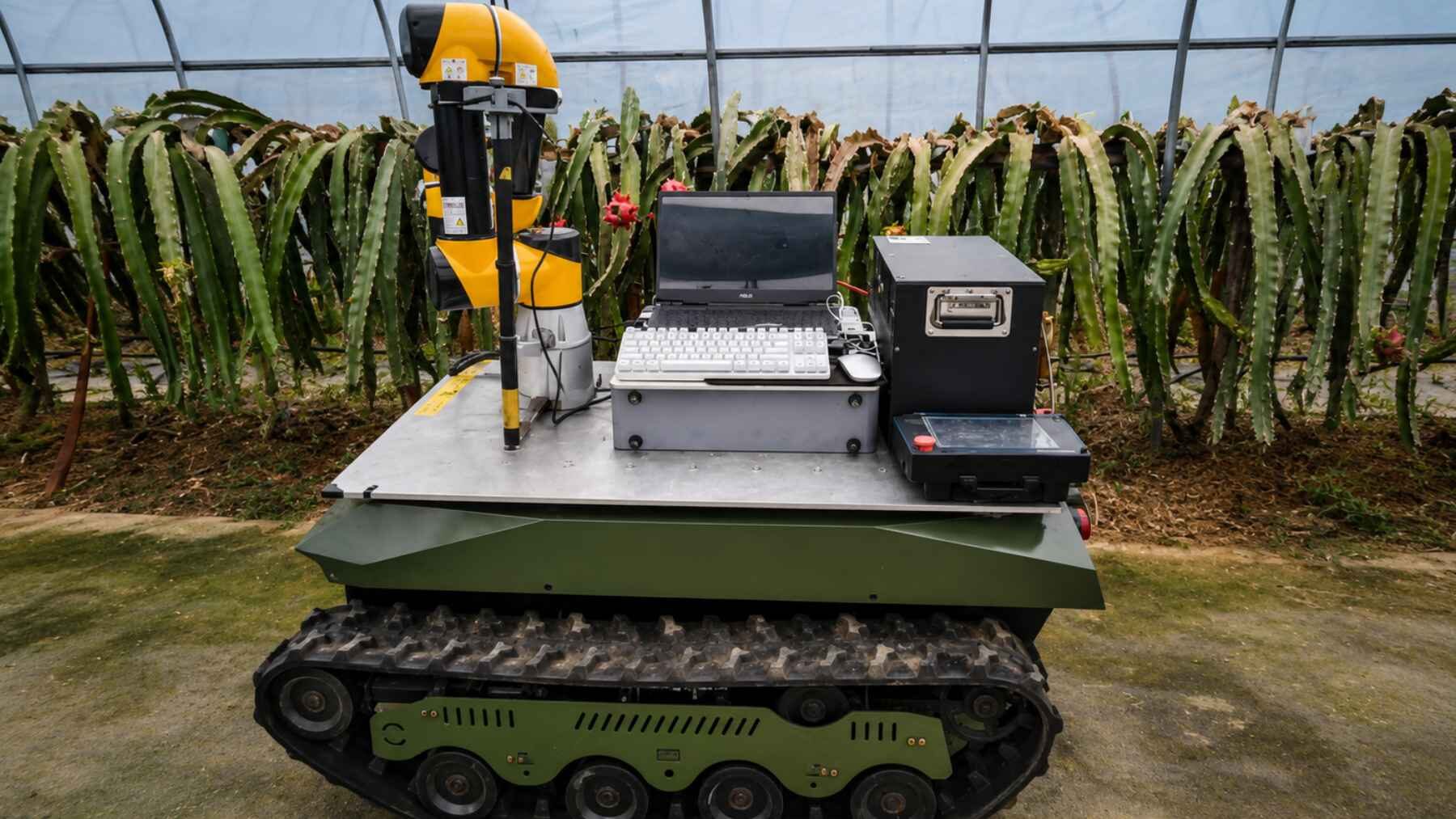
Picking fruit sounds simple until the fruit is heavy, easily bruised, and ready at different times on the same plant. A new autonomous machine called Dragonbot was built to solve that exact problem by finding ripe dragon fruit, cutting it free, and leaving immature fruit alone.
Researchers at the Universitat Politècnica de València in Spain report that the harvesting system collected more than 75% of ripe fruit during field trials, while fewer than 12% of the handled fruit suffered damage. That is not a flawless result, but it is a meaningful step for a crop that still depends heavily on careful manual work.
A robot that knows when to wait
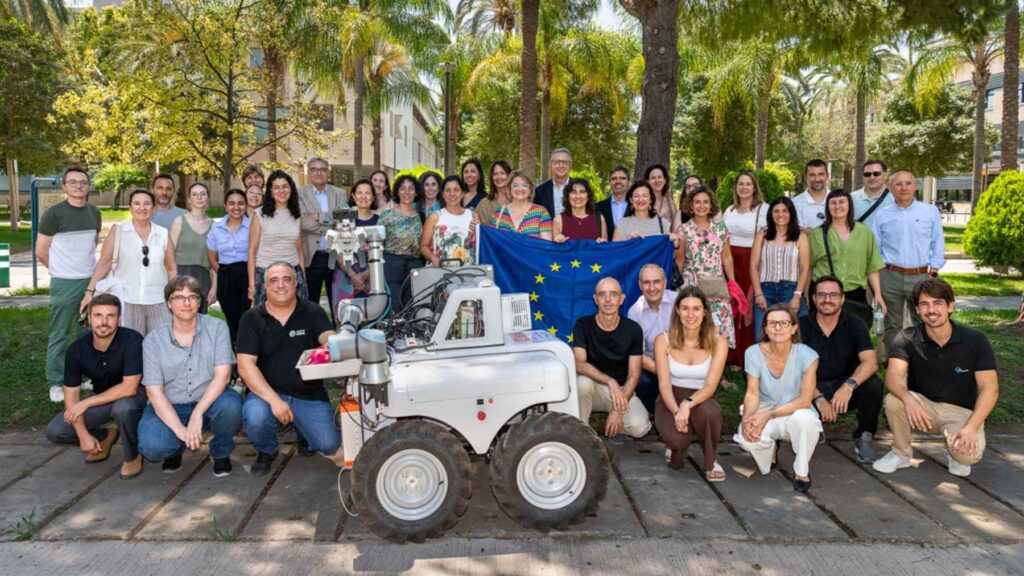
Dragon fruit, also called pitaya, grows on a climbing cactus and has become more common on Mediterranean farms because the plant is hardy and the fruit can command a high price. Francisco Rovira, director of the Agricultural Robotics Laboratory, said Dragonbot is, “as far as we know,” the first robot designed specifically for automated dragon fruit harvesting.
What makes it different from a basic picking machine? Its cameras and computer vision software first locate each fruit, then algorithms estimate whether it has reached the right stage of ripeness. Computer vision simply means a machine uses images to recognize objects and make decisions.
Sometimes the smartest move is to do nothing. When a fruit is not ready, Dragonbot leaves it attached so it can keep ripening instead of sending it too early to cold storage or a packing line.
How Dragonbot grips and cuts
Dragonbot travels on a four-wheel-drive base with steering on two wheels and independent suspension for uneven farm terrain. A robotic arm carries a custom gripper, while flexible air-powered fingers wrap around the fruit without squeezing it too hard.
The cutting assembly includes a vibrating blade and pneumatic shears (powered by compressed air). Carlos Blanes of the University Institute of Automation and Industrial Informatics said the team also programmed the full sequence for collecting and depositing each fruit without bruising it or lowering its quality.
That coordination matters. The machine must see the fruit, find the stem, position the blade, support the fruit, make the cut, and place the harvest down gently, all without bumping nearby stems.
Field results show promise
During farm trials, Dragonbot collected more than three out of every four ripe fruits it targeted, and fewer than 12 in every 100 fruits were damaged. Coral Ortiz, the project coordinator, said the findings “validate the viability of our robot” for pitaya and possibly other delicate crops.
Still, ‘promising’ is not the same as finished. A success rate above 75% means the robot did not complete every ripe pick, while a damage rate below 12% is not zero. The official project materials reviewed for this article also provide no commercial price, release date, or timeline for large-scale deployment.
This is the part often lost in flashy robot headlines. Real farms are variable, with shifting light, leaves blocking cameras, uneven ground, and fruit growing at awkward angles. Those conditions remain major challenges for automated harvesting systems.
The eyes behind the robotic hand
The project divided several difficult jobs among specialist partners. GreenVision worked on estimating fruit maturity, Inderen supplied an agrivoltaic testing environment, and Nutai developed computer vision tools to select the fruit and locate the best cutting point.
Agrivoltaics combines farming with solar power generation on the same land. Earlier project documents said Dragonbot was designed to use batteries charged by photovoltaic panels integrated into the greenhouse, linking the robot to a wider effort to reduce resource use and improve farm efficiency.
In practical terms, the artificial intelligence acts like a quality gate. The difficult part is not merely moving a blade. It is combining location, ripeness, shape, and cutting position quickly enough to make a safe decision.
Earlier research paved the way
Dragonbot did not appear from nowhere. A 2023 study tested a robot-mounted touch sensor on 60 dragon fruits and separated acceptable fruit from deteriorated fruit correctly in more than 77% of cases, with an even stronger result in its validation group. The method checked firmness without cutting into or ruining the fruit.
A 2026 study from the same research line used a low-cost imaging system with visible and ultraviolet light on two groups totaling 152 fruits. In the first group, it classified fruit quality with close to 85% accuracy, while the system identified the highest-quality fruit in more than 92% of cases in both groups.
That detail needs a careful distinction. The imaging system in that study was described as low-cost, but the official Dragonbot materials do not say the complete mobile robot is inexpensive.
Why selective harvesting matters
Picking only ripe fruit can keep less mature fruit growing longer, reduce unnecessary storage, and protect the quality that shoppers see at the grocery store. It may also ease pressure on workers during busy harvest periods, when every ripe fruit seems to demand attention at once.
Farm adoption depends on more than a successful demonstration, though. Research involving soft-fruit growers has found that cost, infrastructure, technical skills, trust, and data concerns can all slow the use of autonomous robots, even when growers see long-term potential.
At the end of the day, Dragonbot’s strongest idea may not be speed, but judgment. The robot is being taught that a good harvest is not just about knowing what to pick, but also knowing what to leave alone.
What happens next
Dragonbot received support through the Generalitat Valenciana’s Strategic Cooperation Projects program, with co-financing from the European Regional Development Fund. It was also presented as a collaborative innovation success story at the Innova Connect event.
The team believes the same approach could eventually be adapted for other delicate fruits. Before that happens, further trials will need to show how reliably the system performs across different seasons, varieties, greenhouse layouts, and lighting conditions.
The official project update has been published by UPV News.