A Spanish consortium is developing carbon-fiber aircraft parts that can carry loads and store electricity. RE-CELL plans a full-scale demonstrator linked to an aircraft landing gear component by August 31, 2027, yet no flight-ready system exists yet.
What if the plane’s own skeleton could power the cabin lights? Instead of adding another heavy battery box, engineers want the structure to do two jobs. In aviation, every extra pound must leave the runway too.
A battery built into the plane
A structural battery stores energy and helps carry mechanical loads. A carbon-fiber panel could support an aircraft and hold electricity, reducing separate materials that perform only one task.
The project targets about 32 Wh per lb. That cannot replace a large propulsion battery tomorrow. The possible advantage comes from lowering total system weight, even if the material stores less energy than a conventional cell.
“The big challenge is not just storing more energy, but doing it without adding a weight penalty,” said Esteban Castro, a research and development engineer at SOFITEC. The first uses would be noncritical systems such as cabin lighting, not propulsion.
Why weight rules the sky
A car can carry a heavy battery pack and still roll down the highway. An airplane must lift every pound for the entire trip. The European Union Aviation Safety Agency (EASA) says battery weight remains a major restriction for electric regional and short-haul aircraft.
China remains the giant of conventional battery manufacturing. According to International Energy Agency data (IEA), the country accounted for more than 80% of global battery manufacturing capacity in 2025. Spain is not matching that scale here, but testing a different answer to the weight problem.
The idea is not unique to Spain, and that context matters. Structural-battery research published in 2024 at Chalmers University of Technology produced a carbon-fiber cell with about 14 Wh per lb. and stiffness comparable to aluminum. RE-CELL is targeting more than twice that energy capacity, although a target is not a proven production result.
Recycled carbon fiber gets a second job
Carbon fiber is valued in aviation because it is strong and light. In the RE-CELL project, recovered fibers reinforce the composite and take part in energy storage. Engineers are also studying supercapacitors, devices that can release energy quickly.
The material needs an electrolyte, which lets electrically charged particles move inside the storage device. RE-CELL is working with solid electrolytes because the finished component must store energy while remaining stiff and durable. Those demands can pull the material in opposite directions.
“We are working to give carbon fiber a second life and turn it into a high-value resource for demanding aviation uses,” said Fernando Ramos, a sustainable mobility researcher at AIMPLAS. Recycled fibers are not perfectly uniform, so their surfaces and mechanical behavior must be carefully controlled.
The landing gear test
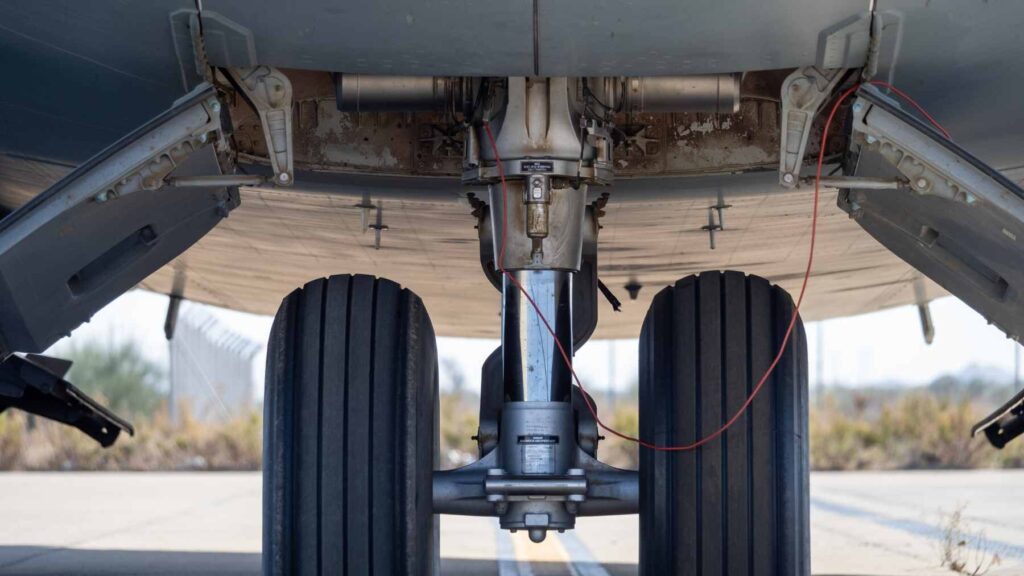
The demonstrator is where the concept moves closer to an aircraft factory. It will be built at full scale and integrated into a component connected with the landing gear. The team can then test processing, assembly, and performance under representative conditions.
That distinction is important. The official materials describe a demonstrator, not landing gear that can already power an airplane or a product approved for flight. The test will ask whether the composite can survive realistic loads while continuing to store and deliver electricity.
“The key advance is studying ion movement and mechanical behavior together, rather than treating them as separate problems,” said Florin Ardelean, a modeling and simulation researcher at I2CON. Put simply, the team must predict what happens when one material is flexed, charged, and discharged.
Big hurdles remain
A promising laboratory sample is only a beginning. The material must keep working under repeated loads and demanding operating conditions, while manufacturers must produce it with consistent quality. That is a much harder test.
Researchers are tackling solid-electrolyte performance, variation in recycled fibers, and the interaction between electrical and mechanical properties. None of those issues is a footnote. A weak point in either function could undermine the reason for combining them.
The project runs from September 1, 2024, through August 31, 2027, with support from the Spanish State Research Agency and the European Union. The partners are combining materials development, computer modeling, recycling, full-scale manufacturing, and industrial validation rather than betting on one laboratory breakthrough.
What this could change
The near-term goal is not a battery-powered airliner crossing an ocean. It is a careful first step that could show whether cabin systems can draw power from parts already built into the aircraft. Small gains matter when weight affects range, payload, and energy use on every flight.
If the approach works, designers could rethink panels, covers, and other components as energy-storing structures. The benefits will depend on safety, repairability, production cost, and how the materials age. At 30,000 feet, the electric bill is not the issue, but every pound is.
Ultimately, RE-CELL is trying to make an airplane’s structure work harder without making the aircraft heavier. Until the landing gear demonstrator is tested, this remains an engineering project, not a finished aviation product.
Official project information was published on RE-CELL’s website.