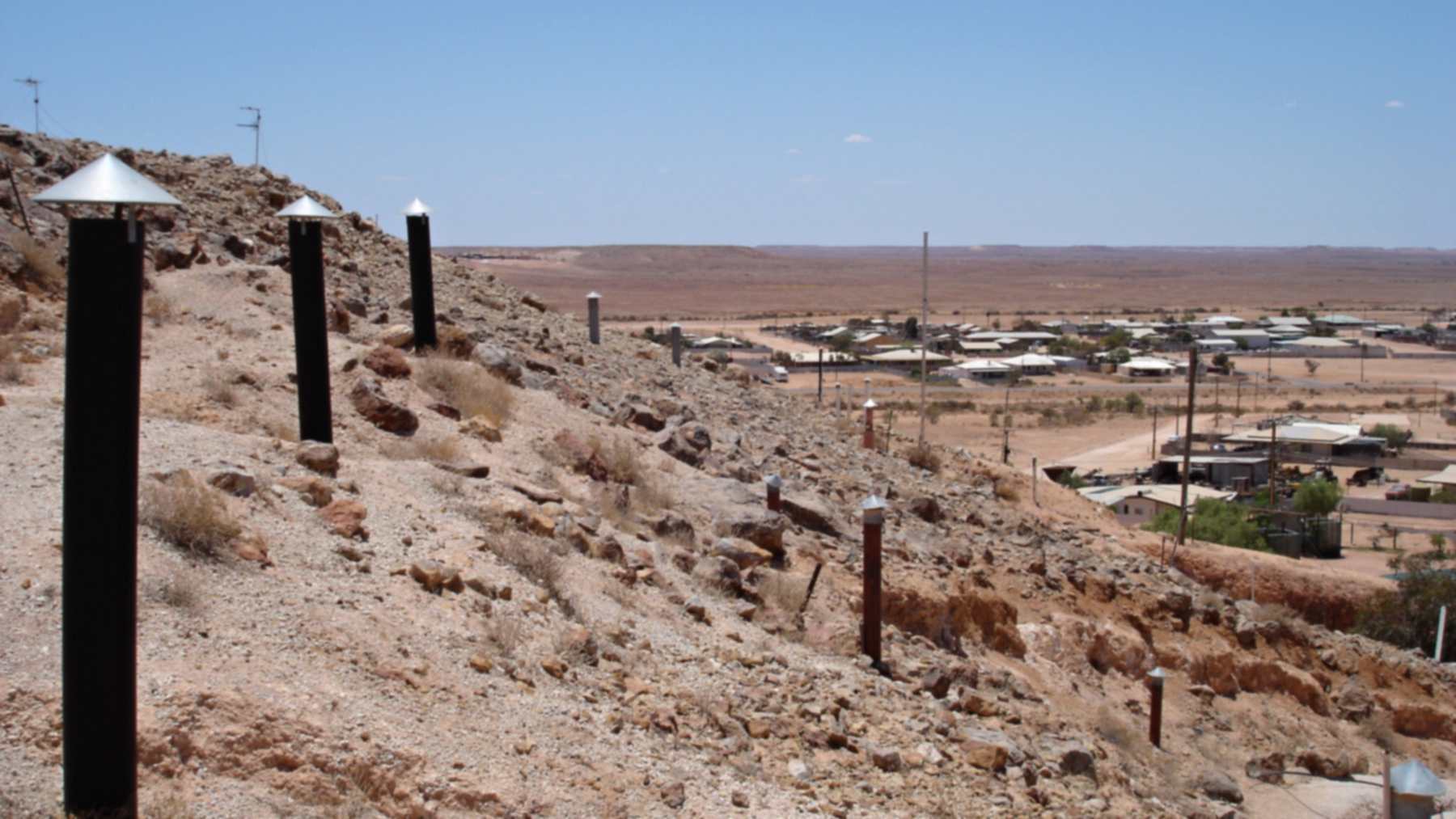
In Coober Pedy, an opal town in the South Australian desert, about half of the residents live in underground homes that stay between 66 and 77°F (19 to 25°C) day and night, according to the local tourism association. Water has been the town’s weak point since its founding in 1915, and by the end of 2026 the state utility SA Water is due to take over its aging water system.
The town began on Feb. 1, 1915, when a gold-prospecting party camped in the desert and went looking for water. William Hutchison, 15, the son of one of the men, found pieces of opal lying on the ground. The first claim was pegged eight days later, and on Feb. 18, short of water and beaten by the heat, the party left for William Creek.
Dugouts dug sideways into the hills
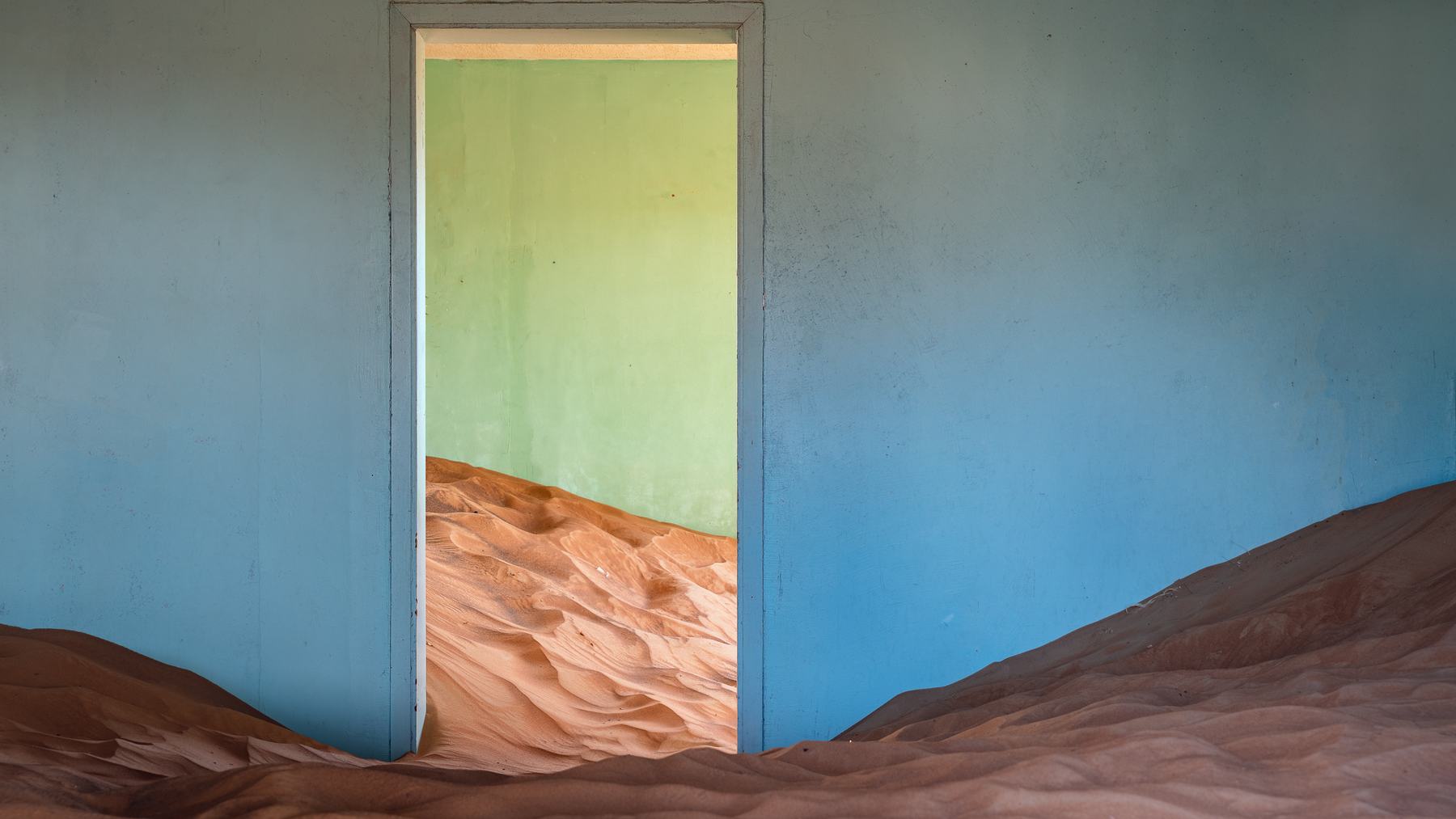
Locals call their homes dugouts. Most are excavated into hillsides rather than dug from shafts, says the Coober Pedy Retail, Business & Tourism Association on its dugouts page. Families buy the lot next door and tunnel through, sometimes linking three or four dwellings. The biggest homes spread to 450 square meters, about 4,840 square feet, all of it inside rock.
Builders call the effect thermal mass, which Australia’s YourHome guide defines as a material’s ability to absorb, store and release heat. Earth-covered homes are coupled to deeper ground, where temperatures are more stable. A house built from old tires holds 68 F with no heating or air conditioning in much the same way, and engineers in Italy use steady rock to cool an underground data center inside an Alpine mine.
Outside, at the Bureau of Meteorology’s weather station at Coober Pedy Airport, open since 1994, January highs average 98.4 F (36.9 C). The record of 118.9 F (48.3 C), set on Dec. 20, 2019, was matched on Jan. 30 this year. Rain averages about 5.7 inches (144.1 millimeters) a year, and one July night fell to 30.2 F (minus 1 C).
A name from a hole
The 1915 men, the New Colorado Prospecting Syndicate, had hunted gold for 14 weeks with no luck, says the District Council of Coober Pedy. A few months after Hutchison’s find, the O’Neill brothers and Fred Blakeley arrived and, according to the tourism group, introduced living underground in dugouts. The flies were bad and there were no building materials.
Railway workers and soldiers back from World War I followed. By 1920, a few hundred miners worked the field, and their Progress Committee named it Coober Pedy, “an aboriginal term meaning ‘white man in a hole,'” the council says.
Opal prices crashed in the Depression. In late 1945, Tottie Kendall, an Aboriginal woman, and her partner Charlie Bryant made a big find at the 8 Mile, and a new rush followed. The association says Australia has 95 percent of the world’s commercial supply, most of it from 70 fields around Coober Pedy, yet 85 percent of what miners dig up is potch, dull opal of little value.
Churches and black greens
People pray underground, too. The Serbian Orthodox Church of Saint Elijah the Prophet was built in 1993, and the Catholic Church of St. Peter and Paul, which the association bills as the first purpose-built underground Catholic church of its type, opened on June 25, 1967.
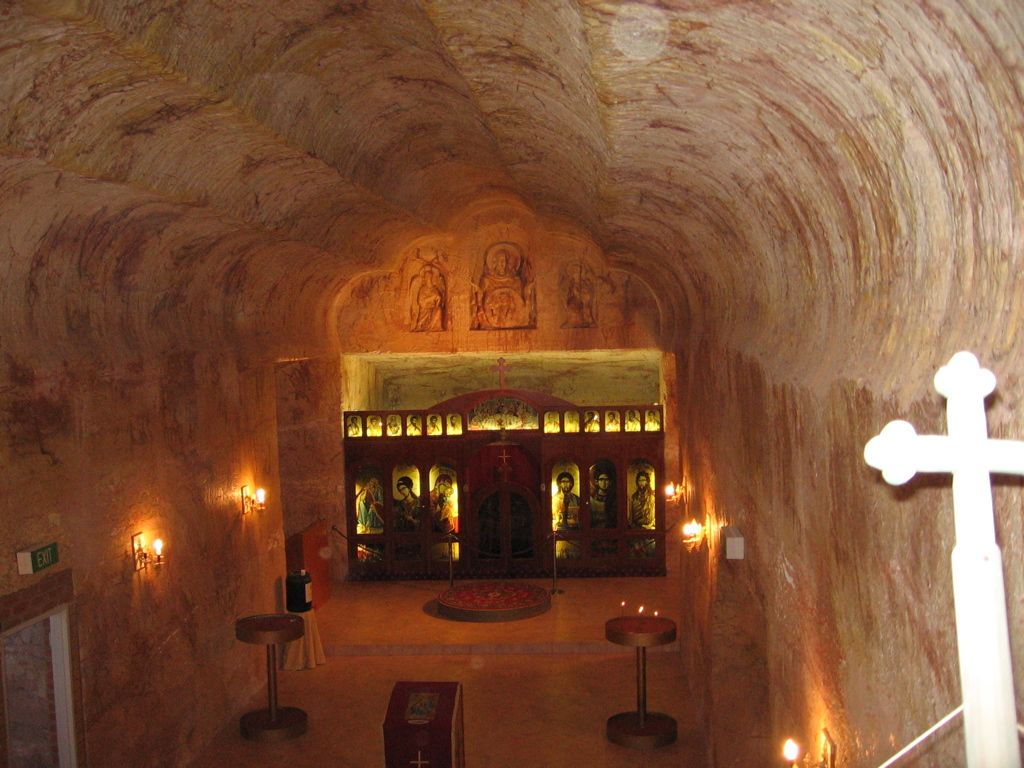
In the 2021 census, Coober Pedy had 1,566 people, and besides English, households spoke Sinhalese, Greek, Croatian, Serbian and Yankunytjatjara, an Aboriginal language of the area.
The 18-hole golf course, opened in 1976, has no grass. “The greens are black and the fairways are white!” the association says. Golfers putt on oiled sand raked smooth, and some have found opal mid-round. Visitors can also tour Faye’s Historic Underground Home, dug by three women with picks and shovels, or the Old Timers Mine, from 1916.
Salty water from 197 feet down
Cool rooms never fixed the water. In 1922, the government built an underground tank for 500,000 gallons, about 2 million liters. A solar desalination plant followed in 1967, but it did not produce enough water and was often damaged by high winds, the association says.
Since 1985 the council has run a reverse osmosis plant, which pushes water through a membrane that traps salt, like the desalination pod Norway sank under the sea. Pumps pull raw water from bores 197 feet (60 meters) deep, about 14 miles (23 kilometers) northeast of town. According to SA Water, they tap the Great Artesian Basin, one of the world’s largest underground water systems, and the water is naturally high in dissolved salts and minerals. Coastal cities desalinate seawater instead, as at a plant fed by intakes in tunnels under the seabed.
The state takes over the pipes
On Feb. 17, 2026, the South Australian government announced that SA Water would run the town’s water by year’s end. Most of the network dates from the 1970s and 1980s and has seen no significant upgrades since, the release said.
Pat Conlon, the council’s principal administrator, said in the release that the infrastructure “desperately needs investment in repair and maintenance the council has no ability to provide,” and that SA Water’s capacity to invest would make supply reliable and far more affordable. The council has been under administration since January 2019.
On its Water Talks project page, SA Water lists leaks, outdated metering and a high risk of failure, and wrote in October that the infrastructure is “at or near the end of its useful life.” First up are the treatment plant, the borefield, a booster pump station and a storage tank. Existing customers pay no connection fee, and the council keeps the sewers. SA Water holds a drop-in session for residents on Thursday, Nov. 5, from 11 a.m. to 2 p.m., at the Coober Pedy Outback Bar & Grill.
What the numbers leave out
“About half” is the tourism group’s estimate, not a census count, and head counts vary. The census found 1,566 people, the council’s history page says about 2,000, and the association cites a council figure near 2,500.
The association’s pages also disagree on the dugout temperature, with one giving 23 to 25 C (73 to 77 F) and another 19 to 25 C, and on whether the O’Neill brothers and Blakeley or returning soldiers first brought the dugout idea. Water prices are not set yet, and the February release said the pricing model “is still being worked on.”
The South Australian government’s Feb. 17, 2026, media release on the transfer is posted on the District Council of Coober Pedy website.
Photo: Pavel Špindler / Wikimedia Commons, CC BY 3.0