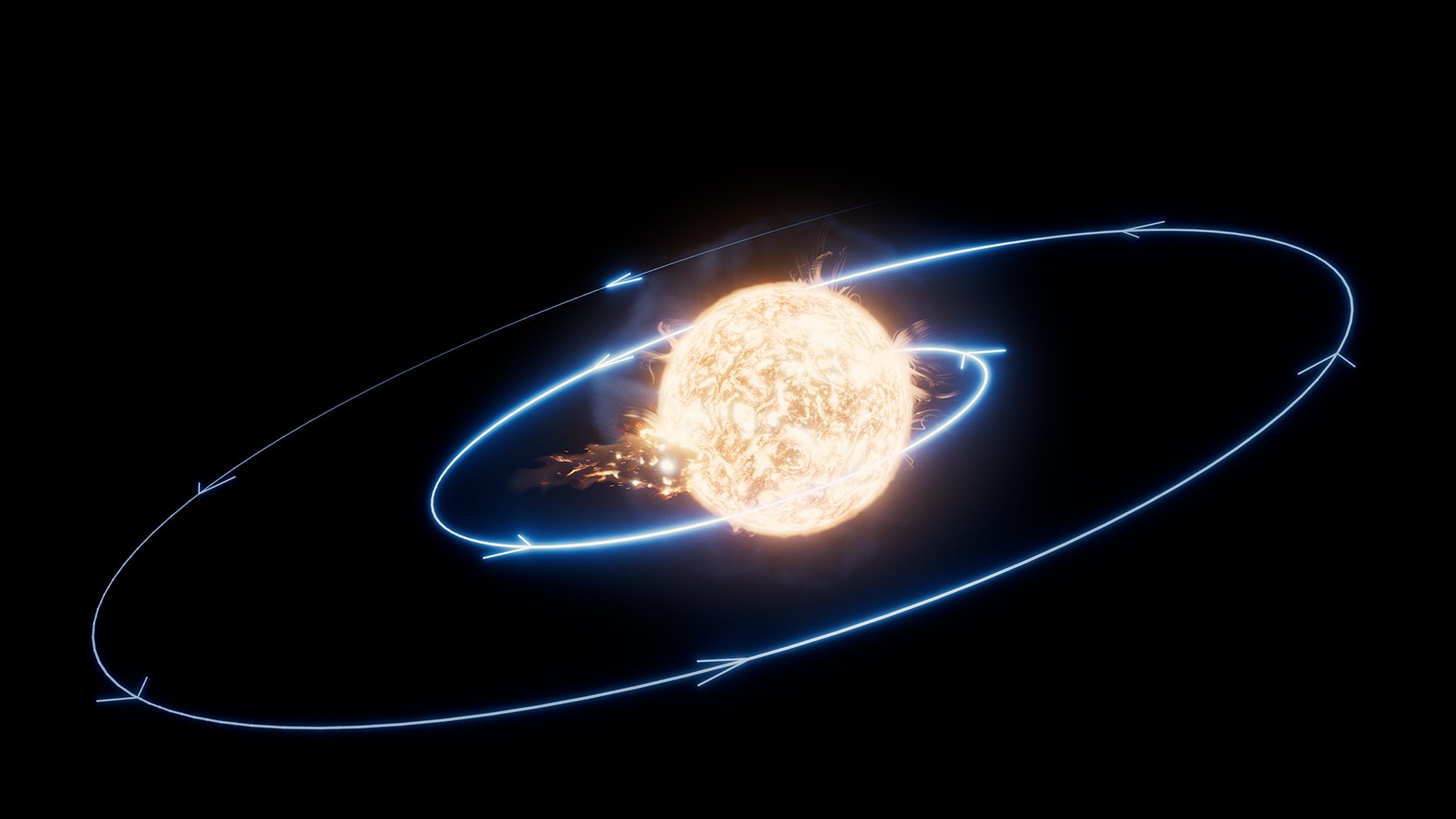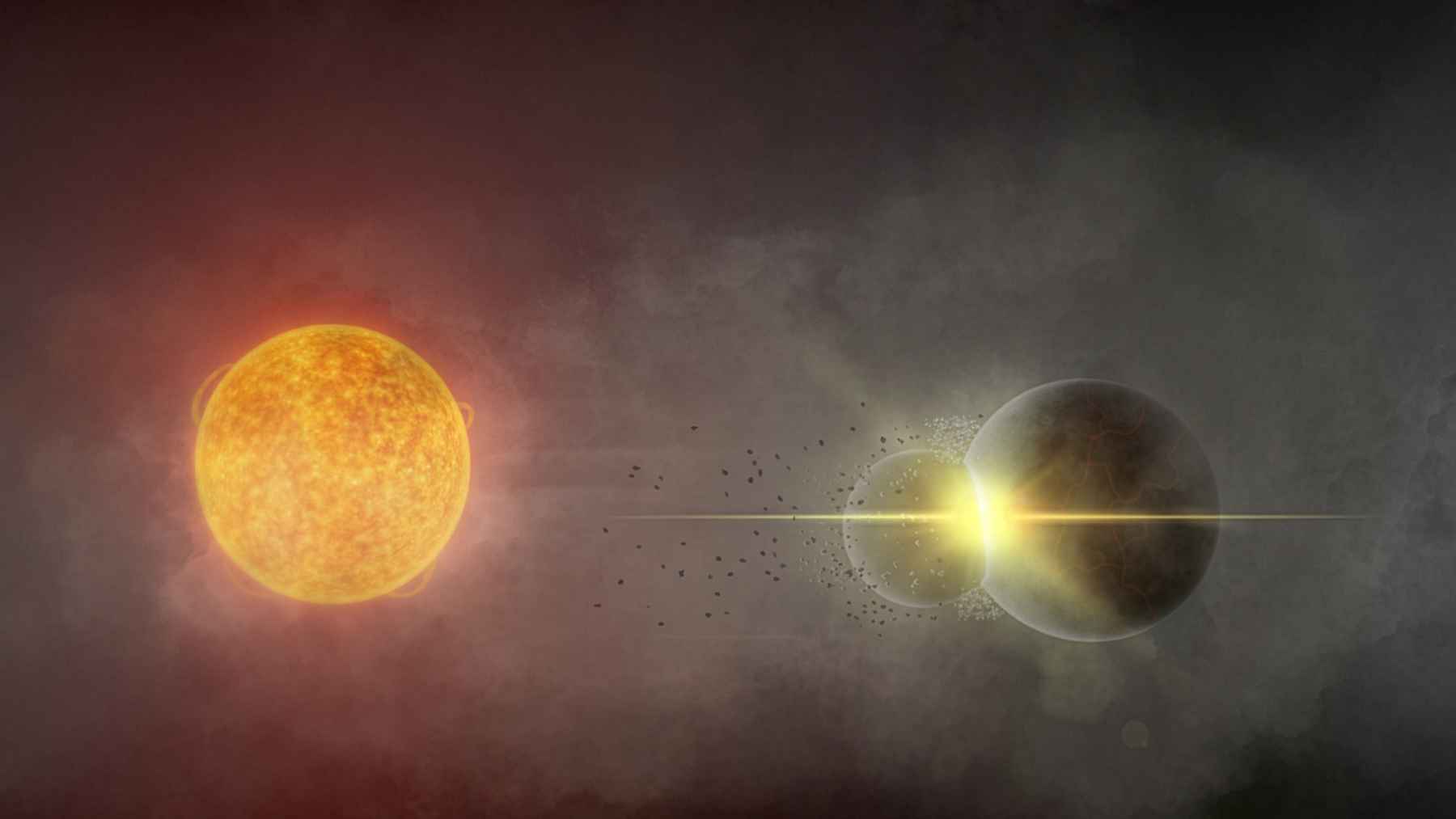
A distant star has been acting like a porch light, dimming in bursts and then fading again. In new research, astronomers say the young F-type star, hotter than the Sun, may be getting eclipsed by dust from a smashup between planetesimals, the building blocks of planets.
The object is called Gaia20ehk, also known as Gaia-GIC-1, about 11,000 light-years away. In a University of Washington news release, Anastasios (Andy) Tzanidakis said the star’s behavior “went completely bonkers,” and senior author James R. A. Davenport added, “How rare is the event that created the Earth and moon? That question is fundamental to astrobiology.”
The open-access study is available through IOPscience.
A star that should not blink like that
Gaia20ehk looked ordinary for years, with a light curve that was almost flat. Then, starting in 2016, it showed three dips, each lasting about seven months and cutting the star’s visible light by about a third.
Astronomers call this kind of pattern a “dipper,” meaning something passes in front of the star and blocks part of its light. A “light curve” is simply a graph of brightness over time, and this one looked more like a storm system than a steady lamp.
The European Space Agency’s Gaia mission flagged the object through its alert system, and the public record shows how the dimming grew more dramatic over time. You can see that long track of measurements in the official Gaia Alerts listing for Gaia20ehk.
Heat in the infrared, shadows in visible light
Visible light tells you what the star is doing at the surface, but infrared light can reveal heat from surrounding material. Think of infrared like a heat camera.
The team compared Gaia’s visible-light dimming with infrared measurements from NASA missions, including the sky-mapping telescope WISE. As the star’s visible brightness fell, the system got brighter in infrared, a common sign that dust is soaking up starlight and re-radiating it as heat.
That dust appears to be hot, around 900 kelvins, which is about 1,160 degrees Fahrenheit. The infrared level has stayed high for more than four years, and the mission SPHEREx has confirmed the system is still glowing strongly at those wavelengths.
A 381-day rhythm hints at where the debris orbits
Before the infrared brightening took over, Gaia’s data showed a repeating rhythm of about 381 days. That is just longer than an Earth year.
Using that period, the researchers inferred that a major dust clump was orbiting about 1.1 astronomical units from its star, or about 102 million miles. The infrared heat, though, matches dust much closer in, around 0.2 astronomical units, roughly 19 million miles.
By looking at how fast the starlight dropped, the team estimated the dust edge was moving across our line of sight at least about 6,700 miles per hour. That is slower than a clean circular orbit would suggest, which hints the debris might be stretched out or following a more oval path.
How much material was involved
The study estimated a minimum blocking area for the dust cloud of 0.13 square astronomical units. If you imagine that area as a circle, it would work out to a disk roughly 38 million miles across, though the real shape could be longer and lopsided.
The mass in the warm dust that shows up in the infrared was estimated at at least 400 quintillion kilograms, which is about 880 quintillion pounds. The key word is “dust,” since infrared measurements are most sensitive to fine grains, not the boulder-size fragments that might be hiding in the same debris field.
That’s why the team treats the mass as a floor, not a final tally. If only a fraction of the original bodies was ground down into infrared-bright powder, the colliding objects themselves could have been far larger than the dust alone suggests.
Could it be something else
Whenever a star dims, astronomers have to ask a basic question first. Is the star changing, or is something in front of it doing the blocking?
The researchers examined other explanations, including the breakup of “exocomets,” meaning comets in another solar system, and more typical young-star variability driven by gas and accretion. Their follow-up spectra did not show the strong emission features many very young, actively feeding stars display, which makes a standard baby-star explanation less convincing.
They also point to other unusual systems that seem to show impact-generated dust clouds, including ASASSN-21qj and a “star-sized” dust clump reported in the young system HD 166191. In those cases, as in Gaia20ehk, the story looks less like a calm disk of leftovers and more like ongoing wreckage.
Why this matters and what comes next
Giant impacts are not just dramatic, they are a predicted stage of making rocky planets. A 2016 review in Space Science Reviews explains how debris disks, meaning rings of dust and rock around stars, can act like signposts for these collisions, letting astronomers study planet formation through the dust it produces in real time.
That overview is available as “Insights into Planet Formation from Debris Disks” on SpringerLink.
There is also a familiar echo here at home, since many scientists think the Moon formed after a massive impact early in Earth’s history. A primer on Moon formation explains why that idea remains the leading framework, and Gaia20ehk’s dust appears to be orbiting in a broadly similar star-planet zone.
Looking ahead, wide-field surveys should make these “caught in the act” events less rare. The Vera C. Rubin Observatory’s decade-long Legacy Survey of Space and Time is built to spot changes across the sky night after night, and the Webb Space Telescope could track this debris as it cools using the Mid-Infrared Instrument.
The main study has been published in The Astrophysical Journal Letters.