Microplastics are turning up in places most people never see, like mud under mangrove roots. A field study suggests fiddler crabs can scoop up those tiny plastic bits and grind some of them into even smaller pieces called nanoplastics, which are harder to track and easier to spread.
The researchers found crabs carrying plastic at about 13 times the level in nearby sediment, and they saw signs that roughly 15 percent of the particles broke into smaller fragments. It sounds a bit like “nature cleaning up,” but the same process could also help plastic move faster into the food chain.
A tiny crab with a big reach
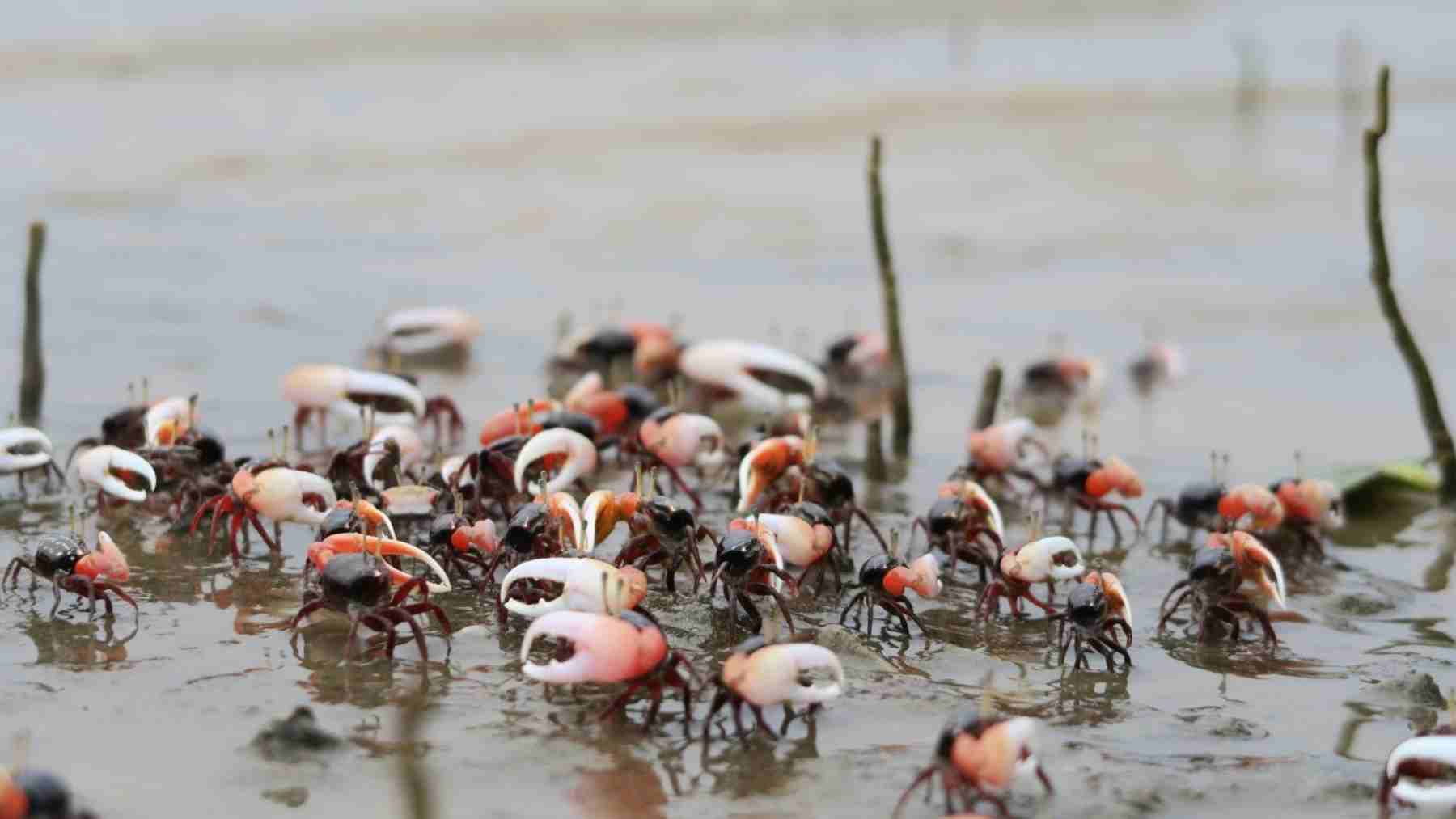
Fiddler crabs are small shoreline crabs with one oversized claw that looks like it is waving. They spend much of their lives digging burrows and shuffling mud, which makes them a kind of “ecosystem engineer” that changes how the shoreline works.
They also feed in a way that can backfire in a polluted world. The crabs scoop up sediment, pick out edible bits, and spit the rest back out, so any plastic mixed into that mud can get a free ride into their bodies.
That matters because mangroves are natural traps. Their dense roots slow water down like a living strainer, catching leaves, silt, and, increasingly, plastic that breaks into smaller pieces over time.
Inside the mangrove experiment
In work released on December 17, 2025, researchers from Universidad de Antioquia, the University of Exeter, and the Corporation Center of Excellence in Marine Sciences, known as CEMarin, focused on mangroves near Turbo in the Gulf of Urabá on Colombia’s Caribbean coast. They tracked a fiddler crab species roughly 1.2 inches wide and about a tenth of an ounce, small enough to fit in your palm.
To see what the crabs did with plastic, the team marked out five small mangrove plots, each about 11 square feet, and added glowing polyethylene beads, a common plastic used in everyday packaging. Over 66 days, they sampled the soil and collected 95 crabs, then checked where the particles went and whether the crabs physically changed them. “We set out to answer three specific questions,” said Professor José M. Riascos, pointing to uptake, where particles end up in the body, and whether feeding breaks them into smaller pieces.
The results showed the crabs concentrated plastic far more than the mud around them in a place the team described as having “some of the highest levels of plastic contamination reported anywhere in the world,” with most particles ending up in the hindgut, the back end of the digestive tract, and other digestive tissues, followed by the gills.
About 15 percent of the particles were fragmented, and female crabs were more likely than males to carry those broken pieces, which could make the smallest bits more available to other animals. Daniela Díaz said animals are “not just passive” in polluted ecosystems, and ecotoxicologist Tamara Galloway said “the converse is less often studied” when it comes to how wildlife can reshape plastic pollution.
From microplastics to nanoplastics
Microplastics are usually defined as plastic pieces about 0.2 inches across or smaller, which is why they can hide in sand, dust, and sea spray. Nanoplastics are far smaller, under about one twenty-five-thousandth of an inch, and they are small enough that researchers worry they can move into cells and tissues.
When plastic shrinks to that scale, it behaves less like a pebble and more like smoke. It can slip through tiny gaps, spread through water more easily, and end up inside animals that never bite plastic bags or bottle caps.
A U.S. government summary of a January 2024 study shows how common those tiny pieces may be in daily life. Using a laser-based method, researchers measured about 240,000 plastic particles in a bottle holding about 34 fluid ounces of water, with most of those pieces in the nanoplastic range. How do you filter something you cannot even see?
What this could mean for seafood
On its own, a fiddler crab is not usually someone’s dinner. But it is dinner for many birds and fish, and those predators can pass whatever they eat up the chain, step by step, until it reaches larger species people actually buy at the grocery store.
The key detail in the crab study is that plastic was found not only in the gut but also in the gills, which are in constant contact with the water the animal breathes. That raises a practical question for follow-up work, which tissues hold onto the smallest particles, and for how long.
When it comes to human health, the most responsible answer right now is also the most frustrating one. The U.S. Food and Drug Administration notes that studies have reported microplastics and nanoplastics in foods including seafood, but the current evidence does not show that the levels detected in foods pose a risk to human health, in part because measurement methods are still inconsistent. So your shrimp basket is not a verdict, but it is part of a bigger monitoring puzzle.
Why it matters beyond one shoreline
This study adds to a bigger shift in how scientists think about plastic pollution. Sunlight, waves, and sand can slowly break plastics down, but living creatures can also change plastic’s shape and size, sometimes on surprisingly short timelines.
That is not necessarily good news. Faster fragmentation can mean faster dispersal, and smaller particles are harder for cleanup tools, filters, and even lab tests to catch, which complicates everything from beach cleanups to seafood monitoring.
Related research in Marine Environmental Research reports that many mangrove organisms can physically wear down plastic surfaces through a process known as bioerosion. It suggests mangrove mud can act like a workshop where plastic gets scuffed up long before it ever reaches open ocean.
The main study has been published in Global Change Biology