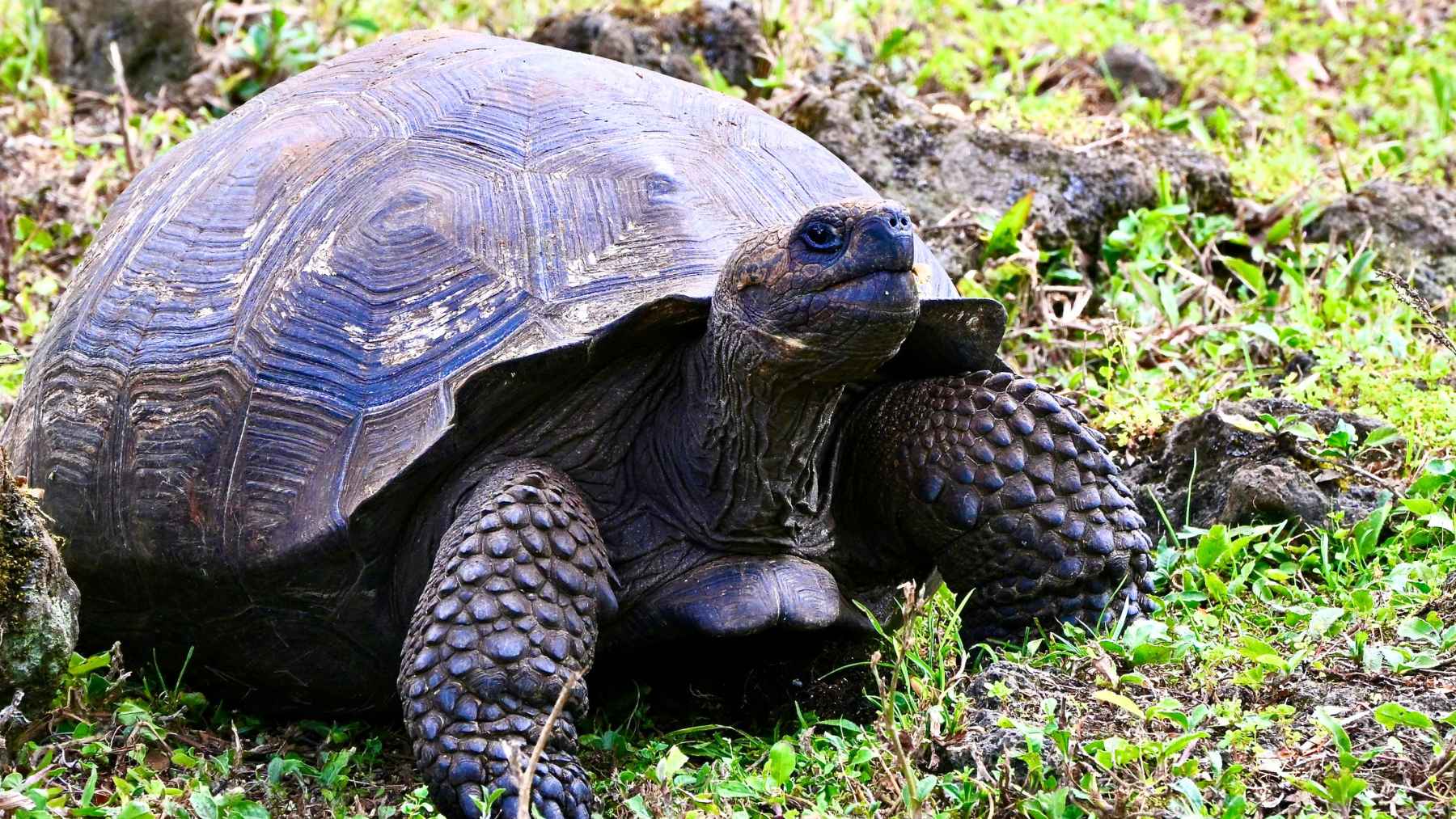
The Galápagos giant tortoise is one of those animals almost everyone recognizes, tied to Charles Darwin and the story of evolution. But in the late 1900s, parts of the tortoise’s home were being stripped bare by an unexpected invader, feral goats. How do you save a slow-moving species when the ground itself is changing around it?
A restoration campaign called Project Isabela answered with a mix of tough choices and new tools, including helicopter hunting, GPS mapping, and social-tracking animals known as “Judas goats.” A peer-reviewed analysis led by Victor Carrion, with coauthors C Josh Donlan, Karl J Campbell, Christian Lavoie, and Felipe Cruz, says the effort removed more than 140,000 invasive goats and helped damaged habitats start to recover.
Why invasive goats became a tortoise problem
“Invasive species” are plants or animals that people bring to a place where they did not evolve, and they spread fast. On islands, that can be especially brutal because native wildlife often has no defenses against new grazers or predators.
Read More: {{post_title link:post}}
People first brought goats to the islands, and the animals later formed feral herds. Feral goats eat seedlings, shrubs, and even bark, turning forests into open, dusty ground. On the slopes of Galápagos volcanoes, that meant less shade and fewer damp spots that hold water, which matters a lot during the dry season.
Giant tortoises are sometimes called “ecosystem engineers” because their grazing and seed spreading shape the landscape for other species. When their feeding areas and shady resting places disappear, the whole system starts to wobble. It is a chain reaction.
Project Isabela’s all-in strategy
Project Isabela ran from 1997 to 2006 and was built as a joint push by the Charles Darwin Foundation and the Galápagos National Park Directorate. In practical terms, that meant clearing goats from northern Isabela and from Santiago and Pinta, while also removing pigs and donkeys in some places.
The scale was hard to picture, and that is part of why the plan drew global attention. The 2011 peer-reviewed study calls Project Isabela the world’s largest island restoration effort of its time, and it describes more than 1,200,000 acres cleared of goats at a cost of 10.5 million dollars.
It also highlights a truth that shows up in regular life, not just conservation. The first steps can be fast, but the last steps are the slowest and most expensive. Anyone who has ever tried to clean up the last bits of glitter knows the feeling.
Helicopters and aerial marksmen
Much of northern Isabela is steep, rugged, and roadless, so teams leaned heavily on helicopters. The study says helicopter crews, working with trained aerial shooters sometimes described as “snipers,” removed more than 55,000 goats from April 2004 to May 2005, with GPS used to record locations.
Read More: {{post_title link:post}}
Helicopters did more than move people. They let crews spot goats in rough lava terrain and respond quickly before animals scattered into cover, which is a big reason the approach worked when herds were still large.
Ground teams with dogs were used in dense vegetation where aircraft were less efficient, especially as herds thinned out. Even so, the study reports that ground hunting accounted for a much smaller share of kills on Isabela, showing how much the campaign depended on speed and reach from the air.
The idea behind “Judas goats”
Once goat numbers fell, the survivors changed their behavior, hiding and avoiding helicopters. How do you find the last few animals when the island is massive and full of lava fields?
Read More: {{post_title link:post}}
Teams captured goats, sterilized them, and fitted them with radio collars so their locations could be tracked. The paper says more than 700 Judas goats were deployed across Isabela and checked thousands of times from the air, while GPS helped crews log where remaining goats were found.
The researchers also describe a special version called “Mata Hari goats,” sterilized females given hormone implants to keep them seeking mates for longer periods. By the end of monitoring on Isabela, the paper says 266 Judas goats were left behind as a future monitoring tool in case goats returned. A separate 2004 study on Pinta Island goat eradication describes how radio-collared Judas goats can make the final phase of removals possible.
What the islands looked like after removals
When intense grazing pressure lifted, the point was to let native habitats regrow, which in turn supports tortoises and other endemic wildlife. In a statement marking decades of conservation work, the foundation said research in the islands is meant to have “practical implications” for how people and nature coexist.
In simple terms, the project aimed to bring back the basics. More shade, more moisture in key areas, and more of the native vegetation tortoises and other species rely on.
The change was not magically perfect, and the study points to new challenges that can follow success. On Santiago, for example, some invasive plants expanded after goats were gone, a reminder that restoration often needs follow-up work.
The lasting debate and the risk of reinvasion
The methods used in Project Isabela were controversial because they were lethal and highly organized. Supporters argued that the alternative was a slow collapse of native habitats, while critics questioned the ethics and the optics of large-scale killing.
Read More: {{post_title link:post}}
The cost story is also striking. On Santiago, the analysis reports that removing the last 1,000 goats took about 18 months and cost 2 million dollars, which shows how “ending” a problem can be harder than starting it.
Then there is the reinvasion risk, which the study treats as a real and expensive threat. It reports at least twelve intentional goat introductions or reintroductions in the archipelago since 1990, including a case in 2008 where a goat was introduced to Wolf Island, more than 60 miles from the inhabited islands.
The main study has been published in PLOS One.