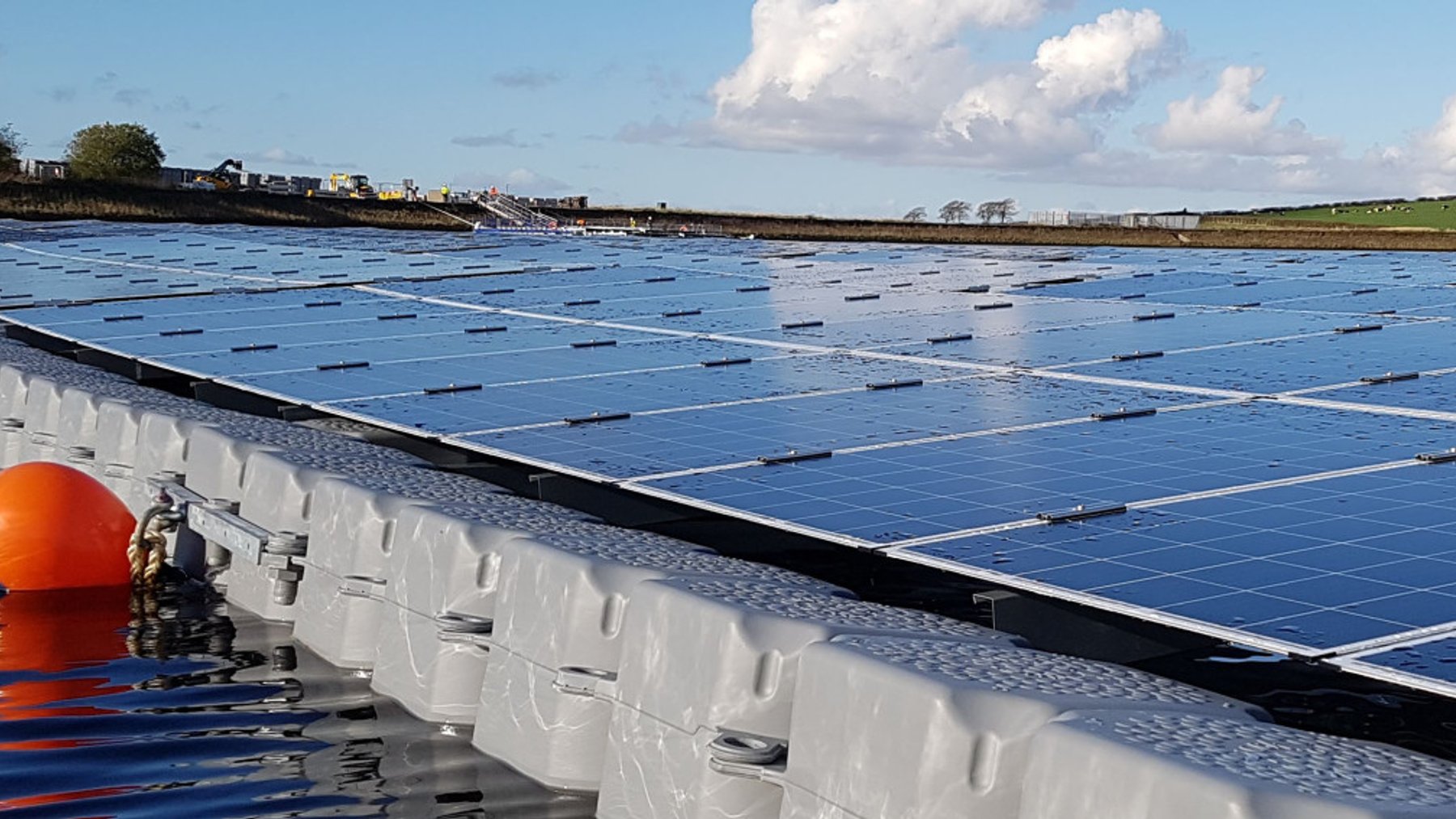
Just outside London, more than 23,000 solar panels float on the Queen Elizabeth II Reservoir, quietly producing electricity for a nearby water treatment plant. The 6.3-megawatt installation was built to use an already occupied surface without covering farmland. A decade later, research suggests the more interesting story may be what floating solar can do for the water beneath it.
By shading and sheltering part of a reservoir, these arrays can reduce evaporation and change conditions that support some algal blooms. Birds may also use the structures for perching or resting, although evidence at this particular reservoir remains anecdotal. So, is this a clean-energy shortcut for a crowded island, or another technology that needs careful rules?
A solar farm assembled like a giant raft
Completed in March 2016, the project was then Europe’s largest floating solar farm, with 23,046 photovoltaic panels resting on 61,000 floats near Walton-on-Thames. Workers assembled the system on shore, pushed it onto the water, and secured it with 177 anchors in the reservoir bed. From a distance, it looks more like a dark geometric island than a power plant.
The 57,000-square-meter array covers less than 10 percent of the reservoir and has a capacity of 6.3 megawatts. Lightsource bp says it can generate about 5.8 million kilowatt-hours a year, roughly the annual electricity use of 1,800 homes. Instead of supplying those homes, the power feeds Thames Water’s private network and meets around one-fifth of the nearby plant’s energy needs.
Why a reservoir can be a smart place for solar
Britain does not have endless land, and new solar farms can trigger arguments over farming, landscapes, and planning. A drinking-water reservoir is already working infrastructure, so placing panels on a limited part of its surface avoids converting another field. Food production can continue elsewhere.
Reservoirs also place generation beside energy-hungry infrastructure. Pumps, filters, and treatment equipment operate for long hours, so the electricity can be consumed close to where it is generated, even if it does not make the electric bill disappear. In practical terms, the sun helps move water toward the tap.
The shade can save water and improve performance
Solar cells lose output as module temperatures rise. A 2024 global study adjusted modeled output upward by 10 percent to reflect the efficiency advantage reported for floating systems, although real performance depends on climate, equipment, and design. That matters during sticky summer heat, when panels are producing strongly but also getting hotter.
The clearest environmental co-benefit is water conservation. A 2024 systematic review examined 422 pieces of evidence on floating solar and freshwater systems, including 114 related to water-use efficiency, and every one found reduced evaporation or increased water savings. Shade blocks some direct sunlight, while the structure can also shelter the surface from wind.
What about cleaner water? Less light and lower surface temperatures may discourage certain harmful algal blooms, and computer modeling has shown that floating arrays can cool water and change seasonal layering. But some designs could worsen oxygen loss in deeper water, which is why UKCEH lake ecologist Dr. Steve Thackeray called for potential impacts to be “factored in during the design of future deployments.”
Birds may gain resting places, but evidence is still thin
Researchers have observed herons perching and cormorants competing for space around floating solar arrays. A 2025 Nature Water paper examined how these structures might provide perching, nesting, or refuge opportunities. That makes a resting place away from shoreline predators plausible, but it does not prove a benefit at the London reservoir.
The claim should not outrun the evidence. Only a small number of studies have directly measured wildlife responses, and arrays could interfere with landing, feeding, or movement depending on their layout. For now, the bird story at Queen Elizabeth II Reservoir should be treated as anecdotal rather than a measured ecological result.
The practical lesson is simple. Floating solar can be planned around open-water needs, site layout, and wildlife monitoring instead of treating biodiversity as an afterthought. Clean power and healthy habitat can share the same water, but only when engineers and ecologists plan together.
Britain is looking at floating solar again
In an April 2026 House of Commons debate, the government called Queen Elizabeth II Reservoir “a fantastic example of floating solar” and highlighted its clean generation and water-retention benefits. Officials said the technology should expand and that more projects were in the pipeline. The politics have moved slowly, but the idea is no longer a curiosity.
Global potential is significant, although reservoirs are not a complete energy answer. Researchers estimated that covering 10 percent of nearly 68,000 suitable lakes and reservoirs could generate about 1,302 terawatt-hours a year worldwide, while the modeled capacity factor for the United Kingdom was about 12 percent. Cloudy winters still matter.
At the end of the day, this reservoir does not prove that every lake should be covered with solar. It shows that carefully sited arrays can make electricity, conserve land, and potentially support water management, provided wildlife and water quality are monitored from the start.
The official parliamentary record was published on UK Parliament.
Photo: Giles Exley / Lancaster University.