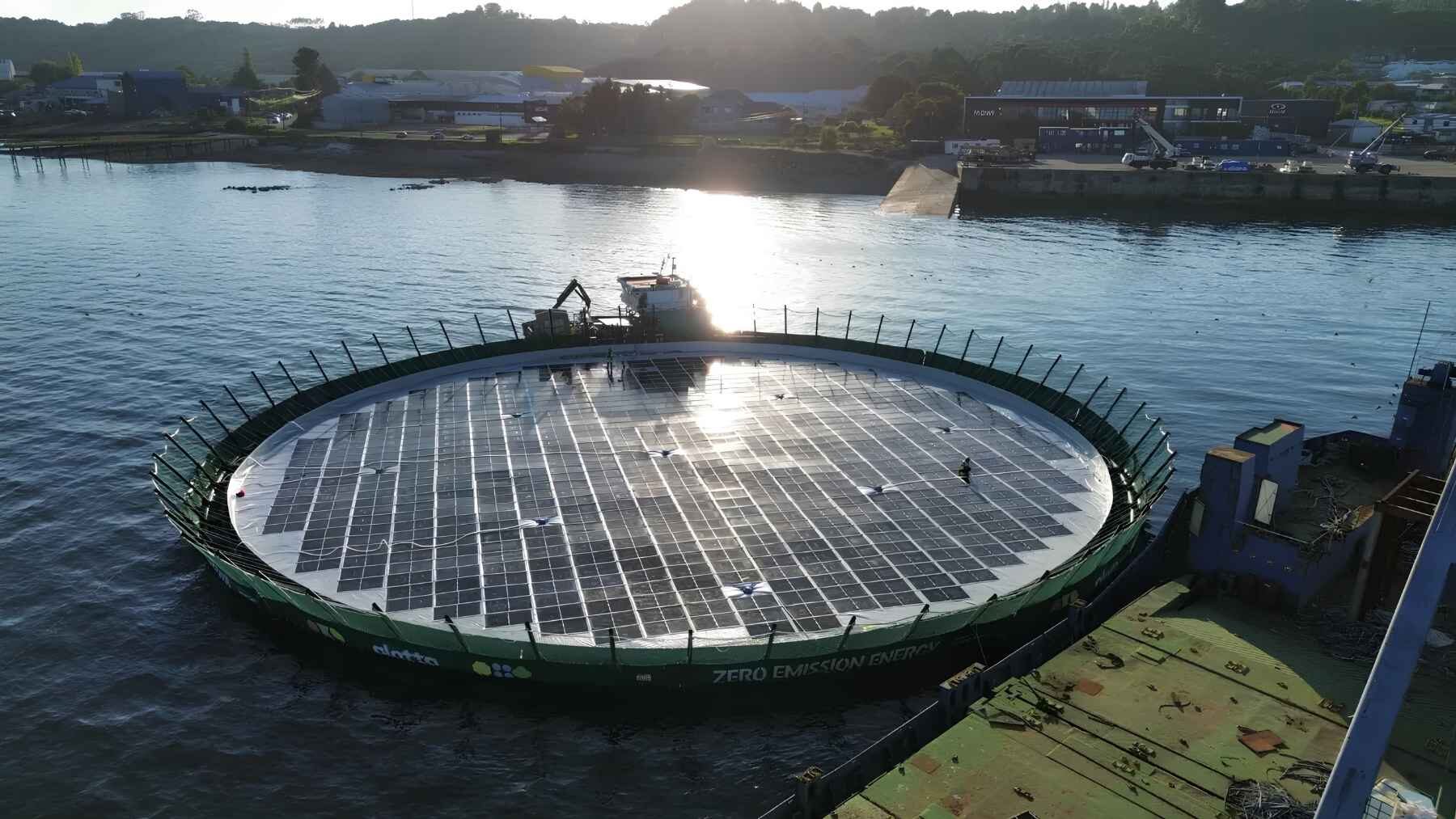
Today we will be going down to South America, specifically in southern Chile in front of a small island called Huar. And what is there? A salmon farm that is 50-meter circular platform. It is all covered with marine-grade solar panels, that actually nowadays powers much of a feeding barge. The curious thing about this project is that actually in a May 2026 operating update, project partner AKVA group Chile reported that this complex but simple hybrid system was reducing diesel consumption by 40% to 50%, while also supplying a similar percentage of electricity. Can you imagine pulling off that kind of energy savings right in the middle of open water?
And yes,the farm still keeps diesel generators available, but the project itself is designed to prioritize sunlight and stored battery power before using diesel as backup.
A floating power plant built for the sea
But what about the rest? Well, this installation has approximately 300 kWp of capacity and is expected to generate about 350,000 kWh annually. Also, the photovoltaic panels are not on land or under a conventional roof. Can you guess where they are?
They sit inside a low-profile circular structure designed for nearshore marine conditions.
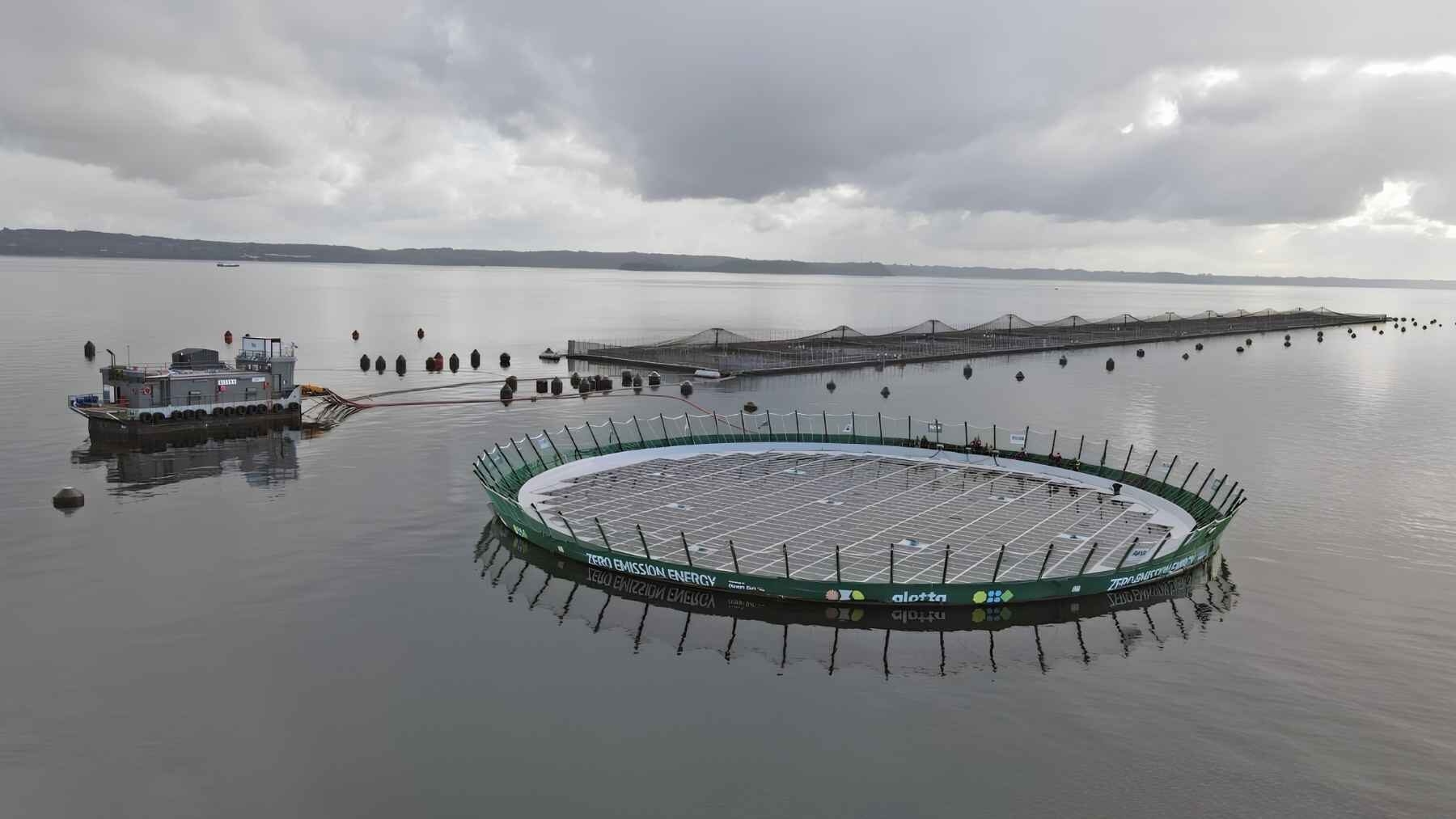
For everything to work as it should, the system must tolerate saltwater, wind, waves, changing weather, and fluctuating electricity demand. This whole installation is designed to first prioritize solar energy, then the batteries, and finally the generators. All this allows the operations to continue when the sunlight is not anymore a possibility.
The generator has not disappeared
As was said before, the system cannot stop working when the sunlight disappears. Taking into account that solar output changes with weather and seasons, so batteries handle shorter gaps, and the diesel generator remains available during long periods of low energy generations or high peak demand.
So, Huar Norte is not a system that is completely free from the use of diesel. But what this hybrid system really does in the end is make diesel the last energy source selected, instead of using it as the first automatic choice.
Fewer fuel trips and less noise
And as you might imagine, using less diesel also reduces the number of boat trips required to deliver fuel. Mowi and AKVA say the system also improves working conditions because the generator produces less noise.
But this might not be the same for fish. Although these can be low-frequency sounds, a reviewed experiment found that this sound exposure might have caused neurological changes associated with chronic stress in farmed Atlantic salmon.
Four partners divide the work
This project has many actors. Mowi is the one that operates the salmon site, AKVA group was the one that supplied the floating infrastructure and the whole integration, maintenance, and service, and Alotta was the one that delivered the solar system and renewable electricity, while Fjord Maritime provided the batteries and energy-management technology.
It was under the commercial arrangement that Alotta installs, owns, and maintains the solar equipment while, at the same time, Mowi purchases the electricity it produces.
A model with room to grow
Huar Norte is a great example for the world as a way to show that remote marine operations can substantially reduce fossil fuel use without needing a connection to shore power.
Here the system has not eliminated diesel, as it is still important to have that supply for moments of low solar energy. However, the reported 40% to 50% reduction represents a big change toward renewable power for isolated aquaculture sites.
The official announcement was published on Mowi Chile.