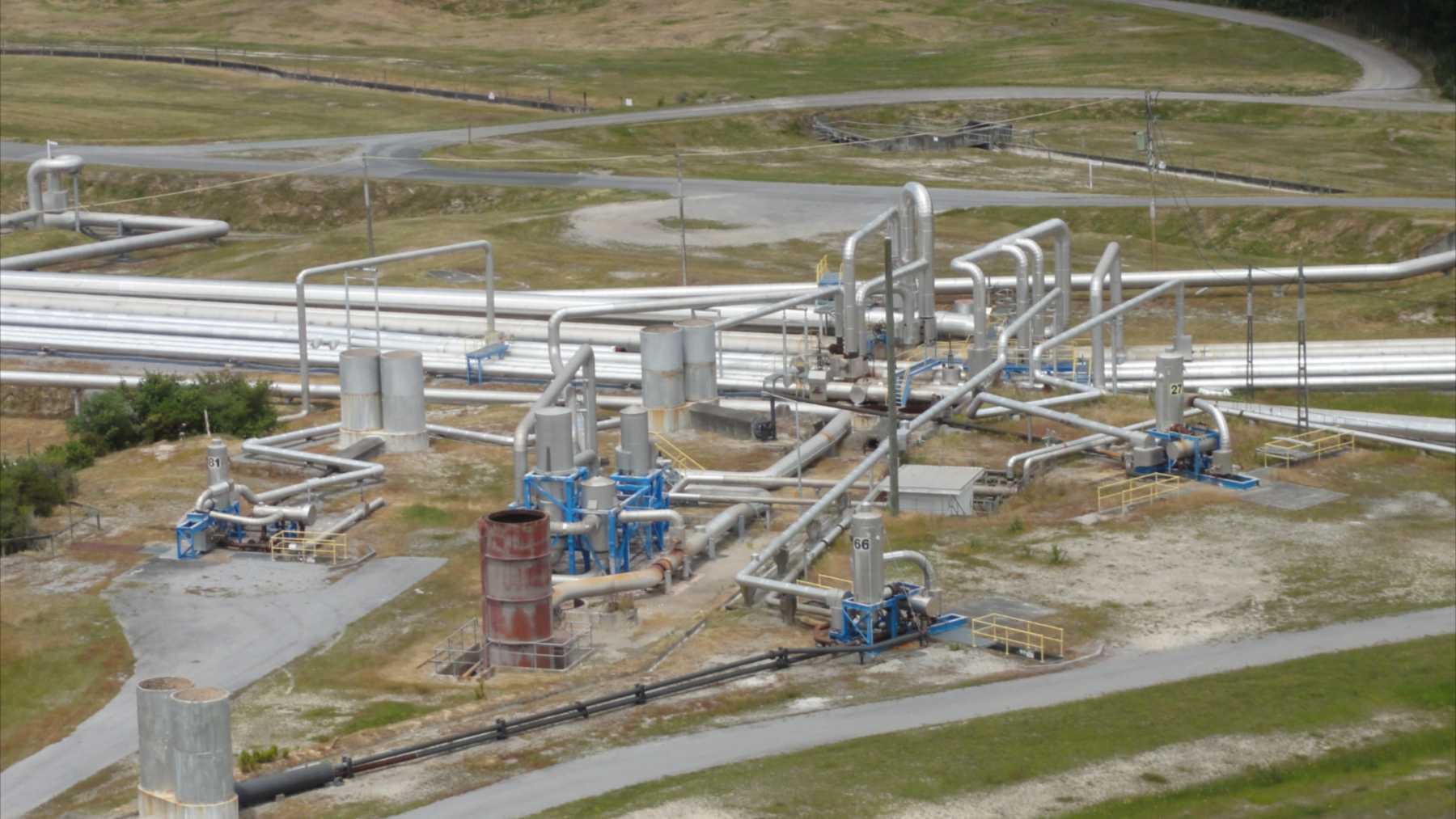
The Wairakei geothermal power station, on a steamfield just north of Lake Taupō on New Zealand’s North Island, generated its first power on Nov. 15, 1958, and it is still running 68 years later while its owner builds the plant that will start to replace it.
It was the world’s second geothermal power station and “the first to utilise flash steam from geothermal water as an energy source,” according to the New Zealand Geothermal Association. Flash steam is hot water under pressure that partly boils into steam once it is brought to the surface and the pressure drops.
Built after a war and a drought
New Zealand came out of World War II short of electricity, and a two-year drought pushed the government to look at geothermal heat alongside its hydro dams, as Contact Energy recalled when the station turned 60 in 2018, in a note reported by ThinkGeoEnergy. Investigation and drilling at Wairakei started in 1949, and in 1956 a consortium from New Zealand, Britain and Switzerland was contracted to build it.
Construction of stages 1 and 1A, with 102 megawatts between them, “began in 1956 and finished in 1960,” the geothermal association says, and Stage 2, with 90 megawatts, “finished commissioning in October 1963, bringing the total nameplate capacity to 191 MW(e).”
“For six decades Wairakei has been acknowledged as a world-leading source of continual innovation,” Dennis Barnes, then chief executive of Contact Energy, said at the anniversary.
Why flash steam changed geothermal power
Before Wairakei, the only geothermal power station in the world was at Larderello in Tuscany, where Piero Ginori Conti lit five light bulbs with geothermal steam in 1904. “The Larderello geothermal power plant in Tuscany is the oldest dry steam power plant in the world,” the U.S. Department of Energy notes, and dry steam can be piped almost straight into a turbine. The region is still a focus for geologists, who recently reported a vast magma reservoir beneath Tuscany.
Wairakei’s reservoir holds mostly very hot water instead. The Engineering New Zealand heritage record of the project describes that water being sent into “silencers where a drop in atmospheric pressure causes some of it to flash,” while the steam separated from it drives the turbines.
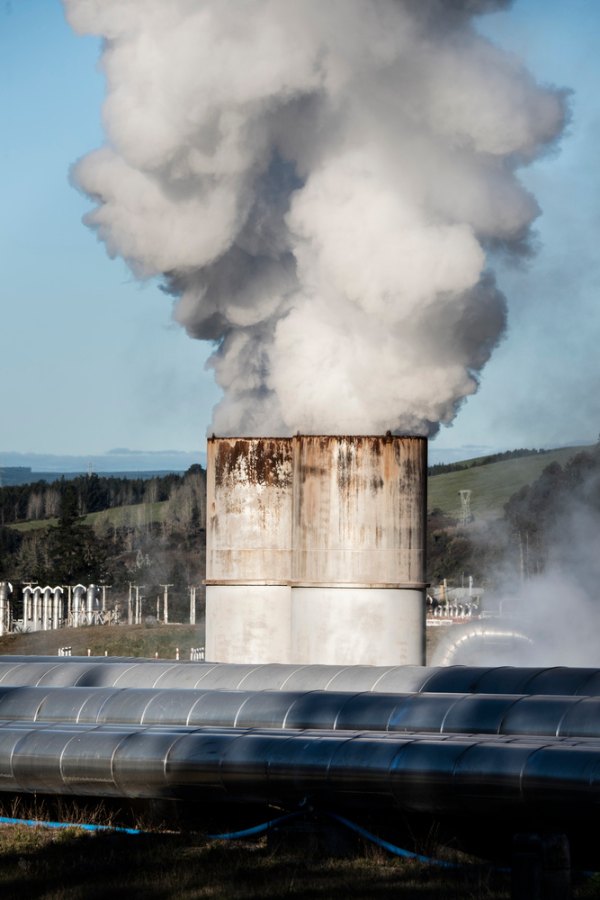
“By proving that ‘wet steam’ could reliably produce electricity, New Zealand scientists unlocked the global potential of geothermal energy,” the national research institute Earth Sciences New Zealand says in its history of the project. Its predecessors’ work revealed how “heat, fluids and fractured rock interact deep within the Taupō Volcanic Zone,” which enabled “safer drilling, efficient steam separation and long-term geothermal field management.”
Flash plants use fluids “at temperatures greater than 182°C/360°F,” according to the Department of Energy, which adds that “flash steam plants are a common type of geothermal power plant in operation today.”
Wells drilled deep into a volcanic zone
The field covers about 8 to 10 square miles (20 to 25 square kilometers) and lies 5 miles (8 kilometers) north of Taupō along State Highway 1, according to the geothermal association. It sits inside the Taupō Volcanic Zone, a belt about 155 miles (250 kilometers) long and 31 miles (50 kilometers) wide, the Engineering New Zealand record says.
More than 290 wells have been drilled there, and the association counts 73 producing wells and 19 injection wells, which send used fluid back underground. Most of the early wells were shallower than about 3,300 feet (1,000 meters), the deepest now reaches about 9,880 feet (3,012 meters), and the hottest reading is 522°F (272°C) at about 3,600 feet (1,100 meters).
“The earth is hot here,” Paul Ware, project manager of the nearby Nga Awa Purua geothermal station, a joint venture of Mighty River Power and local iwi, told New Zealand Geographic. “Two shovels deep the temperature is already 60 degrees,” he said, meaning Celsius, or 140°F.
John Searle, that project’s chief engineer, told the magazine that “there is so much untapped potential under our very feet,” because “these are small reservoirs of high-temperature steamfields which are self-discharging, meaning you don’t have to pump them.”
Decades of production changed the ground
Before development, Wairakei “contained geysers, hot springs, and sinter terraces scattered along ‘Geyser Valley,'” the association writes. Pulling steam and water out of the reservoir “drew down ground water levels at Wairakei and curtailed the geysers and associated alkaline springs.”
The pressure drop reached the surface as well, and at one spot subsidence from 60 years of operations lowered the surface by more than 49 feet (15 meters) within a circular “bowl,” and some shallow aquifers cooled by up to 180°F (100°C).
“It has to be a closed system, otherwise you can end up draining the steamfield so it no longer yields workable pressure, which is why there are no more geysers at Wairakei or Craters of the Moon,” Ware told New Zealand Geographic.
Falling pressure also hit the station itself. In 1982, the New Zealand Electricity Department decommissioned two high-pressure units and cut the plant’s capacity to 153 megawatts, and in 1995 the government spun the Wairakei assets off into Contact Energy.
A plant built beside the river
Location was part of the problem. “When they built Wairākei Power Station in the 1950s they didn’t fully understand that it was more efficient to have power stations closer to the steam source. Their focus back then was on being close to the river so they would have access to water to cool the power plant,” Mike Dunstall, Contact’s general manager of geothermal resources, told the Rotorua Daily Post in 2022.
The main upflow of hot fluid lies along the western edge of the field, in the Te Mihi area, at about 509°F (265°C), the association says. Contact already runs a station there, and the old plant by the Waikato River now has a maximum capacity of 133 megawatts from 10 steam turbines and produces about 1,062 gigawatt hours a year, according to the company.
Te Mihi Stage 2 takes over
In November 2024, Contact approved Te Mihi Stage 2, a 101-megawatt plant costing NZ$712 million, as the first step in replacing Wairakei. “Moving to this phased re-development plan for Wairakei, including the partial extension of the Wairakei station to 2031, has proven up to be the highest returning option for Contact shareholders,” said Mike Fuge, Contact’s chief executive.
The new station is a binary-cycle plant, in which geothermal fluid heats a second liquid, isopentane, until it vaporizes and spins a turbine. Contact expects it to produce about 840 gigawatt hours a year, enough for the equivalent of 120,000 New Zealand homes, and says “construction began in November 2024 and is expected to come online in September 2027.”
Ormat Technologies is building the two-unit plant under an engineering, procurement and construction contract. “We are thrilled to partner with Contact Energy on this landmark geothermal project,” Doron Blachar, Ormat’s chief executive, said, as reported by ThinkGeoEnergy.
Under Contact’s plan, 67 megawatts keep running at the old station from mid-2027 until mid-2031, when its resource consent ends. In its results for the year, released in August 2026, Contact said it “continues to extend its advantage as New Zealand’s geothermal leader, with construction well progressed at the Te Mihi Stage 2 geothermal development,” a project the company describes as a way to partly replace the output of the 1950s station.
What the new plants still leave open
Te Mihi Stage 2 will not match Wairakei on its own, since its expected 840 gigawatt hours a year fall short of the old station’s 1,062. A Te Mihi Stage 3 is expected online by mid-2031, but it is still subject to a final investment decision.
The reservoir sets its own limits too. “You can only take so much from it without upsetting its pressure balance, and our biggest challenge is finding the maximum sustainable yield which the steamfield can throw off almost in perpetuity,” Ware said.
What the field offers in return is steady power, since Wairakei is one of 17 geothermal stations that together “generate around 22 percent of New Zealand’s electricity,” according to Earth Sciences New Zealand, and Contact says such plants “operate all day, every day, because they are not reliant on the wind blowing or the sun shining.” New Zealand’s grid is also adding newer tools such as the 100-megawatt battery at Huntly Power Station, while in England a Cornwall project says it is now generating geothermal electricity from more than 3 miles underground.
Contact set out its plan for Wairakei and Te Mihi Stage 2 in an announcement to the NZX on Nov. 13, 2024.