Since we have been following modern astronomy, we have believed that the Universe had a violent, explosive and sudden beginning. This is because we follow the Big Bang model that says that everything, space, time, matter and energy, would have emerged from an infinitely small and dense point. This theory is taught in schools, universities and reproduced in science fiction works. However, it seems that everything is at stake now… what seemed to be an absolute consensus among physicists is beginning to be challenged by a bold new theory.
It seems that the Big Bang has flaws
Everyone tends to follow the Big Bang model, it’s true. But the truth is that it was never exactly flawless. Let’s remember: this theory says that the Universe began with a “singularity” — a point of infinite density where, basically, the laws of physics simply don’t work. And that’s exactly where many theoretical physicists raise their eyebrows. After all, if the theory leads us to something we can’t explain, is it really complete?
Another point that still leaves many people puzzled is the so-called cosmic inflation, a super-fast expansion that would have happened right at the beginning of the Universe. Although it sounds like an elegant idea to justify why everything seems so uniform out there, it depends on the existence of a hypothetical field that no one has ever actually seen. And it doesn’t stop there: the standard model also doesn’t fully explain where giant structures, like supermassive black holes, came from, nor what dark matter really is.
The origin of everything: inside a black hole?
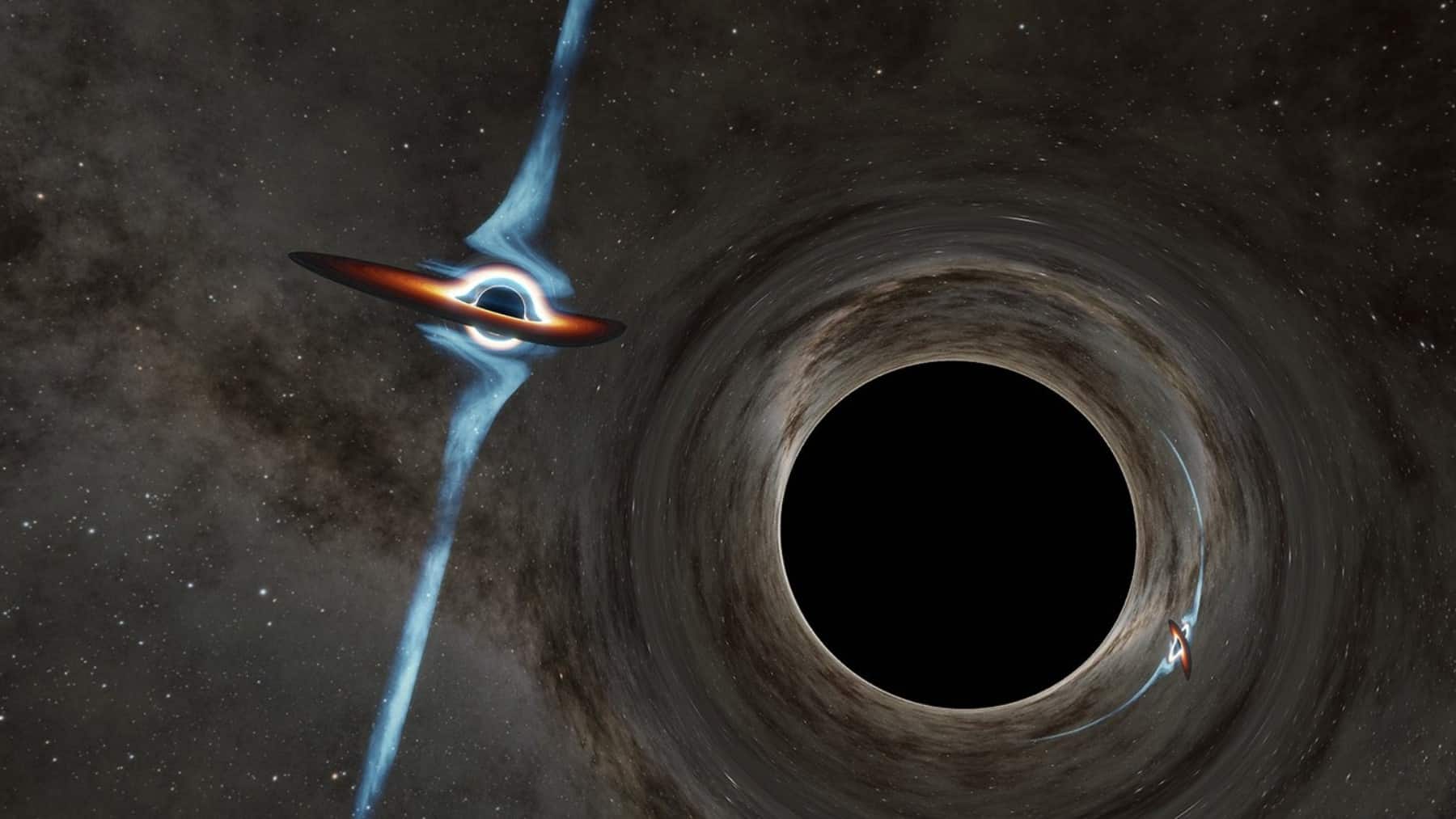
Recently, a group of scientists led by Professor Enrique Gaztañaga of the University of Portsmouth proposed a revolutionary model. He says that our Universe may have emerged inside a black hole (here comes the question: do we live inside a black hole?). According to this new theory, the Black Hole Universe, the cosmos would have formed not from nothing, but from the gravitational collapse of an immense cloud of matter into a “parent” universe. This collapse would have created a black hole, and inside it, the matter reached an extreme density. However, instead of forming a singularity, it would have “jumped” out in a rebound movement, initiating the expansion of a new universe: ours.
It sounds crazy, but this theory eliminates the need for a singularity and replaces the Big Bang with a cosmic cycle:
- Collapse.
- Compression
- Rebound.
- Rebirth.
The most impressive thing about all this is that this process respects the known laws of physics, without needing hypothetical fields or magical conditions. Furthermore, the rebound would naturally generate a phase of accelerated expansion, explaining the current structure of the Universe, but with a much more elegant origin.
How will this affect us?
Faced with so much new information, the question remains: what do we do with all this? One thing is certain: this discovery has enormous weight and could change much of what we know. First, the model predicts that the Universe is slightly curved, something that new measurements are already beginning to indicate, contradicting the idea of a perfectly flat cosmos. Second, this new way of looking at the Universe may finally help unlock some of the great mysteries that we have been facing for decades, such as where supermassive black holes came from and what dark matter actually is.
To test all these hypotheses, Gaztañaga is coordinating the ARRAKIHS mission, which will use space telescopes with innovative filters to detect faint structures at the edges of galaxies. This data could confirm (or refute) the predictions of the Black Hole Universe model and offer new clues about the true origin of the cosmos. Apparently, the James Webb Telescope has another important mission ahead… It just announced a historic discovery right here in our galaxy.