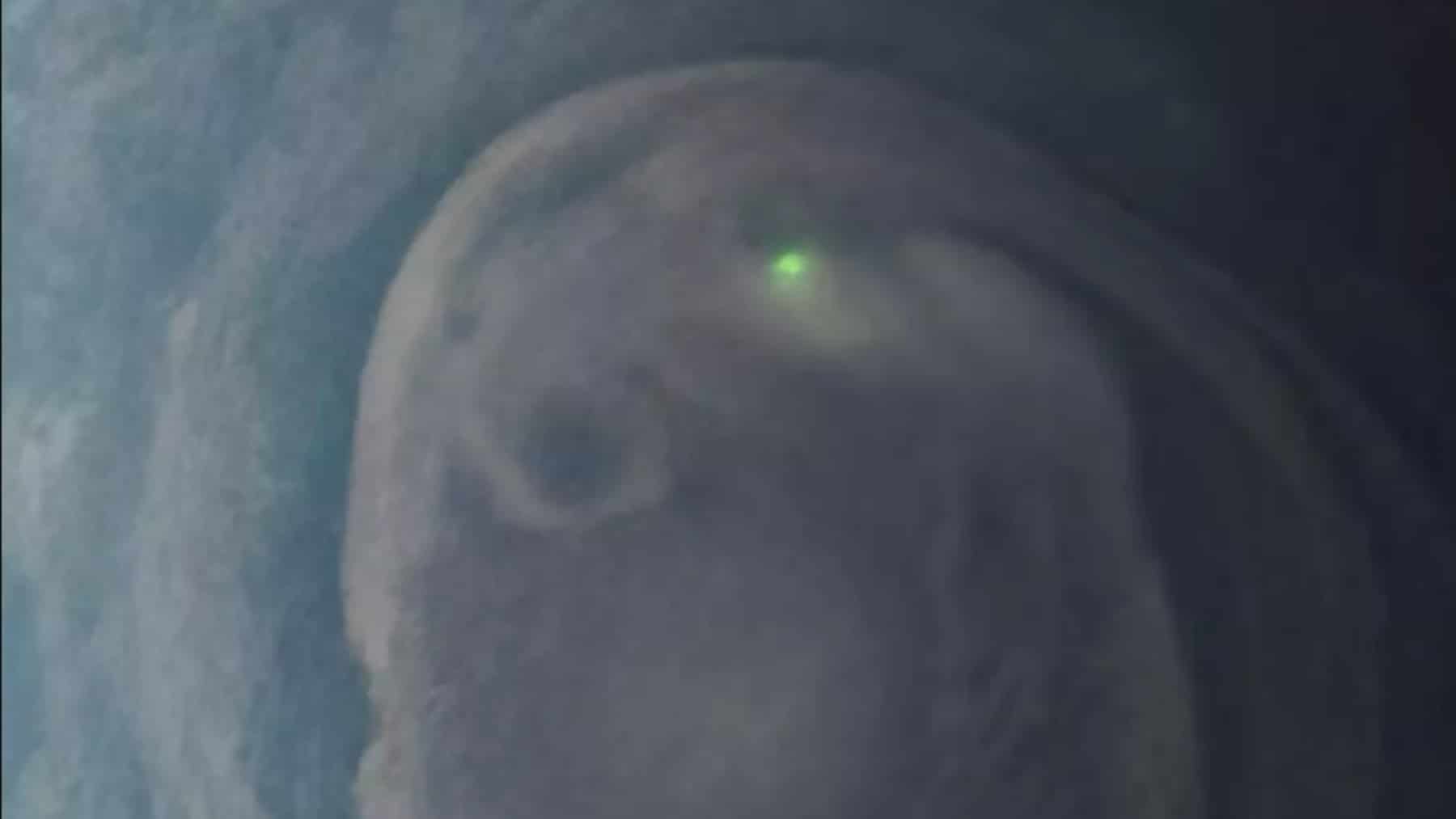
NASA has once again benefited from doing its due diligence as a company and remaining committed to making discoveries. This time, NASA spotted a mysterious green glow on Jupiter as it travelled at super-speed. This discovery opens up a lot of questions that need answering. What exactly is this mysterious glow? Is it new or has it always existed?
Coincidence or premeditated: How did NASA spot the mysterious green glow on Jupiter?
NASA is notorious for being the barrier between human beings and Space, as it provides information that is not easily verifiable. Sometimes, NASA coincidentally encounters new objects on the planets, but in this particular instance of a green light captured on Jupiter, the company was meticulous and intentional about the discovery.
NASA’s research on Jupiter has been years in the making, as the Juno mission spacecraft began exploring Jupiter in 2011 and arrived there in 2016. After a four-year wait, the Juno mission’s JunoCam captured an image displaying a green glow close to Jupiter’s north pole. The flash of light is said to have been travelling at breakneck speed, which makes the image captured even more astounding due to how tricky it is to capture objects moving at high speed. In typical NASA fashion, the image sparked rumblings about what the flash could be, and several hypotheses have been put forward.
Unpacking different interpretations: what is this mysterious green glow spotted on Jupiter?
In modern society, most scientists have access to advanced resources and technologies, so people often have different explanations of complex findings. The most widely accepted interpretation of the discovery made on Jupiter is that a lightning bolt caused it. Scientists have long established that lightning on Jupiter is vastly different from that found on Earth. On Jupiter, lightning is caused by clouds containing ammonia-water solution, and the lightning has previously been recorded as much more powerful than that on Earth. Kevin M. Gill is the scientist credited with producing a visible colour frame of the mysterious discovery.
Attempting to explain Jupiter’s mysterious green glow, which defies explanation
If something defies explanation, it opens up an avenue for multiple explanations to emerge. Some scientists have posited that the green glow could have emerged from Jupiter’s green gases that emit green light. Regarding the breakneck speed of the glow, a lot of clarification is required. One obvious question is: has the green glow always existed in Jupiter, but could not be captured for many years because of its fast pace? Has there been confirmation of this mysterious discovery’s continued existence, or was it a one-in-a-million kind of image? Only time will tell if all these questions can be answered with conviction and assuredness.
Analysing the relevance of NASA spotting a green glow on Jupiter: Does the discovery mean anything for Earth?
When NASA makes discoveries on any of the planets, human beings selfishly begin to decipher how the discoveries might impact Earth. Scientists clearly find Jupiter intriguing; hence, the Juno mission arrived there in 2016. Although NASA’s discovery of the green glow is a significant milestone, the lack of certainty surrounding its specification and description makes it difficult to interpret its possible effects on Earth. The sole key takeaway from the discovery is that scientists are aware that lightning is not just unique to Earth but exists in even more powerful forms on other planets.
It is commendable that the discoveries made by NASA on other planets can be captured through a spacecraft such as Juno. Nevertheless, the spacecraft has now received a glowing, green glimmer of hope to remain committed to its cause of studying Jupiter. The extremely fast, mysterious green glow spotted on Jupiter could be a prequel to a ground-breaking discovery that completely shakes up the Earth.