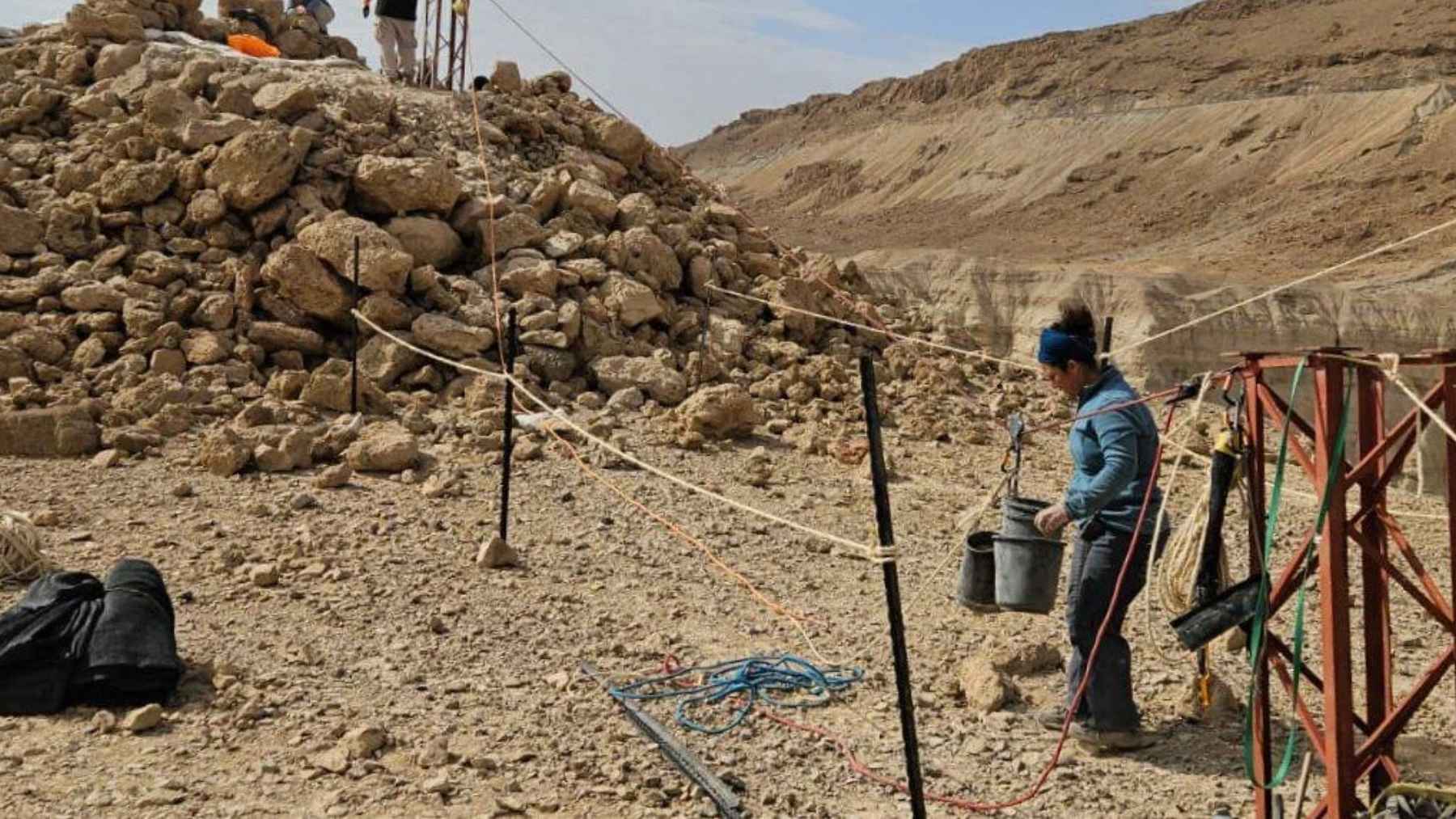
High above the Dead Sea, archaeologists are working through a collapsed stone pyramid that is about 2,200 years old and strangely hard to classify. From far away it looks like a plain mound, but up close it is built from huge hand-cut blocks that don’t match what experts usually expect from the area’s ancient ruins.
Early finds suggest this was not a lonely monument on a hill. Coins, papyrus scraps, and everyday objects point to a busy stop along a desert route where travel, trade, and government control all collided. So what was it really for, and who benefited most from its position?
A desert puzzle above Nahal Zohar
The excavation is taking place north of Nahal Zohar in Israel’s Judean Desert, with teams from the Israel Antiquities Authority and the Ministry of Heritage clearing rubble to expose the structure and what lies beneath it. The work is led by Dr. Eitan Klein, who focuses on protecting vulnerable desert sites that have long been targets for looters.
Beneath the pyramid, archaeologists have identified what appears to be a way station, basically a shaded stop where travelers could rest, store gear, or wait out the heat. Volunteers have already uncovered Greek writing, bronze vessels, weapons, textiles, and small personal items, the kind of mix you’d expect where people actually spent time rather than just passed through.
Why coins and papyrus are such a big deal
The site dates to the Hellenistic period, when Greek-style kingdoms ruled large parts of the eastern Mediterranean after the empire-building era that followed Alexander the Great. Bronze coins tied to Ptolemaic rulers and to the later Seleucid king Antiochus IV place activity here in the third and early second centuries BCE.
The papyrus fragments may end up being just as important as the coins, even though they look like fragile scraps. Papyrus is a writing material made from pressed reeds, and it normally rots away, but the desert’s dry air can preserve it for centuries, even millennia, like papers kept in a perfectly dry drawer.
A rescue dig shaped by looting pressure
This excavation is also part of a wider push to save desert heritage before it disappears into the black market. Over recent years, specialist survey teams have mapped long stretches of cliffs and identified roughly 900 caves, many of them reachable only with rope gear and careful climbing.
That effort has already recovered thousands of artifacts, including rare organic items that almost never survive in wetter places, like textiles, wood, and leather. A 2021 government announcement about the same desert campaign described newly recovered biblical scroll fragments and a remarkably preserved woven basket dating back about 10,500 years, a reminder of just how much history can sit untouched in dry rock for ages.
Salt, bitumen, and the economics of a harsh landscape
To understand why anyone would build big in a place like this, it helps to think about what the Dead Sea region produced. Salt was valuable, and so was bitumen, a natural tar that could be used to seal containers, waterproof surfaces, and help protect boats and buildings from leaks.
Science has also backed up how far that material traveled. A 2017 chemical analysis paper linked Dead Sea bitumen to Egyptian mummification balms, showing how desert resources could move across borders through trade networks that sound ancient but worked a lot like supply chains today.
That trade context makes one leading idea feel plausible, that the hilltop complex helped monitor traffic and taxes along a key route. “This pyramidal structure we discovered is huge, and made of hand-hewn stones, each one weighing hundreds of kilograms,” Klein said, as researchers weigh whether the site began as a fortified post and later changed roles, possibly even becoming a monumental grave in Roman times.
The press release was published on Israel Antiquities Authority.