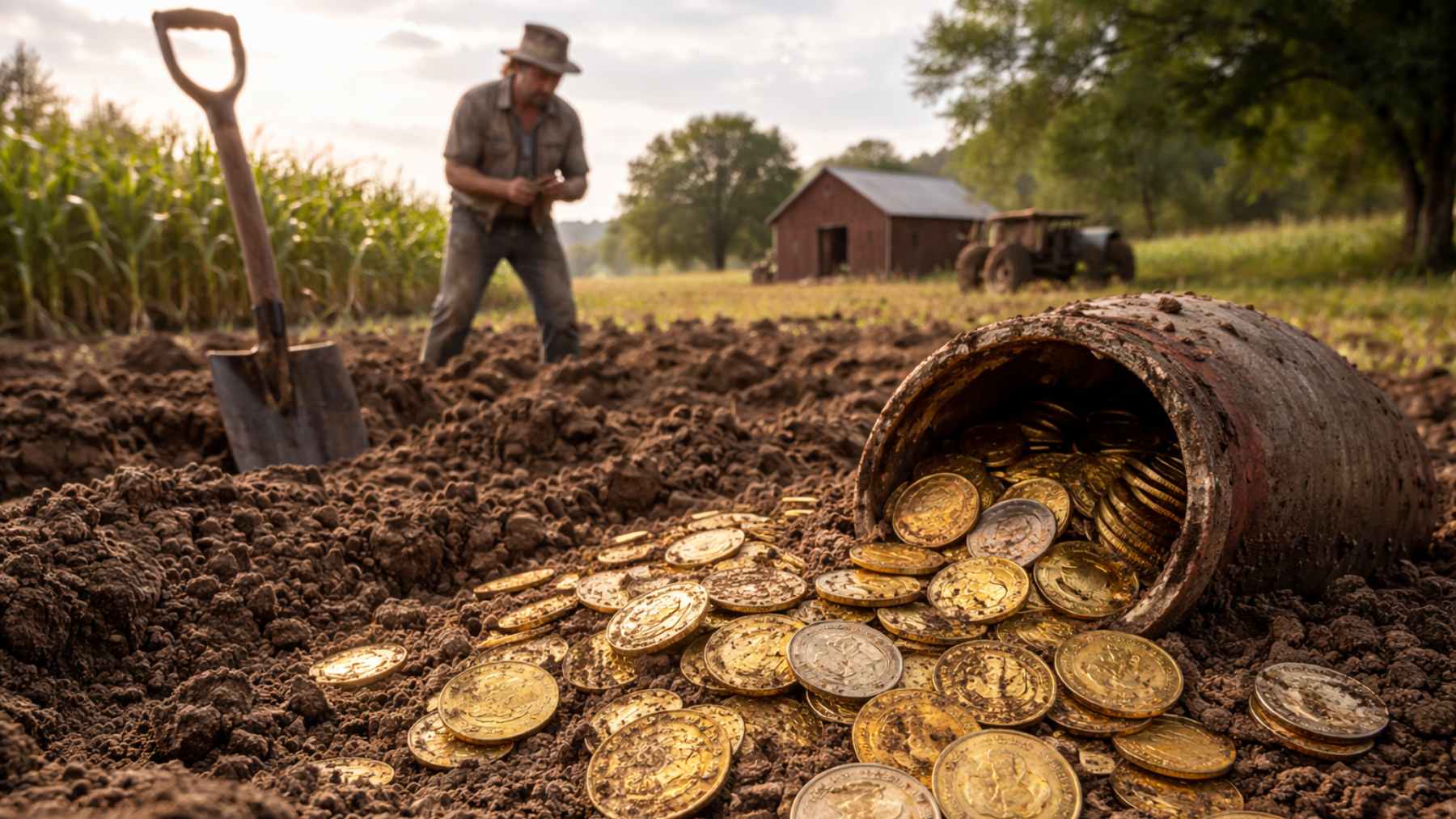
Most of us have daydreamed about stumbling across buried treasure while doing chores in the yard. For an anonymous corn farmer in Kentucky, that fantasy became real when he uncovered hundreds of coins while checking a freshly plowed field on his land. Who expects a surprise like that on a workday?
The find turned out to be a cache of Civil War era money now known as the Great Kentucky Hoard. Experts say the collection includes more than 800 coins, most of them gold, and that the stash is worth well over $3 million to modern collectors.
A walk across a plowed field that changed everything
According to reporting from News Talk 96.5 KPEL, the farmer was doing what he always does after working his cornfield, walking the rows and scanning the soil for anything unusual. He says he found his first coin on the same land at age nine, which is why he still checks the ground so carefully today.
On this day he first spotted a 19th-century silver half dollar, then noticed what he called a glint of gold and pulled out a gold twenty-dollar piece. Over the next hour he dug with his hands as more coins spilled from the loosened soil, until he had collected more than 800 pieces, about 770 of them made of gold.
What is inside the Great Kentucky Hoard?
In archaeology and coin collecting, a hoard is a hidden stash of valuable objects that someone buried and never retrieved. In this case the hoard is made up of more than 700 United States gold coins from the mid 1800s along with a smaller number of silver pieces.
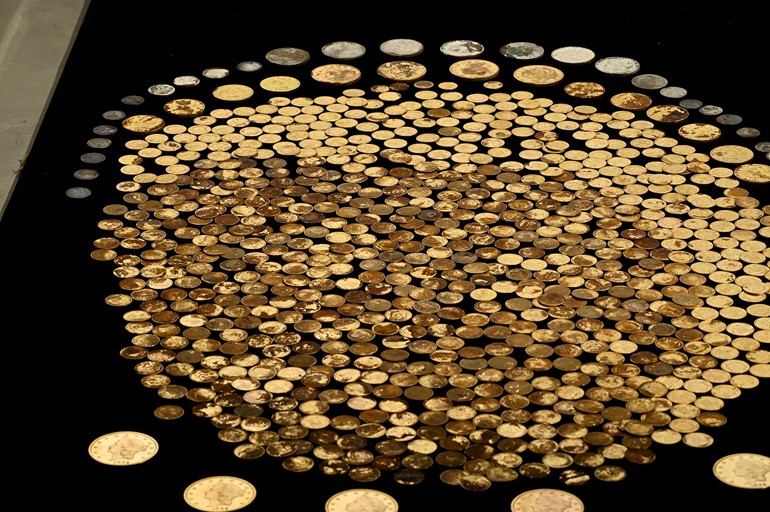
Most of the coins are one-dollar gold pieces, joined by ten-dollar Liberty Head coins and twenty-dollar Liberty double eagles that once represented very large sums of money for a household. Specialists highlight the presence of around 18 gold double eagles dated 1863, coins that are usually extremely rare on the market by themselves.
Buried during the chaos of the Civil War
The coins were minted in a state that found itself pulled in different directions during the American Civil War. Kentucky tried to stay officially neutral, and historians note that families there often hid their savings rather than risk losing everything to roaming armies and raids.
Conflict archaeologist Ryan McNutt of Georgia Southern University has suggested that the hoard may have been buried just before Confederate general John Hunt Morgan launched a campaign of raids across Kentucky and neighboring states in 1863. That possibility fits the coin dates and echoes other stories of valuables hidden during that turbulent period.
From farm field to graded coins worth millions
After realizing what he had found, the farmer contacted rare coin dealer Jeff Garrett in Lexington for help identifying and valuing the hoard. Garrett in turn worked with the Numismatic Guaranty Company, a leading coin grading firm, to clean, authenticate, and grade every piece.
Technicians at the grading lab gently removed dirt, checked that the coins were genuine, and assigned each one a condition score. Their notes describe bright, original luster on many pieces and quality ranging from extremely fine to mint state, impressive for coins that had spent more than a century underground.
Why this discovery captures the imagination
Numismatists view the Great Kentucky Hoard as a kind of time capsule, a snapshot of what everyday money looked like in one corner of the United States during the Civil War. Experts at the grading firm and other dealers say the hoard has already helped them study rare minting errors and confirm how coins from smaller mints circulated at the time, which is a lot of insight to gain from one farmer’s walk across a field.
Very few people will ever uncover buried gold on this scale, whether in a field, a backyard, or under a loose floorboard. Yet the Kentucky farmer’s experience is a reminder that history can sit quietly just beneath our feet, waiting for one more glance at the ground.
The official press release was published by the Numismatic Guaranty Company.