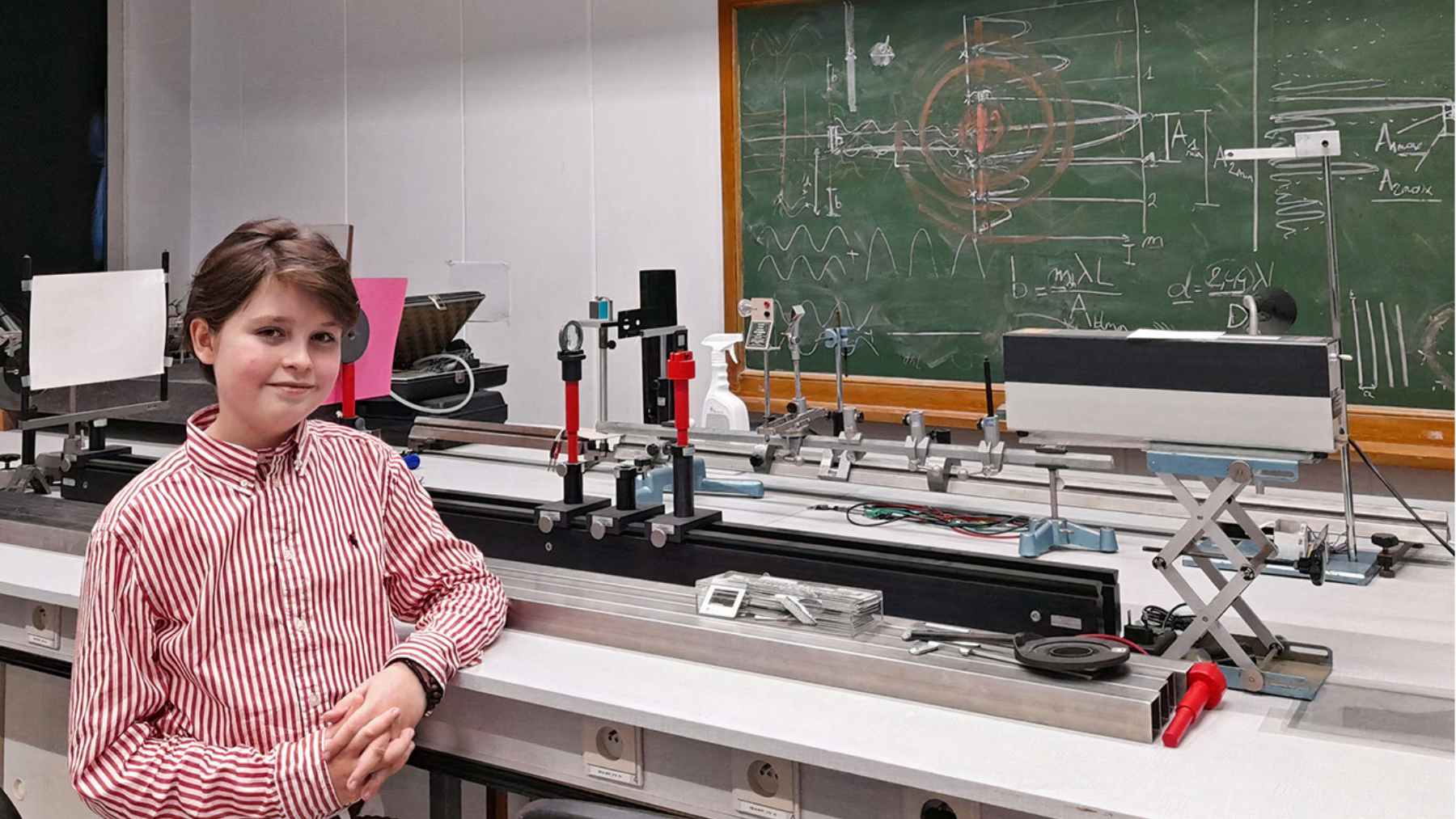
At 15, most teenagers are worrying about exams or learning to drive. Belgian researcher Laurent Simons has already defended a PhD in quantum physics at the University of Antwerp, with a thesis on “Bose polarons in superfluids and supersolids.”
Within weeks he moved to Munich to start a second PhD in medical science focused on artificial intelligence, where his long-term ambition is, in his own words, “creating superhumans” and defeating aging.
It sounds like the plot of a sci-fi series. Yet the academic record is real, formally documented and supervised through conventional university channels. The bigger question is what happens if projects like his actually work on a large scale, in a world already struggling with climate change, resource use, and inequality.
From frozen atoms to living cells
Simons’ physics PhD explored how single impurity particles behave inside Bose Einstein condensates, an exotic state of matter where atoms are cooled so much that they act like one giant quantum wave. This type of work helps scientists understand many body quantum systems, which can inform future quantum computers and ultra precise sensors.
Along the way he interned at the Max Planck Institute for Quantum Optics and completed bachelor and master degrees in physics at unusual speed, finishing secondary school at eight and a university degree before most teenagers start high school.
Now his daily work looks very different. In Munich he is part of a biomedical research lab that uses advanced computing and AI for “in silico bioengineering” to model tissues and disease on computers and to design new therapies. Public information points to algorithms, simulations, and data sets rather than experiments on human volunteers at this stage.
So there is no army of enhanced people hiding in a basement lab. Not yet. What we see is a teenager stepping straight into one of the hottest and most controversial frontiers in science.
Human enhancement on a very finite Earth
Longevity and human enhancement research is booming. Private companies such as Altos Labs and Retro Biosciences are investing heavily in cell rejuvenation and other methods that could delay aging and extend healthy life.
If efforts like these succeed, more people may live longer, healthier lives. That sounds positive for individuals. Yet it also raises uncomfortable ecological questions. A longer-living global population that keeps current consumption patterns would mean more lifetime energy use, more materials, and more pressure on ecosystems, unless societies change how they produce and consume.
Research already links population size and growth to higher emissions and continued environmental damage.
Then there is the AI part. Training and running powerful models already takes a growing bite out of the world’s electricity. Data centers used around 415 terawatt hours of electricity in 2024, roughly 1.5% of global demand, and that figure could more than double by 2030 if current trends continue.
Studies estimate that AI workloads account for a rising share of that use, alongside heavy water consumption for cooling and a reliance on rare minerals for hardware.
In plain terms, the same tools that might one day help engineers design “superhuman” biology are powered by server farms that can rival small cities in power draw and water needs. If the electricity behind those servers still comes mostly from fossil fuels, the climate tab shows up on everyone’s utility bill and in the air we breathe.
Ethics, oversight, and a teenager in the spotlight
Ethicists use “human enhancement” as a catch-all term for interventions that go beyond treating disease toward boosting performance, longevity, or cognition. The boundaries are fuzzy. A pacemaker clearly restores health; a hypothetical brain implant that doubles memory sits in murkier territory.
In Simons’ case, there is no public evidence of radical experiments. Universities in Europe require ethics approval and strict oversight for any research that touches human subjects or genetic modification, and none of the documents about his current work indicate such trials.
Still, his explicit goal of “creating superhumans” places him at the center of a debate that usually involves seasoned scientists and bioethics committees rather than teenagers. Parents, universities, and funding bodies will have to decide how much pressure, publicity, and responsibility is healthy for someone who is not yet an adult. That kind of governance question rarely makes headlines, but it shapes what actually happens in the lab.
Superhuman dreams, planetary limits
For now, Simons’ story is a striking symbol of where science is heading. Quantum physics feeds into AI, AI feeds into biomedicine, and all of it sits on top of a physical infrastructure that pulls electricity from the same grids that keep the lights on in ordinary homes.
Will AI guided medicine and longer lifespans help societies adapt to climate change and environmental stress, or will they deepen existing inequalities and resource use. Much depends on choices made outside the lab, from how quickly energy systems decarbonize to who gets access to advanced treatments.
In the middle of all this stands a teenager who just finished one thesis on frozen atoms and is now trying to reimagine human bodies for a warming world.
The study was published by the University of Antwerp.