If you imagine the last days of the dinosaurs, you probably picture tyrannosaurs and other big meat-eating theropods ruling the scene. A new fossil from southern Patagonia adds a very different kind of top predator to that picture, one with armor, a short bulldog-style snout, and terrifying teeth.
An international team has described Kostensuchus atrox, a large extinct relative of crocodiles that lived about 70 million years ago in what is now Santa Cruz Province in Argentina.
The animal reached roughly eleven and a half feet in length and an estimated weight of around 550 pounds, with a wide skull packed with sharp, serrated teeth suited for tearing flesh, and it likely preyed on medium-sized dinosaurs that shared its habitat.
A crocodile cousin built for meat
Kostensuchus belongs to a group of extinct crocodile relatives called peirosaurids, part of a broader branch of mostly land-dwelling crocodyliforms known as notosuchians. In simple terms, these were crocodile cousins that experimented with many different body shapes and lifestyles on land while dinosaurs dominated the continents.
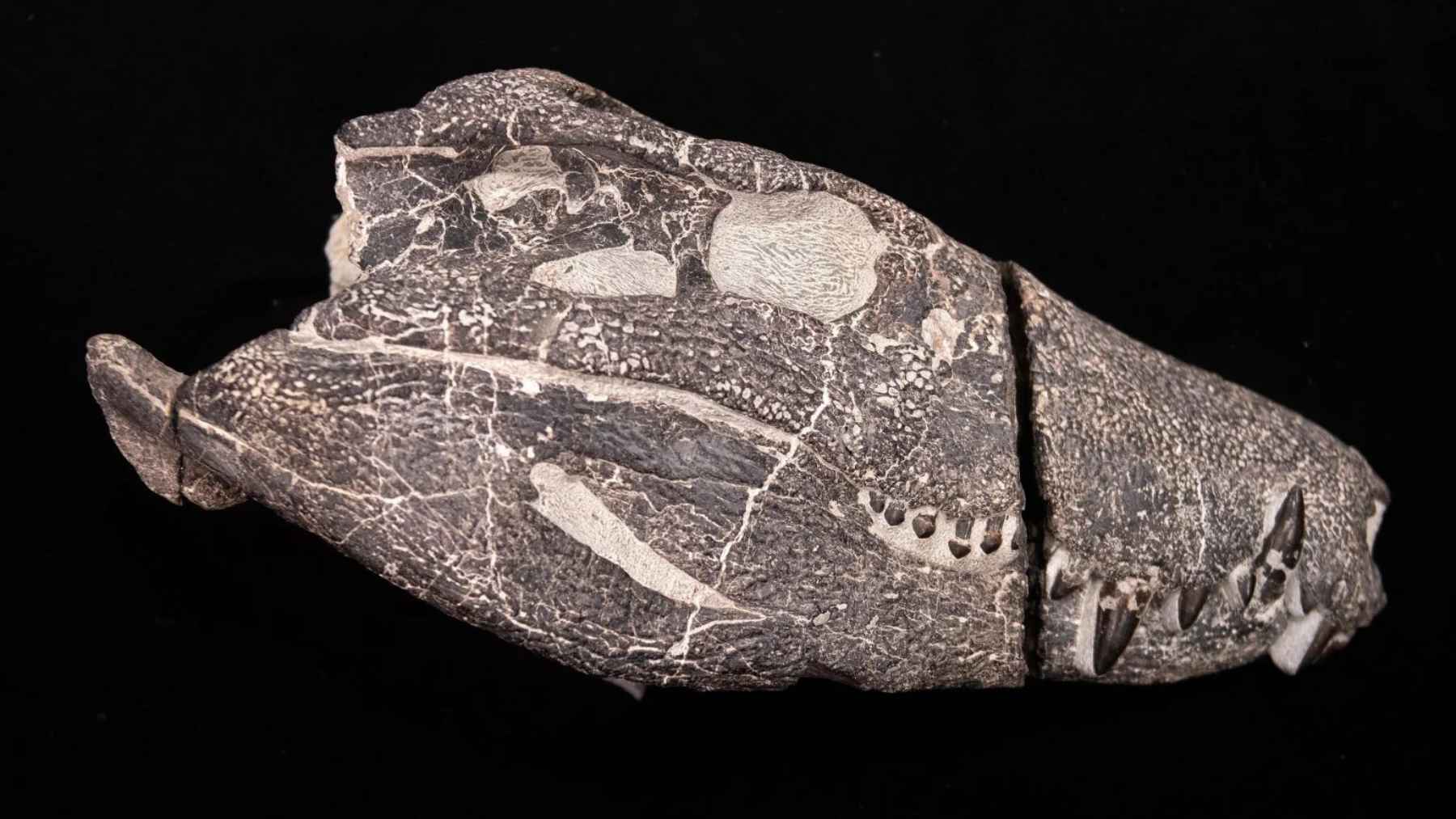
The skull of Kostensuchus was short, high, and very wide, with a snout that made up just over half of the head length. Its teeth were ziphodont, meaning they were blade-like with tiny serrations along the edges, a design that works a bit like a steak knife when biting into meat.
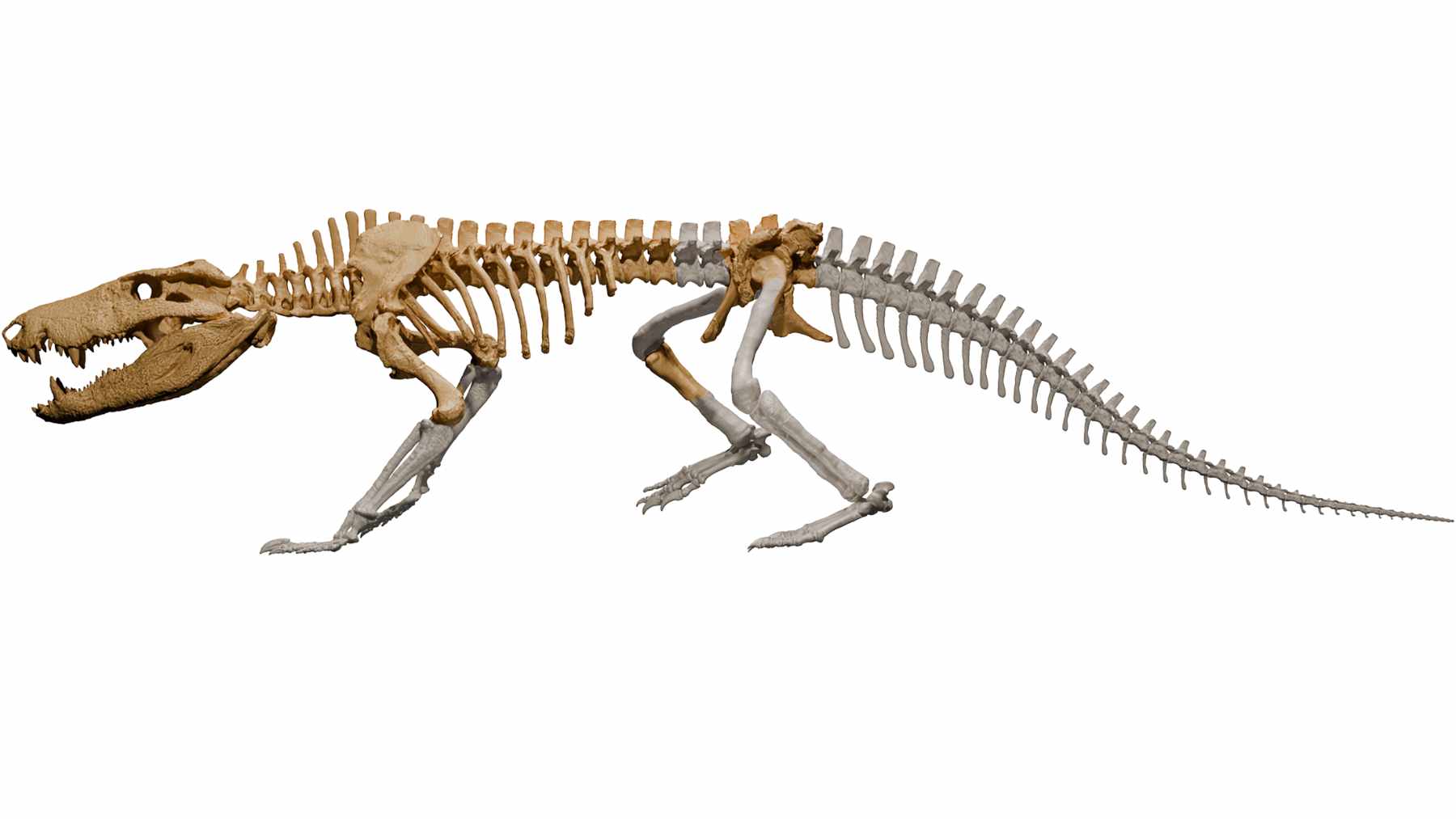
Researchers classify the animal as a hypercarnivore, a predator whose diet was made up mostly of meat rather than a mix of plants and animals. They estimate its body length at about three and a half meters and its mass at around 250 kilograms, significantly larger than earlier peirosaurids from the same region and more in line with modern big crocodiles.
Digging a predator out of solid rock
The fossil comes from the Chorrillo Formation near Estancia La Anita, roughly thirty kilometers southwest of the town of El Calafate in southern Patagonia. These rocks were laid down in the Maastrichtian stage, the final slice of the Cretaceous period, when the area was a warm, seasonally humid landscape of rivers, lakes, and floodplains.
During a field survey in early 2020, technician Marcelo Isasi noticed dark fragments inside a dense rock nodule that did not match the surrounding sediment. Careful excavation revealed an almost complete skull and lower jaws along with much of the front half of the skeleton, all locked inside the concretion and later freed through years of painstaking lab work.
The study was led by paleontologist Fernando E. Novas of the Museo Argentino de Ciencias Naturales, working with colleagues from the Argentine research council CONICET, the Federal University of Rio de Janeiro, the University of Coimbra, and the University of Tokyo. Field and lab work received support from organizations including the National Geographic Society, which helped fund expeditions to this remote corner of Patagonia.
Rewriting the food chain at the end of the dinosaur age
The Chorrillo Formation has already yielded an impressive cast of dinosaurs, including the giant predator Maip, the long-necked titanosaur Nullotitan, and smaller plant eaters such as Isasicursor, along with turtles, frogs, and early mammals. Until now, no crocodile relatives were known from these rocks, so Kostensuchus fills an important gap in the local food web.
Based on its size and tooth anatomy, the team concludes that Kostensuchus sat near the top of that food chain, second in body size only to Maip among known predators from the same formation. Its powerful jaws and cutting teeth would have been well suited to tackling medium-sized dinosaurs, as well as turtles and other vertebrates that shared the rivers and floodplains.
Studies of the limb bones suggest that this animal likely walked with a somewhat more sprawling posture than some of its notosuchian cousins but was still able to move effectively on land. That hints at a lifestyle where it patrolled riverbanks and nearby plains rather than staying mostly in the water the way most modern crocodiles do, which would have given it plenty of chances to ambush passing prey.
A new branch on the crocodile family tree
By comparing Kostensuchus with other fossil crocodile relatives, the researchers found that it belongs to a subgroup of broad-snouted peirosaurids that also includes forms from central Patagonia and Madagascar.
Until now, most of those species were known only from fragmentary jaws, so the new skeleton finally shows what a large member of this branch looked like from head to hips.
The study suggests that, over the Cretaceous period, some notosuchians evolved from smaller, more omnivorous forms into big, meat-focused predators like Kostensuchus, while a separate croc lineage, the baurusuchids, followed a similar path in other parts of South America.
In practical terms, that means ancient crocodile cousins repeatedly reinvented themselves as land-based apex predators, often sharing ecosystems with large theropod dinosaurs rather than simply scavenging their leftovers.
At the end of the day, discoveries like this do more than add a new strange name to the fossil record. They help scientists rebuild entire ancient ecosystems and remind us that even familiar groups such as crocodiles have a much wilder past than the quiet riverbanks we see today.
The study was published in PLOS ONE.
Image credit: Gabriel Díaz Yanten / PLOS ONE