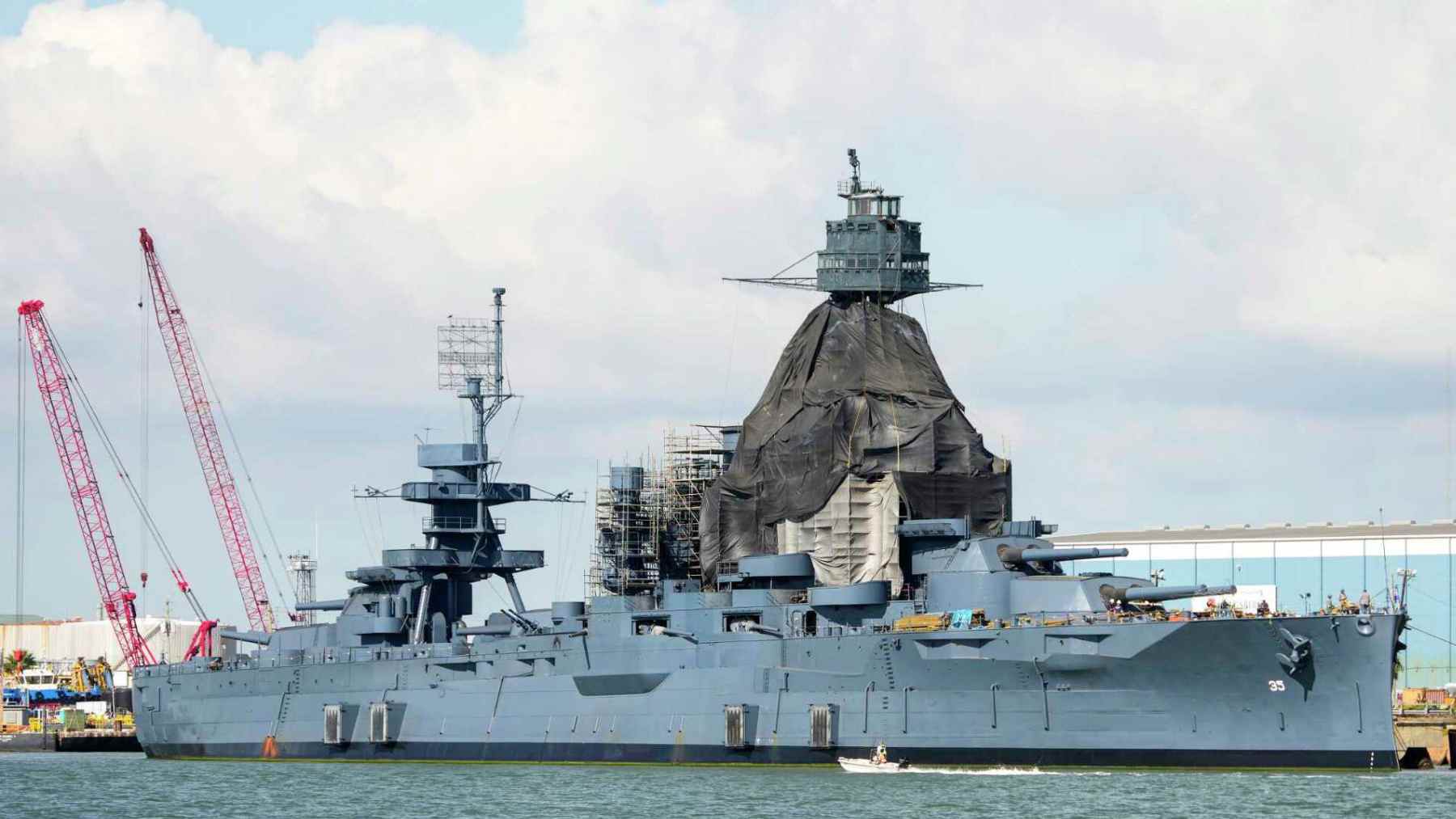
When you picture a climate or pollution story, a grey World War I battleship probably is not the first image that comes to mind. Yet the long, messy rescue of Battleship Texas in Galveston is quietly becoming one of the most unusual environmental projects on the U.S. Gulf Coast.
For years, the aging hull of the ship leaked so badly that crews had to pump about 300,000 gallons of water out of the vessel every single day, just to keep it afloat in the Houston Ship Channel. Officials warned that if nothing changed, the corroding steel could contaminate the busy waterway, which sits across from one of the world’s largest petrochemical complexes.
In 2012, when a major leak flooded internal spaces, workers even floated an oil boom around the ship to catch any fuel or oily water that might escape.
At that point, the question was no longer only about saving a historic warship. It was also about what to do with a 27,000-ton steel artifact that had become a slow-moving environmental risk.
Meanwhile, all that pumping had a very down-to-earth cost. Keeping dozens of pumps running day and night uses energy and money, the sort of hidden line item that quietly shows up in somebody’s electric bill.
From landmark to potential pollutant
After World War II, Texas was transformed into a museum and permanently berthed near the San Jacinto Battleground, carved out of marsh that drains into the Houston Ship Channel. Decades in brackish water took their toll. By 2017, the hull was so thin in places that staff said you could poke a finger through the steel.
Pumps ran around the clock to stay ahead of the leaks. “We pump about 300,000 gallons of water a day out of the Battleship Texas,” the foundation’s executive director explained at the time.
Engineers who inspected the ship warned that leaving it in the water carried a double risk. The decaying hull could contaminate the channel as coatings, fuel residues, and corroded metals washed out. Scrapping the ship, on the other hand, would stir up asbestos and other hazardous materials during dismantling. It is the kind of no-win situation many coastal communities know well. Let the old infrastructure rot, or tear it apart and manage a wave of new waste.
A $75 million repair as climate adaptation
The turning point came in 2022, when the State of Texas and the Battleship Texas Foundation moved the ship to Gulf Copper’s dry dock in Galveston and funded a full structural overhaul. The legislature has committed $60 million toward what is now a $75 million restoration effort.
Once the hull was out of the water, shipyard crews replaced about 700 tons of steel plating below the waterline, cut away and rebuilt the torpedo blisters, and coated the new structures inside and out to slow future corrosion. By late 2025, the foundation’s operations chief could finally say something staff had not heard in decades. “For the first time in a very, very long time, the ship does not have any leaks. It is free floating.”
The next chapter is all about where and how to park this steel giant in a warming world. Galveston’s Pier 15 will be the new permanent berth, but only after the port dredges the channel and engineers finish a heavy-duty mooring system. That system is being designed to keep the ship secure through floodwaters as high as nineteen feet and winds up to 160 miles per hour, reflecting the increasing strength of Gulf hurricanes.
Permits from the U.S. Army Corps of Engineers and other regulators are still needed, and the foundation has agreed to regular post-season inspections of the moorings after each hurricane season. In practical terms, that means this museum ship is being treated more like critical coastal infrastructure than a static memorial.
Wetlands where a battleship once sat
Moving Texas off the San Jacinto site also opened the door for a different kind of restoration. State officials have approved roughly $40 million to fill in the artificial cove that once housed the battleship and return that piece of shoreline to marshy wetlands, as part of a broader $142 million upgrade of the battleground.
Researchers believe that area historically functioned as coastal wetland, and the project aims to recreate that landscape. The restored marsh will provide habitat for local wildlife and add a thin, but important, buffer against storm surge in a region where every foot of elevation matters when hurricanes roll in.
So an old warship does not just get a fresh coat of Navy blue paint in Galveston. Its move lets another shore breathe again.
Recycling steel and memories
There is also a quieter sustainability story tucked into the welds and rivets. The Battleship Texas Foundation notes that usable scrap steel and deck wood removed during the repairs are being turned into commemorative items and artworks, instead of heading straight to the scrapyard.
That may sound symbolic at first. Yet for many museum ships and industrial relics, finding higher-value uses for old materials is one of the few ways to keep tons of historic steel out of landfills or low-grade recycling streams. In this case, the project is also functioning as a live classroom.
Local vocational students have been visiting the yard to see how welding, carpentry, and fabrication work together on a complex restoration, gaining real-world experience in the process.
At the end of the day, Battleship Texas is still a floating monument, with big guns and a long war record. But her near sinking forced Texas to confront a very modern set of questions about pollution, climate risks, and what to do with aging infrastructure on a storm exposed coast.
The official statement was published by the Battleship Texas Foundation.