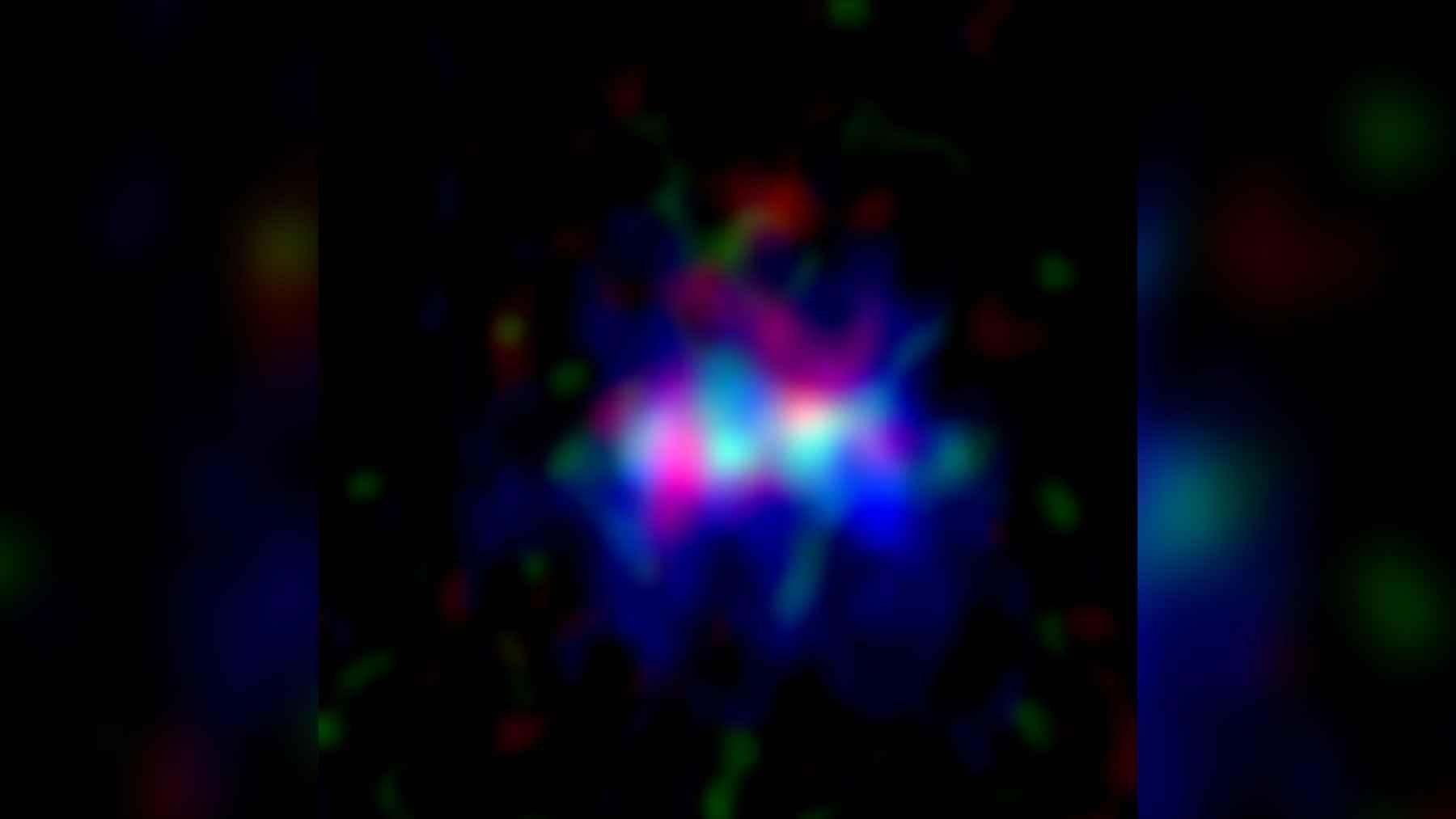
Imagine a single galaxy giving birth to new suns at a pace 180 times faster than the Milky Way. That is what astronomers have seen in a tiny, reddish smudge called Y1,more than 13 billion light years away. The galaxy sits in the very young universe, only about 600 million years after the Big Bang, yet it behaves like a cosmic factory running in overdrive.
Y1 is wrapped in clouds of superheated cosmic dust and gas, lit up by newborn stars. Using the ALMA observatory in Chile, researchers measured how brightly that dust glows at millimeter wavelengths and worked out that this small system is turning more than 180 solar masses of gas into stars every year. Our own galaxy manages roughly one solar mass in the same period of time.
For astronomers, it is like opening a window into a much more crowded and energetic universe than the one we live in today. For the rest of us, it is a glimpse into the distant furnace where many of the atoms in our air, oceans and solar panels were first forged.
A stellar nursery in turbo mode
To get a sense of what is happening in Y1, think of familiar star-forming regions such as the Orion Nebula. In those clouds, gas and dust collapse under gravity, heat up and eventually ignite nuclear fusion. Y1 follows the same basic playbook, only turned up several notches.
ALMA’s antennas picked up radiation from dust grains glowing at about 90 Kelvin, close to minus 180 degrees Celsius. That sounds cold compared with a summer sidewalk, but for a galaxy so far away it is unusually warm.
Most distant star forming galaxies show dust that is tens of degrees colder. The elevated temperature tells scientists that Y1 is packed with young, massive stars pouring out energy into their surroundings.
The galaxy itself is known more formally as MACS0416_Y1. It sits behind a closer cluster of galaxies whose gravity bends and boosts Y1’s light, a natural “magnifying glass” that helps telescopes on Earth pick up such a faint and distant object.
Solving the early dust puzzle
There is another reason this discovery matters. For years, observations suggested that many early galaxies contained more dust than they should, given how young they were. Dust grains normally form around aging stars and in supernova explosions.
In a universe only a few hundred million years old, there should not have been enough time for huge dust reservoirs to appear.
Y1 hints at a different answer. Because its dust is so warm, a relatively small amount of material shines very brightly in infrared light. That means some early galaxies may have fooled astronomers.
A compact pocket of hot dust can mimic the signal that would come from a much larger quantity of cooler dust. The new measurements support the idea that part of the “too much dust too early” problem is really a temperature effect rather than a bookkeeping disaster.
In practical terms, that reshapes estimates of how fast the first galaxies enriched their surroundings with heavy elements. It also refines computer models that try to connect the smooth glow of the early cosmos with the rich web of galaxies we see today.
From a distant galaxy to life on Earth
It might be tempting to file Y1 under “cool space stuff” and move on to worrying about traffic jams or the next electric bill. Yet there is a direct line between what happens in extreme objects like this and everyday life on our planet.
Inside Y1, stars are forging elements heavier than helium, then flinging them into space when they die. Over cosmic time, that chemical debris builds the raw material for rocky planets, atmospheres rich in oxygen and carbon, and even the silicon that ends up in solar cells and smartphones.
The metals in wind turbines, the iron in our blood and the calcium in seashells all trace their story back to ancient star factories that once looked a lot like Y1.
So when astronomers say this galaxy is an ultraluminous infrared “star factory”, they are really talking about the places that set the stage for habitable worlds and, eventually, for environmental challenges like climate change that we grapple with today.
What comes next in this cosmic investigation
Y1 probably is not unique. Researchers suspect there are many similar, short-lived bursts of intense star formation scattered through the early universe. The challenge is that they are small, distant and often hidden in dust, so they only reveal themselves at specific wavelengths that instruments like ALMA can see.
Future observations will try to map Y1 in finer detail and search for more examples. Each new object will help answer a basic question that still hangs over cosmology.
How quickly did the first galaxies grow, and how did they transform thin primordial gas into the complex chemical mix that eventually produced planets like Earth?
The answer will not change tomorrow’s weather forecast or the level in a nearby reservoir. But it will add context to the story of how a universe filled with simple elements turned into one where forests, oceans and cities exist at all.
The study was published in Monthly Notices of the Royal Astronomical Society.