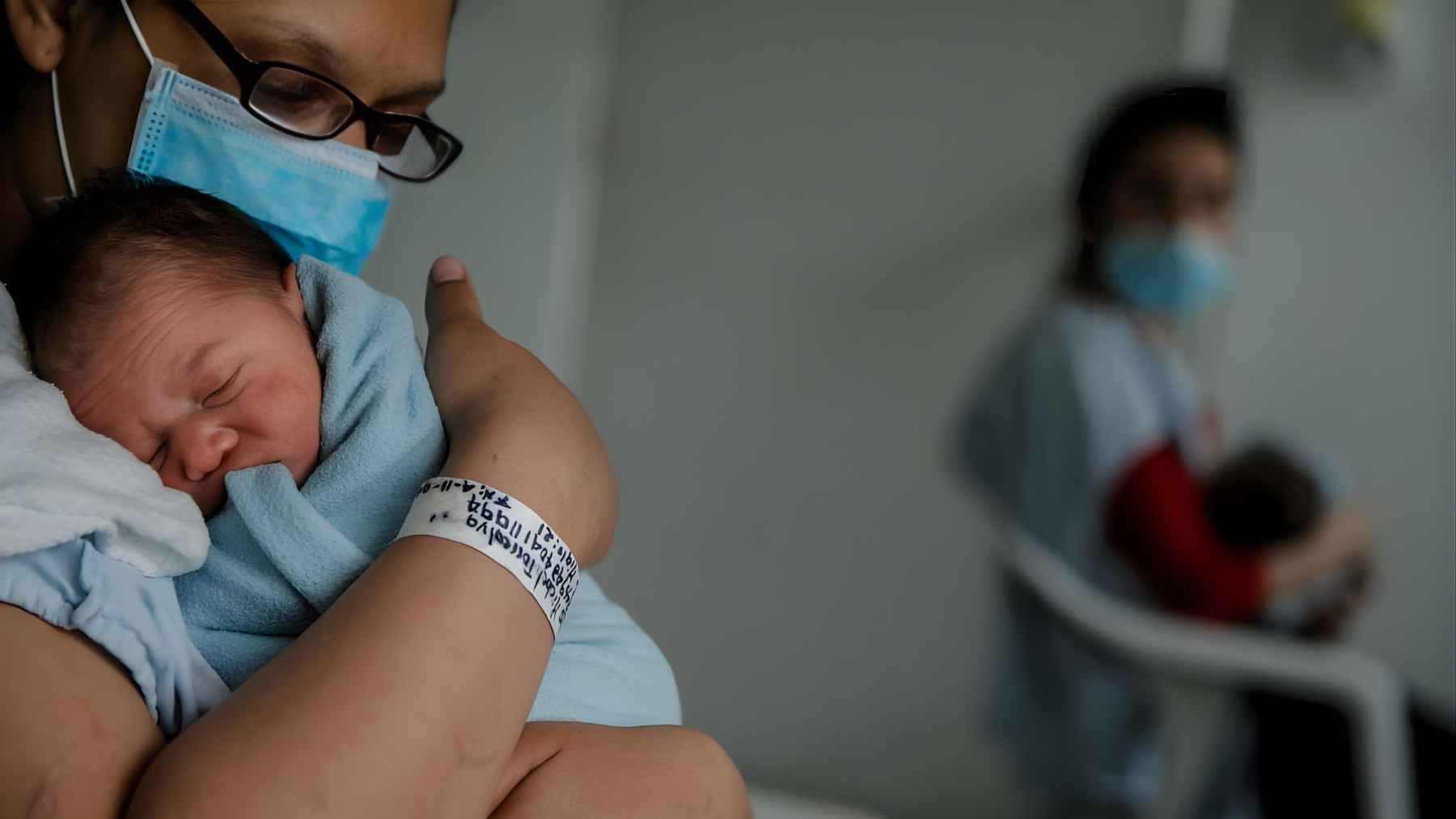
In many parts of the world today, a baby’s birth certificate is just as likely to list unmarried parents as married ones. Fresh figures compiled by the Organisation for Economic Co-operation and Development show that, on average, about 43% of births in member countries now occur outside marriage, compared with only 7% in 1970. So where is this shift strongest, and what does it really tell us about modern family life?
Latin America at the top of the ranking
At the very top of the new ranking is Colombia, where 87% of babies are born to parents who are not formally married. Close behind are Chile with 78.1%, Costa Rica with 74% and Mexico with 73.7%.
In much of Latin America, living together without marrying has been socially accepted for generations. Cohabiting couples often have many of the same rights as married couples, and long-standing inequality has made access to lawyers, courts and formal registration uneven. Over time, that mix of culture and institutions has made the wedding ceremony less central than the partnership itself.
For everyday life, that shows up in very concrete ways. School forms, health insurance paperwork and inheritance rules increasingly have to account for parents who share a home and children, but not a marriage certificate.
Nordic countries follow a different model
Several Nordic and Western European countries now see most births outside marriage as well. Iceland records about 69.4%, Norway 61.2%, France 58.5% and Sweden 57.5%.
Here the story looks a little different. Strong welfare states and universal child benefits help ensure that children are protected regardless of whether their parents marry. Cohabiting couples often have legal recognition that comes close to marriage, so tying the knot becomes more of a personal or symbolic choice than an economic survival strategy.
In practical terms, that means a child born to cohabiting parents in Stockholm or Reykjavik is likely to grow up with the same access to daycare, health care and parental leave as a child whose parents held a big wedding.
East Asia and the eastern Mediterranean hold the line
At the other end of the spectrum sit countries where marriage still closely frames childbearing. Japan has the lowest recorded share in the new data at 2.4% of births outside marriage. South Korea stands at 4.7%, Türkiye at 3.1%, Israel at 8.6% and Greece at 9.7%.
In these societies, religious traditions, strong family expectations and legal frameworks all pull in the same direction. Having a baby is still widely understood as something that happens within a formal union. Social stigma and limited support for single parents make nonmarital births rare, even as marriage rates slowly fall and young adults delay partnership.
In the middle, a quiet normalization
Between these extremes are countries such as the United States, the United Kingdom, Italy and Austria, where around four in ten babies are born outside marriage.
Researchers note that rising nonmarital births do not automatically mean more children grow up with only one parent. The OECD’s own indicator note stresses that differences in these shares “do not necessarily reflect differences in the proportion of children born to non-partnered mothers” because many babies are born to cohabiting couples.
In other words, the statistic mainly captures how often couples marry before parenthood, not whether children live in two-parent homes. That nuance is easy to miss when the headline number is so striking.
Why the numbers matter
For policymakers, these trends are not just social curiosities. They shape demand for childcare, housing and income support, and they influence how tax systems and parental leave rules are designed. An office that still assumes one married breadwinner and one stay at home spouse will struggle to serve a world where many parents are unmarried, cohabiting or raising children on their own.
For families, the figures hint at a broader question. Are laws and services built around a single ideal of the family, or around the reality of how people actually live and care for children today.
To a large extent, the new OECD data suggest that family life is diversifying rather than collapsing. The key challenge now is to make sure that every child, whatever their parents’ marital status, can grow up in a stable, well-supported home.
The report was published by the OECD Family Database.