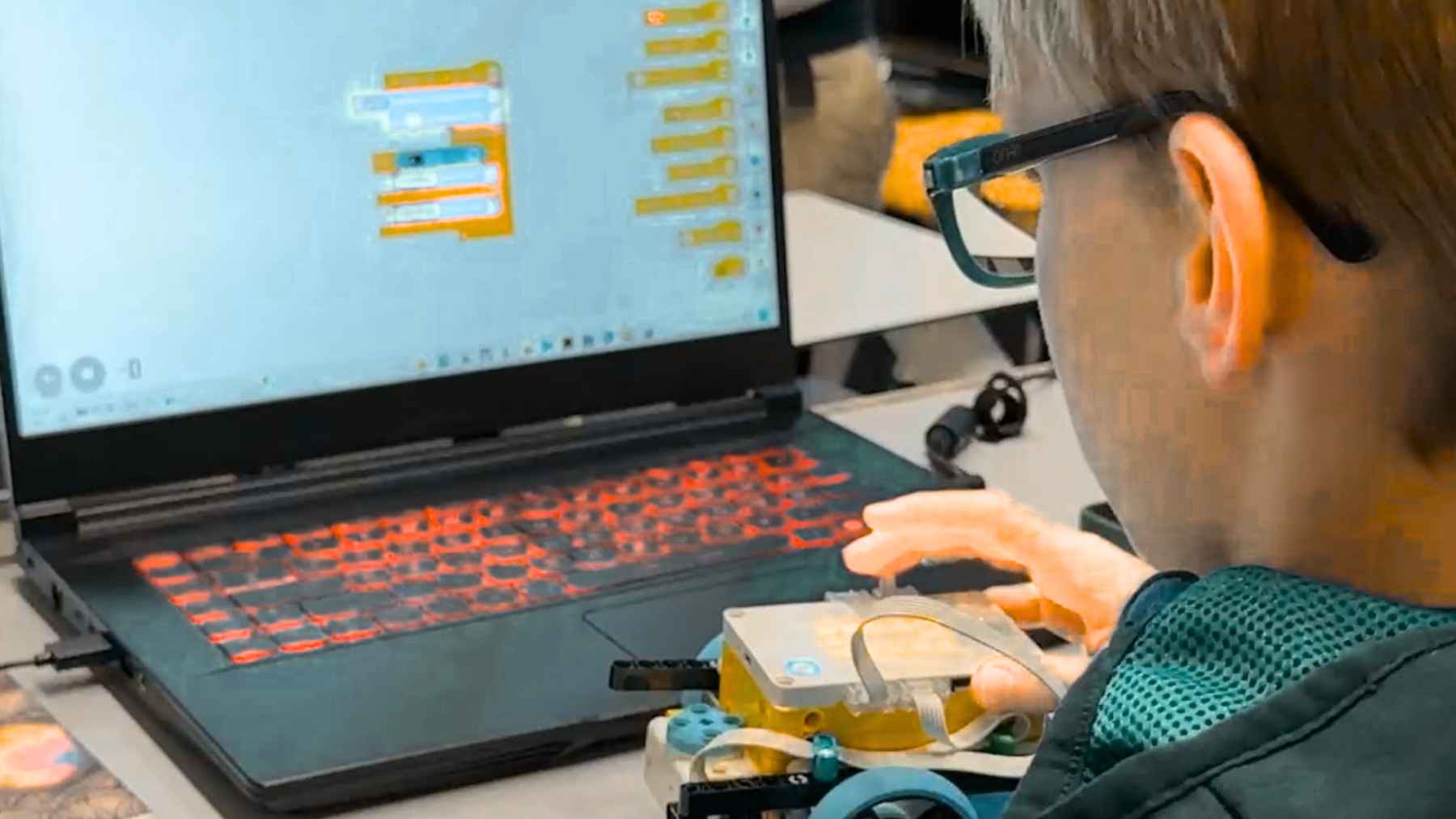
On a quiet Friday afternoon in Rostock, ten year olds are doing something that looks a lot like play. Oskar is writing his own simple web browser in Python. Emil is trying to convince a Lego robot to follow a wiggly black line on a white board without getting lost. Nearby, classmates solder tiny components that will later blink, beep or measure something in the real world. It feels like an after school club. In reality, it is an early training ground for the kind of skills a warming planet badly needs.
From cell technology to climate education
The workshop sits inside the campus of CJD Christophorusschule Rostock, but it is run by MikroMINT e.V., a nonprofit with surprisingly deep roots in environmental science. The association began in 1996 under a different name, founded by researchers from University of Rostock who worked on environmental questions using cell technology, biochemistry and microscopy.
Over time, the team shifted from doing research themselves to helping children and teenagers do it. Since 2018, MikroMINT has operated a dedicated student research center that gives young people access to laboratory equipment, 3D printers, microcontrollers and sensors. The idea is simple and powerful. Instead of only reading about physics, biology or climate change, students design small projects and run their own experiments.
According to official descriptions, the program now spans physics, chemistry, biology, mineralogy, computer science and engineering. Students are encouraged to prepare for competitions such as RoboCupJunior and other national science contests, often working on questions linked to the environment or new technologies.
Robots, browsers and a different kind of homework
In that context, Oskar’s homemade browser is more than a neat party trick. By choosing Python and writing hundreds of lines of code, he is learning how digital tools are actually built instead of only using them. That same mindset will be essential when future engineers have to optimize energy use in data centers or design software that runs efficiently on solar powered sensors.
Emil’s line follower robot tells a similar story. At first glance it is just a Lego car that struggles to stay on track. Under the hood, though, he is adjusting light sensors, tweaking control loops and learning how machines react to changing inputs. Those skills are exactly the ones needed when robots are sent to inspect wind turbines, sort recyclable materials or measure pollution in places humans cannot easily reach.
Adults are present, but mostly in the background. A board member of MikroMINT, Thomas Borowitz, guides the technology group. Engineers from local industry have helped with soldering and design. A cybersecurity expert has visited to talk about data protection. For the children, it feels almost normal to have serious professionals drop by while they experiment. For the region, it quietly builds a pipeline of talent that already sees climate and technology as connected fields.
Training ocean and insect detectives
The green thread running through the workshop becomes even clearer when you look at MikroMINT’s newer projects. Under the PromOcean banner, the student lab works with the Ocean Technology Campus Rostock and marine research institutes on small measurement systems for coastal waters. One flagship activity is a floating “Warnow probe” that records data such as salinity and temperature in the local river. Students can build parts of the electronics, view live data and learn how ocean technology helps track climate driven changes in marine ecosystems.
On land, another collaboration focuses on insects. Together with university educators, MikroMINT runs the project “Insektenvielfalt fördern and Artenkenntnis entwickeln”, which roughly translates to “promoting insect diversity and building species knowledge”. Workshops invite students and teachers to collect, identify and document insects, then connect those findings to broader questions about climate change and habitat loss. German education authorities and nature conservation agencies see this kind of species expertise as a basic requirement for effective conservation in the future.
In practical terms, that means a teenager might spend one week debugging a robot’s code and the next week looking through a microscope at tiny beetles from a nearby meadow. Both activities strengthen the same core habits. Careful observation. Patience with data. Curiosity about how systems behave when conditions change.
Why these green skills matter for the planet
Global reports suggest that this sort of hands on climate and technology education is not a luxury. It is becoming a necessity. UNESCO describes climate change education as a way to give young people the knowledge, skills, values and attitudes they need to act as “agents of change” rather than passive observers.
At the same time, the clean energy and environmental sectors are expanding faster than the supply of trained workers. Recent analysis from the International Energy Agency shows that energy jobs have grown more quickly than overall employment, with companies already reporting serious shortages of engineers and technicians for renewables, grids and electric mobility. A separate study cited by the Boston Consulting Group estimates a global shortfall of around seven million skilled workers for renewable projects by 2030 if current trends continue.
Seen through that lens, a room full of ten year olds in Rostock trying to make robots follow lines or write their own browser is not just a charming local story. It is one small answer to a much larger question. Who will actually design, build and maintain the tools that keep the lights on, protect biodiversity and shrink our carbon footprint in the decades ahead.
Parents might simply notice that their child spends Friday afternoons happily soldering instead of glued to a screen. Local companies may see a new generation that already speaks the language of sensors, code and data. For the climate, the long term payoff could be even bigger. Early experiences like these make it more likely that some of those children will later choose careers in marine technology, environmental monitoring or sustainable engineering.
The official statement was published on “MikroMINT e.V.”.