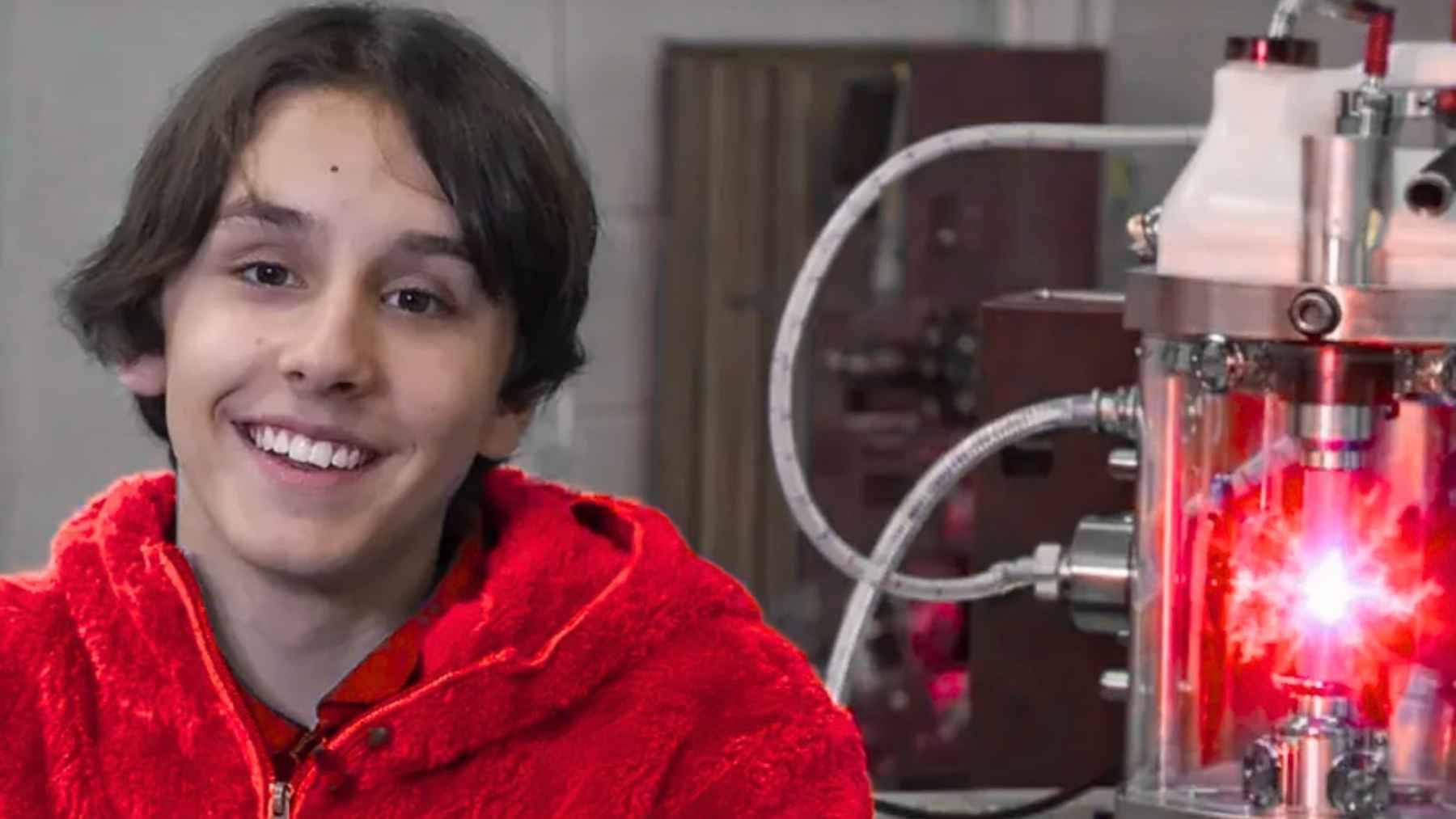
At just twelve years old, Aiden McMillan has built a working nuclear fusion device in his family home in Dallas, Texas. He spent four years researching and assembling the machine, then confirmed success when it began producing neutrons, a key sign that fusion was taking place. That moment turned a long after school project into a story watched around the world.
While many kids his age split their free time between homework, video games, and hanging out with friends, Aiden spent much of his childhood digging into nuclear physics. He first became fascinated by fusion at eight, then used evenings and weekends to study and sketch out designs for a device he could build at home. The hardest part at first was not the equations, it was convincing his mother that the project could be done safely.
Four years of nuclear fusion work after school
Aiden is a seventh grade student in the Dallas Independent School District. According to his family, he devoted four years to the project, starting with long periods of reading and doing calculations before he ever touched a piece of equipment. Only after that patient groundwork did he begin building the device step by step, testing each part in a spare room at home.
Along the way he had to learn practical skills that do not show up in most middle school textbooks, from handling vacuum pumps to managing high voltage safely. His mother was initially wary of having a fusion experiment in the house, and asked him to prove that he understood every risk. Winning that trust may have been as important as any formula, because without it the project would never have left the notebook stage.
What a homemade fusion device actually does
Nuclear fusion is the same basic process that powers the Sun, where very light atoms join together and release large amounts of energy. In simple terms, it is the opposite of the splitting process used in most nuclear power plants, and it produces far less long lived radioactive waste. If humans ever manage to control fusion fully, experts say it could become a clean and almost limitless source of electricity for homes and businesses.
At the end of the day, his small device is not lighting up the neighborhood or lowering anyone’s electric bill. Instead, it recreates the fusion reaction on a tiny scale by slamming atoms together inside a sealed chamber until some of them merge. The proof that it works comes from measuring the neutrons created in those reactions, the same result that professional labs look for.
Chasing a world record and shifting expectations
With his device verified by neutron measurements, Aiden has applied to Guinness World Records to be recognized as the youngest person to build a working fusion device. If his application is approved, he would surpass Jackson Oswalt, who achieved fusion in 2018 only hours before turning thirteen. The record is still under review, but the story has already traveled well beyond his own school and city.
Stories about his achievement have circulated widely and sparked debates about what young students can do when they have access to tools and support. As one supporter put it, “Aiden’s success is not only a matter of personal pride, it shows that age is not a limitation when someone has dedication and the right support.” So maybe the real question is this for adults, not kids, how many other curious minds could take on advanced technology if they were given the same chance.