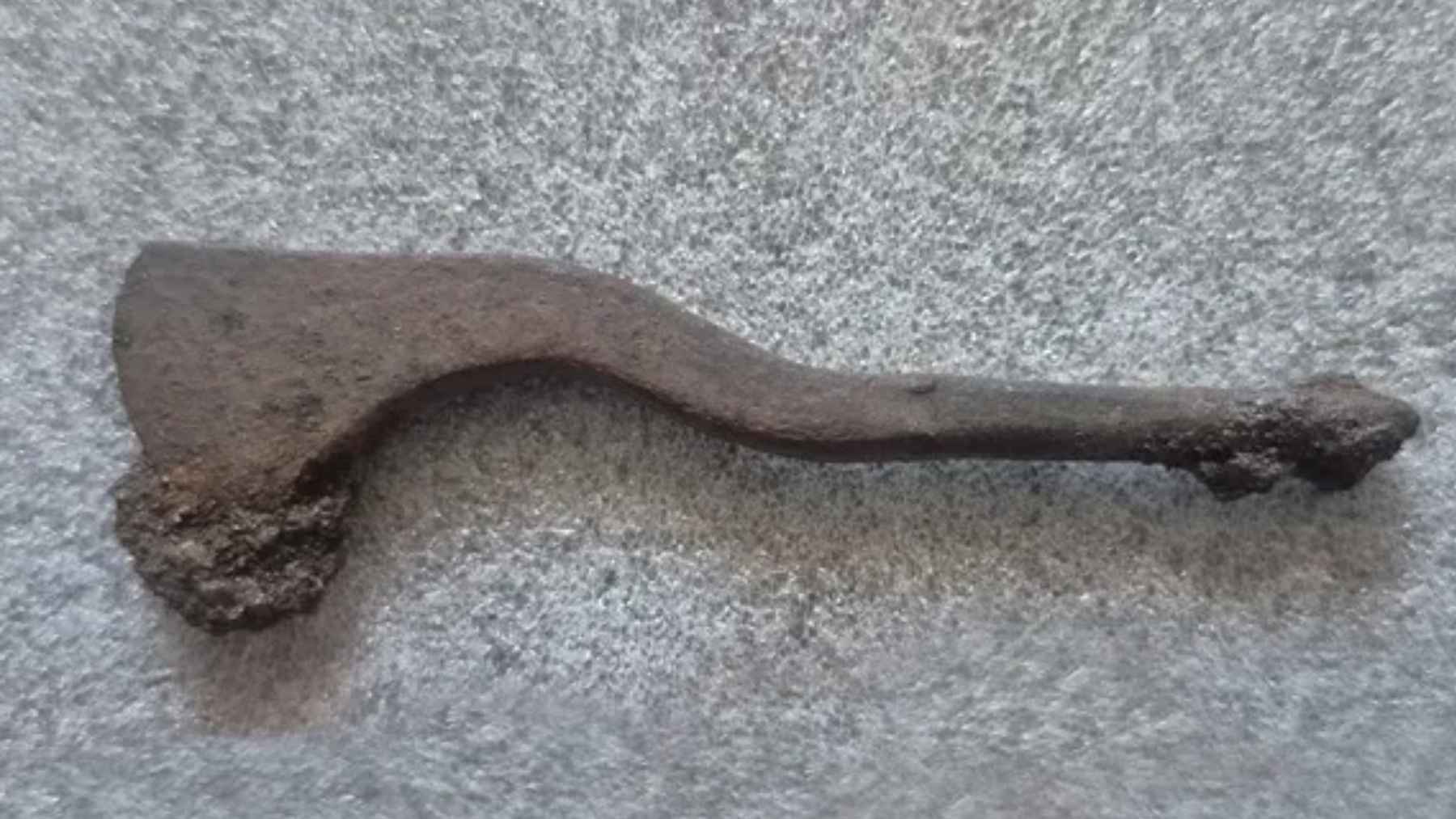
Archaeologists in Poland have uncovered a 2,300-year-old iron tool that they believe was used to open holes in human skulls, offering rare proof that Iron Age Celtic groups in Europe practiced cranial surgery.
The object was found at the fortified settlement of Łysa Góra in the Mazovia region and appears to be a specialized trepanation scalpel rather than an ordinary knife.
A team from the State Archaeological Museum in Warsaw working with the University of Warsaw links the tool to a long tradition of trepanation, the oldest known form of surgery.
At first glance it is just a small piece of iron, yet it opens a window onto how people in this Iron Age community tried to deal with trauma, pain and perhaps even what they saw as troubled spirits.
A rare surgical tool in an unexpected Celtic outpost
The tool is a slender iron blade that narrows into a sharp spike, probably once set into a wooden handle so it could be used like a small scalpel. Excavation leader Bartłomiej Kaczyński notes that its shape and careful manufacture are typical of Celtic metalwork and match surgical instruments from a few better known sites in modern Romania, Austria and Croatia.
Dating to around the third or second century before the common era, the object is the first clear Celtic trepanation tool reported so far from the northern zone of Europe.
Łysa Góra is already described by researchers as the most northeastern Celtic settlement known in Europe, so the find strengthens the idea that Iron Age medical knowledge traveled farther than many maps of the Celtic world usually suggest.
How ancient trepanation worked
Trepanation is the practice of cutting or scraping an opening into the skull, usually stopping just before the tough membrane that protects the brain.
People have carried out this risky procedure since the Neolithic period in many parts of the world, often to relieve pressure after a head injury, ease chronic headaches or respond to seizures and other mysterious symptoms.
Anyone who has ever felt a crushing headache after a bad knock can imagine why early communities searched for drastic ways to release pressure inside the head.
In classical Greek medicine, doctors inspired by Hippocratic ideas saw trepanation as a way to let trapped blood and fluids escape and reduce the risk of deadly infections. In the Celtic world, archaeologists think the same cut into the skull often had both medical and spiritual meanings, aimed at helping the body and calming what people understood as harmful forces.
Kaczyński has argued that the very presence of such a tool at Łysa Góra points to a specialist in medical procedures living with the community, someone who likely knew human anatomy and medicinal plants well enough to be trusted with a neighbor’s skull.
Metalworkers, healers and a busy Iron Age settlement
The trepanation tool did not appear in isolation. In the more lightly fortified northwestern part of the settlement, archaeologists uncovered cup shaped lumps of slag from smelting furnaces, a compact iron anvil used to finish small pieces, and a range of objects such as axes, brooches and horse harness fittings.
Taken together, these finds show that skilled metalworkers were shaping iron and other metals on site rather than importing every blade and buckle ready made.
Other finds, including amber beads and finished metal goods, tie the hilltop closely to trade routes that linked the Baltic coast with markets much farther south along the ancient Amber Road.
Archaeologists now see the settlement as a small but strategic hub, home to warriors, craftspeople and at least one healer whose toolkit seems to have included an instrument capable of opening a human skull.
What the missing skulls can still tell us
So far, excavations at Łysa Góra have not produced any human skulls that clearly show signs of trepanation. That gap leaves a key question partly open. Was this tool actually used on patients in this settlement, or was it part of a specialist kit that moved along trade routes and was used elsewhere?
What researchers do know is that trepanation itself was not a rare experiment in the wider region. A 2018 study in the International Journal of Osteoarchaeology examined six trepanned skulls from central Poland, ranging in date from the late Neolithic to early modern times, and found clear signs that every patient survived the surgery for some time.
Set against that background, the Łysa Góra scalpel looks less like a one-off curiosity and more like a missing link in a long chain of medical know-how in Central Europe.
The main press release has been published by NaukawPolsce.