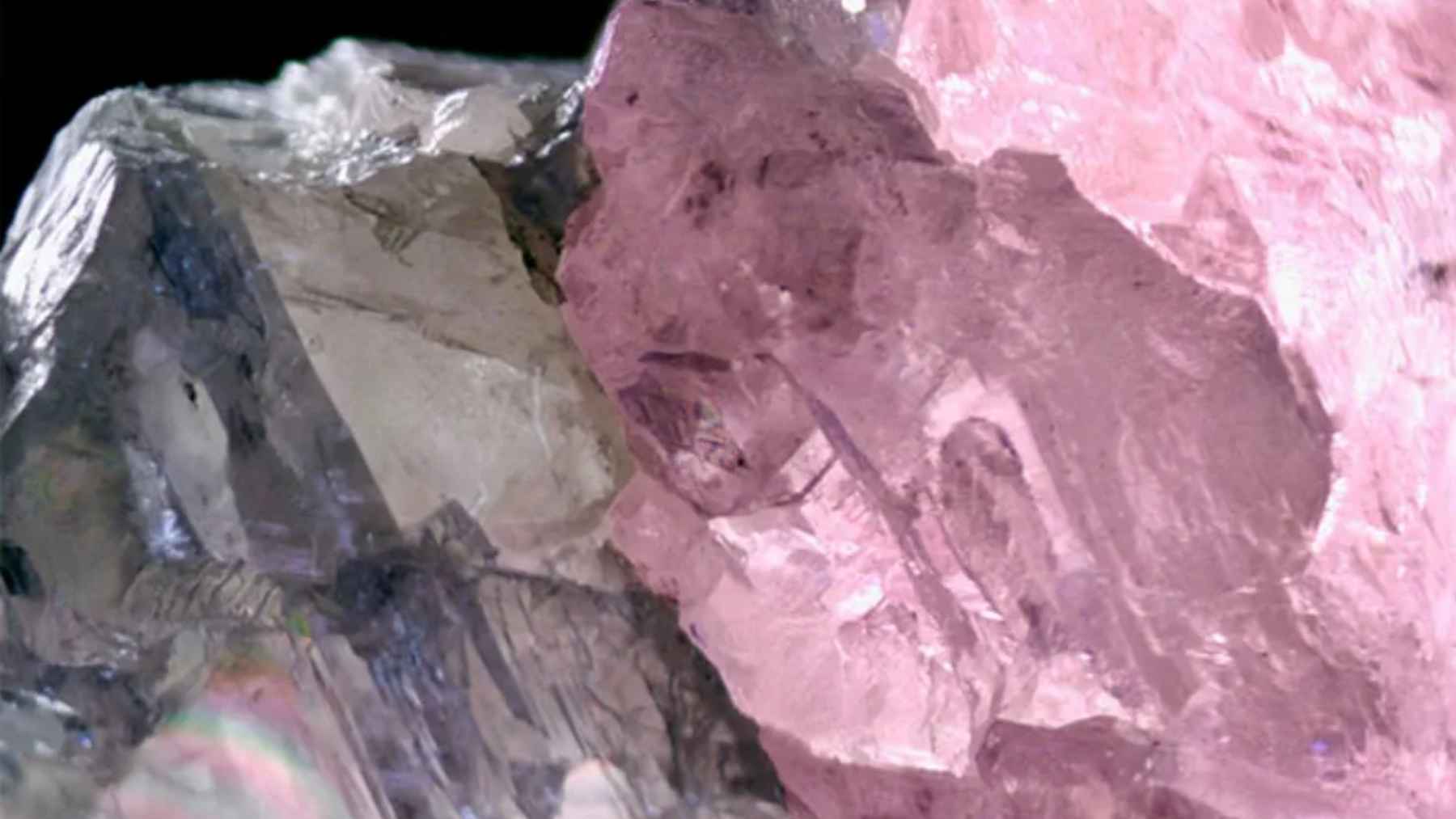
A rough diamond recovered in Botswana looks like someone drew a clean line through it. One side is pink. The other is clear. The boundary is so sharp that, at a glance, it feels almost impossible that nature did it.
Gem researchers say the stone may be recording two different chapters of its growth, written deep inside Earth. If that’s right, the diamond is not just rare for collectors. It’s also a natural “before and after” sample that could help explain how intense underground stress can leave lasting color changes in a crystal.
A two tone diamond that is unusually large
The diamond weighs 37.41 carats and measures about 1 inch along its longest side. Scientists at the Gemological Institute of America examined it at the organization’s Botswana laboratory after it came from the Karowe mine.
What makes it especially useful is scale. Similar pink and clear bicolor rough diamonds studied in labs have typically been under 2 carats, including earlier examples described in “Bicolor Rough Diamond Crystals”. With a much larger specimen, researchers can test more spots and compare the two halves in greater detail.
The simple idea behind a pink diamond
Diamonds form far below the surface, where carbon atoms lock into a tight, repeating structure. You can think of that structure like a perfectly stacked wall of blocks. When everything stays balanced, the result is usually a clear stone.
Pink is different. Instead of coming mainly from “extra” atoms mixed into the diamond, pink often appears when the internal structure gets pushed out of shape by strong stress. It’s a permanent bend in the pattern, like a crease that never fully smooths out.
A color boundary that acts like a timeline
To figure out what separated the pink and clear sides, researchers used imaging and light-based tests that track how a material absorbs and gives off light. The pink side showed a broad feature around 550 nanometers that is widely linked to natural pink color, while the clear side did not.
Both sides were classified as Type IIa, a very pure kind of diamond with little nitrogen. That’s important because it points away from impurities as the main cause of the split. Instead, the clean divide fits the idea that the pink region was stressed first, and the clear region grew later under calmer conditions.
What stress might have done underground
So what kind of stress are we talking about? In geology, huge forces can squeeze and shift deep rocks during major events like mountain building, even if the action happens slowly over long periods. In a diamond, that pressure can distort the crystal structure enough to change how it interacts with light, which is how pink can show up.
This stone is valuable because it holds both states in one place. One half looks like it “remembers” the squeeze. The other half looks like it kept growing afterward, almost like the planet hit pause on the stress and then pressed play again.
Why the finding matters above ground
Pink and red diamonds make up only a tiny slice of the natural stones graded, even among fancy colors that are already rare. A large bicolor example gives labs a clearer reference for separating color caused by stress from color caused by other factors, which matters for science and for how stones are identified and described.
It also adds a surprisingly down-to-earth takeaway. Something as small as a gemstone can carry clues about forces that shape continents, even if those forces are far removed from everyday life. A thin line inside a crystal can hint at Earth’s deep past. Just like that.
The official report was published on GIA Research News.