For decades, one of the strangest animals in the fossil record was drawn literally upside down and back to front. The creature is called Hallucigenia, a spiky worm from the Cambrian seas about 508 million years ago.
Recent reanalysis with powerful microscopes finally pinned down which end is the head, revealed a mouth full of teeth, and linked this odd little animal to the huge modern group of moulting creatures that includes spiders, insects, and crabs.
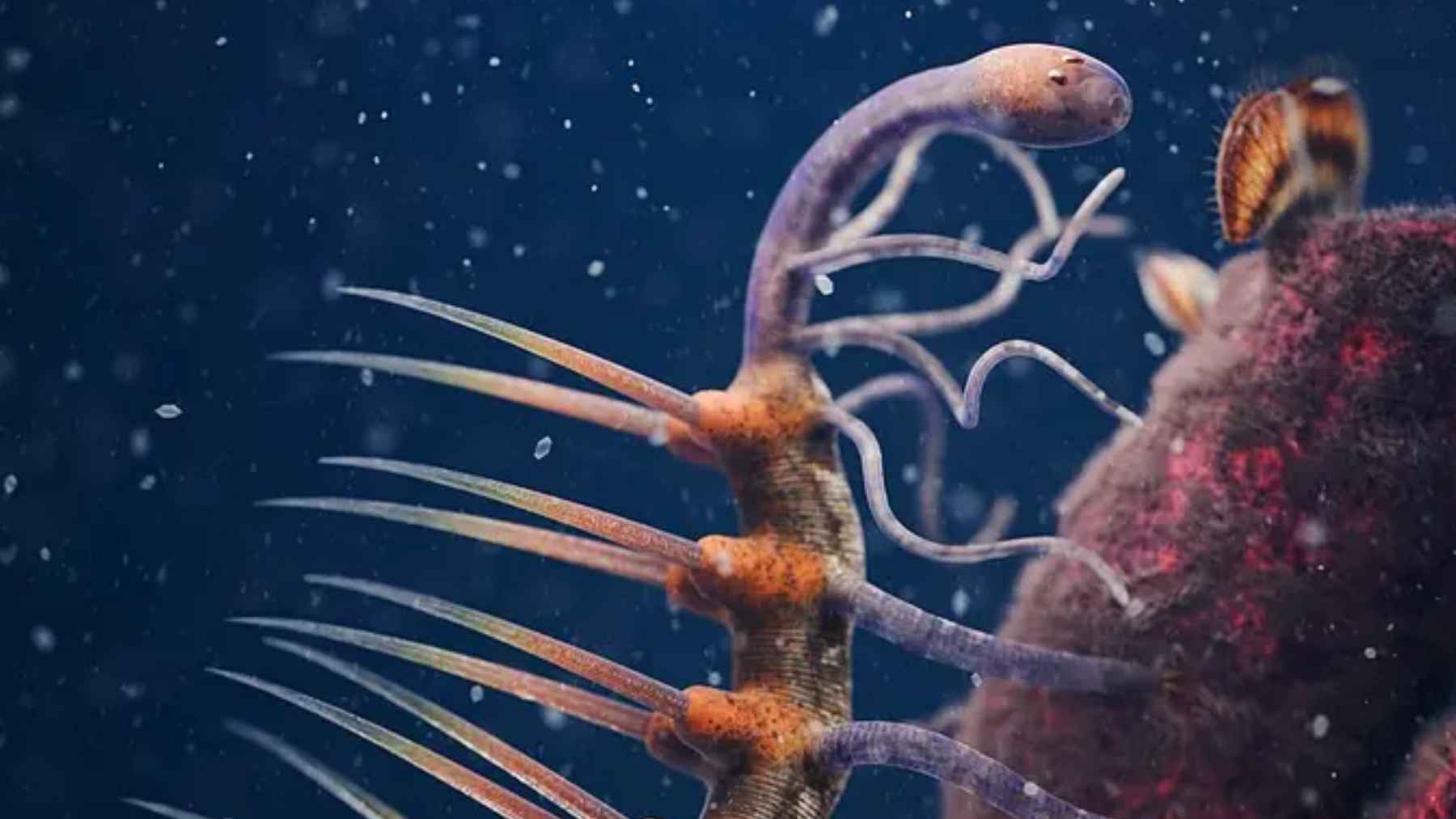
If you tried to design a “weird prehistoric pet” from scratch, you would probably end up close to Hallucigenia. The animal was only about half a centimeter to a few centimeters long, with soft, tube-like legs underneath and a row of rigid spines along its back.
It lived on the floor of Cambrian oceans, in communities now preserved in the famous Burgess Shale of the Canadian Rockies. That site records an entire seafloor ecosystem in remarkable detail, thanks to rapid mudflows that buried animals in fine sediment and protected even soft tissues from decay.
An animal so strange scientists drew it upside down
When Hallucigenia was first re-described in the 1970s, British paleontologist Simon Conway Morris interpreted the fossil as a worm walking on stiff spikes, with soft tentacles waving along its back to catch food. It looked so surreal that he named it “Hallucigenia.” Only later did additional specimens reveal that the supposed “tentacles” actually came in pairs.
In the early 90s, Lars Ramsköld and Hou Xianguang flipped the fossil, showing that the paired structures were legs on the underside, while the spines sat on the back as armor.
Even then, the story was not finished. A dark, round blotch at one end of many fossils was long treated as a simple head. The 2015 breakthrough came when researchers from the University of Cambridge and the Royal Ontario Museum used electron microscopes to look closer.
They showed that the dark blob was not anatomy at all, but a stain left by decayed gut contents that oozed out when the animal was crushed in the sediment.
A ring of teeth and a built in suction pump
Once that mistake was cleared up, paleontologists could finally uncover the real head, which sits at the opposite end of the body on a thin neck. New images revealed a small elongated head with a pair of simple eyes above a circular mouth framed by a ring of teeth. Inside the throat they found another set of tiny, needle-like teeth.
The team interprets this combination as a kind of suction pump. Teeth around the mouth probably flexed in and out to pull food inward, while the throat teeth worked like a one-way ratchet that kept morsels from slipping back out between “sucks”.
A recent preprint on Hallucigenia’s diet even describes several tiny individuals clustered around the carcass of a jelly-like animal, hinting that these worms may have scavenged in small groups on the seafloor.
Life on a Cambrian seafloor
What did a day in the life of Hallucigenia look like? It probably moved slowly over the sediment on its soft legs, using the claws at the tip of each limb to grip firm surfaces. Some researchers suggest it may have anchored itself to sponges or other structures while feeding, relying on its spiny back as a deterrent to predators such as the large swimming hunter Anomalocaris that also lived in Burgess Shale communities.
In practical terms, this was a small bottom dweller in a crowded neighborhood. Burgess Shale faunas include predators, grazers, filter feeders, and burrowers, all packed into a relatively thin slice of ancient ocean. Hallucigenia’s combination of claws and armor fits neatly into that setting as a slow-moving animal that needed good grip and good protection more than speed.
From “hallucination” to a key branch on the animal tree
For a long time, some scientists wondered whether Hallucigenia represented a dead end in evolution. Ongoing work has turned that view around. Detailed analysis of its claws shows a stacked, cone-in-cone construction that closely matches the claws and jaws of living velvet worms, strange caterpillar-like animals that still creep through tropical leaf litter today.
Together with the tooth-lined throat, these features place Hallucigenia within the wider group of moulting animals known as ecdysozoans. That group includes modern arthropods such as insects, spiders, and crustaceans, as well as velvet worms and water bears.
A recent study in the journal PNAS compared Cambrian lobopodians like Hallucigenia with modern tardigrades and found that many of the key traits of these tiny “water bears” have deep roots in this early radiation.
At the end of the day, this spiky little worm has become a kind of compass for understanding how today’s arthropod dominated ecosystems came to be. The same lineage that once crawled slowly across Cambrian mud now includes the spiders in your bathroom and the insects that pollinate crops.
Why this fossil mystery matters now
Hallucigenia’s story shows how science corrects itself over time. A small mistake in how a fossil is oriented can ripple into big misunderstandings about entire branches of the tree of life. New tools, such as electron microscopy and three-dimensional imaging, are now letting researchers revisit classic fossils and spot details that were invisible in the 20th century.
There is a broader lesson too. Burgess Shale type sites capture entire ecosystems in transition just after a burst of evolutionary innovation. They remind us that biodiversity has always been shaped by a mix of rapid change, experimentation in body plans, and extinction.
As modern ecosystems face pressure from climate change and habitat loss, deep time examples like Hallucigenia help scientists see how resilient, and how fragile, complex communities can be.
The press release was published by the University of Cambridge.