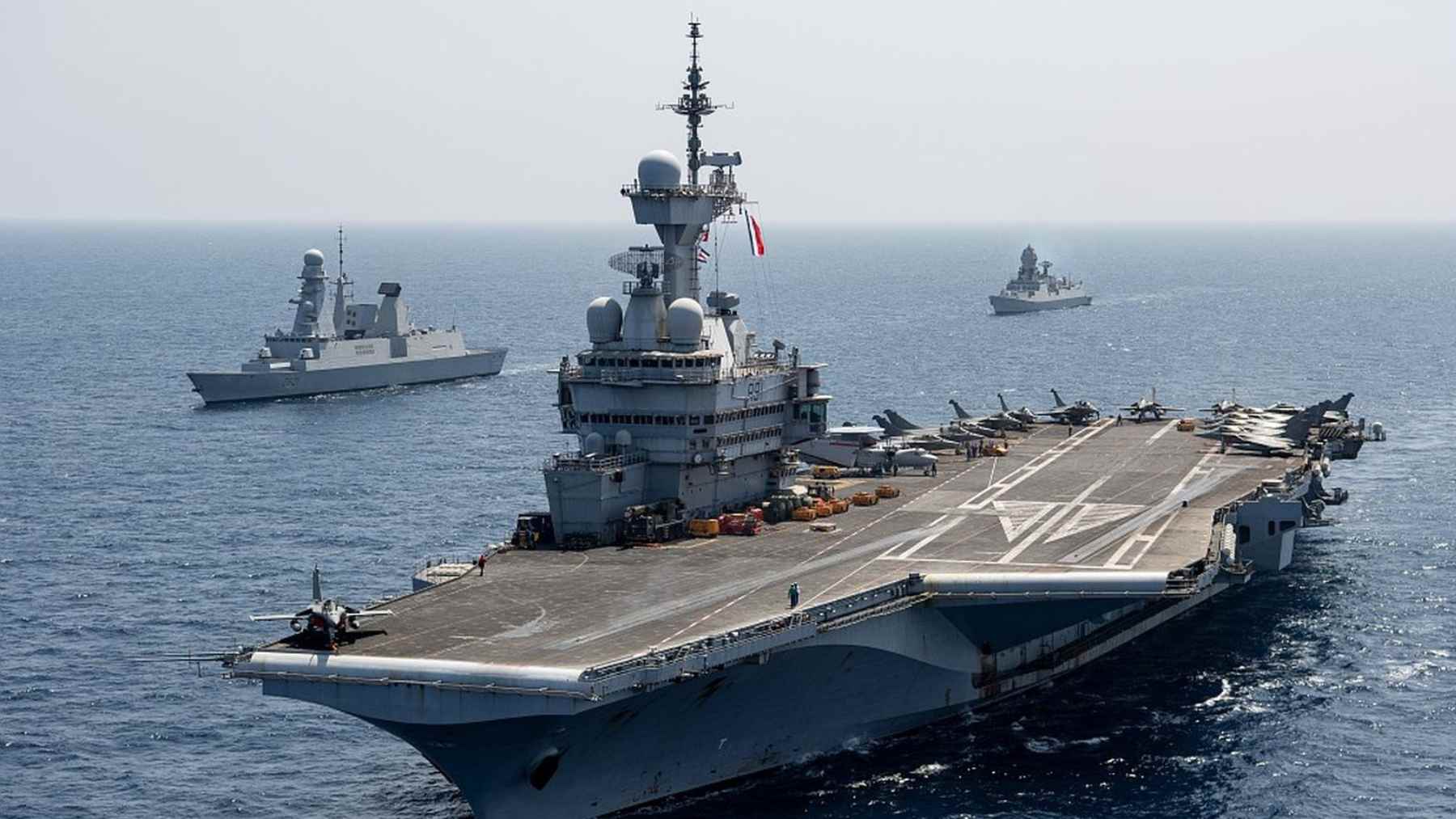
France has sent its nuclear powered aircraft carrier Charles de Gaulle and an escort fleet toward the North Atlantic and Arctic for Exercise ORION 26, a massive multi-domain war game with more than 12,000 personnel, 25 ships and around 140 aircraft and drones involved.
On paper this is about readiness and deterrence. In practice it also means a surge of fuel use, noise and activity in waters that scientists already describe as some of the most climate stressed and ecologically fragile on the planet.
High intensity training in a fragile region
According to the French Ministry of Armed Forces, ORION 26 is an inter-service and allied drill designed to prepare troops for high-intensity conflict in complex, contested environments, including cyber and space. The carrier group left Toulon at the end of January and will operate for weeks in the North Atlantic, with planned activity that reaches into Arctic approaches near Greenland.
The scenario is fictitious yet the footprint at sea is very real. A carrier air wing that repeatedly launches fighter jets, a screen of escorts and support ships, and long supply chains on land together create a temporary spike in emissions and disturbance across a large ocean area. It is the kind of spike that rarely appears in public climate accounting.
Military emissions and the climate blind spot
Researchers who tried to estimate the carbon footprint of European Union armed forces found that EU militaries together emitted about 24.8 million tonnes of CO₂ equivalent in 2019, roughly the same as 14 million average cars. France ranked among the higher emitting states in that analysis.
More recent work suggests military activities worldwide may already account for around 5.5% of global greenhouse gas emissions, a share larger than civilian aviation or shipping, with that number likely to rise as defense spending increases. Yet detailed reporting of these emissions remains patchy because military fuel use still enjoys exemptions or looser rules in many climate frameworks.
The Charles de Gaulle itself uses nuclear propulsion, which cuts direct CO₂ output from its main engines. But the carrier strike group around it still relies on fossil fuels for destroyers, logistics vessels and the Rafale fighter jets that will be flying frequent sorties in ORION 26. The longer the group trains far from home ports in the North Atlantic Ocean, the larger that temporary footprint becomes.
Black carbon and new traffic in Arctic waters
When naval exercises extend toward Arctic zones, they add to a shipping trend that already troubles climate scientists. Studies show that ships operating in Arctic waters still burn large quantities of heavy fuel oil, which produces black carbon particles that settle on snow and ice, darken the surface and speed up melting.
Environmental groups have pushed for a full ban on heavy fuel oil in the Arctic and highlight that switching to cleaner distillate fuels could cut black carbon emissions from ships by 30 to 80 percent. Military fleets are often not at the center of these debates, even though they operate some of the largest and most powerful vessels in the region.
For people being told to turn down the thermostat at home and swap cars for public transit, this gap can feel jarring. Civilian life gets audited line by line, while fleets steaming north sit largely outside the carbon conversation.
Sonar, noise and whales in the exercise area
The environmental impact is not only about exhaust pipes. Exercises that practice anti-submarine warfare typically rely on high-intensity active sonar and dense ship traffic. Controlled experiments and field observations have shown that beaked whales and other deep-diving cetaceans abruptly stop foraging, flee the area or even strand in connection with powerful naval sonar.
As climate change reduces sea ice and opens more Arctic waters to human activity, researchers are already documenting a much noisier underwater soundscape from commercial shipping, fishing and military activity. For whales that rely on sound to navigate, find food and communicate, this growing acoustic fog can be the difference between thriving and simply surviving.
ORION 26 is not unique here. It sits within a pattern where security drills keep expanding into the same high-latitude seas that climate scientists urge the world to treat with extra care.
Balancing security and environmental responsibility
None of this means countries like France will simply stop training their armed forces. The French government sees ORION 26 as proof that it can lead a multinational coalition and operate seamlessly alongside allies in a potential crisis on European soil or at sea.
The question is how quickly military planners can fold environmental safeguards into these operations. Experts and advocacy groups increasingly call for full and transparent military emissions reporting, strict limits on heavy fuel oil use in sensitive regions and real-time acoustic monitoring during major exercises so that activity can be adjusted when whales or other vulnerable species are present.
That might sound abstract, yet in practical terms it means decisions like routing fleets outside key migration corridors, slowing down to cut fuel burn and noise, or investing in cleaner propulsion for support vessels. It is the equivalent of insulating the barracks and hangars instead of only telling families to lower the electric bill at home.
At the end of the day, ORION 26 shows how 21st-century security and environmental protection now share the same stage. What happens in this three-month war game will fade from the headlines, but its echoes in policy on military emissions and Arctic protection could last much longer.
The official statement was published by Ministère des Armées.