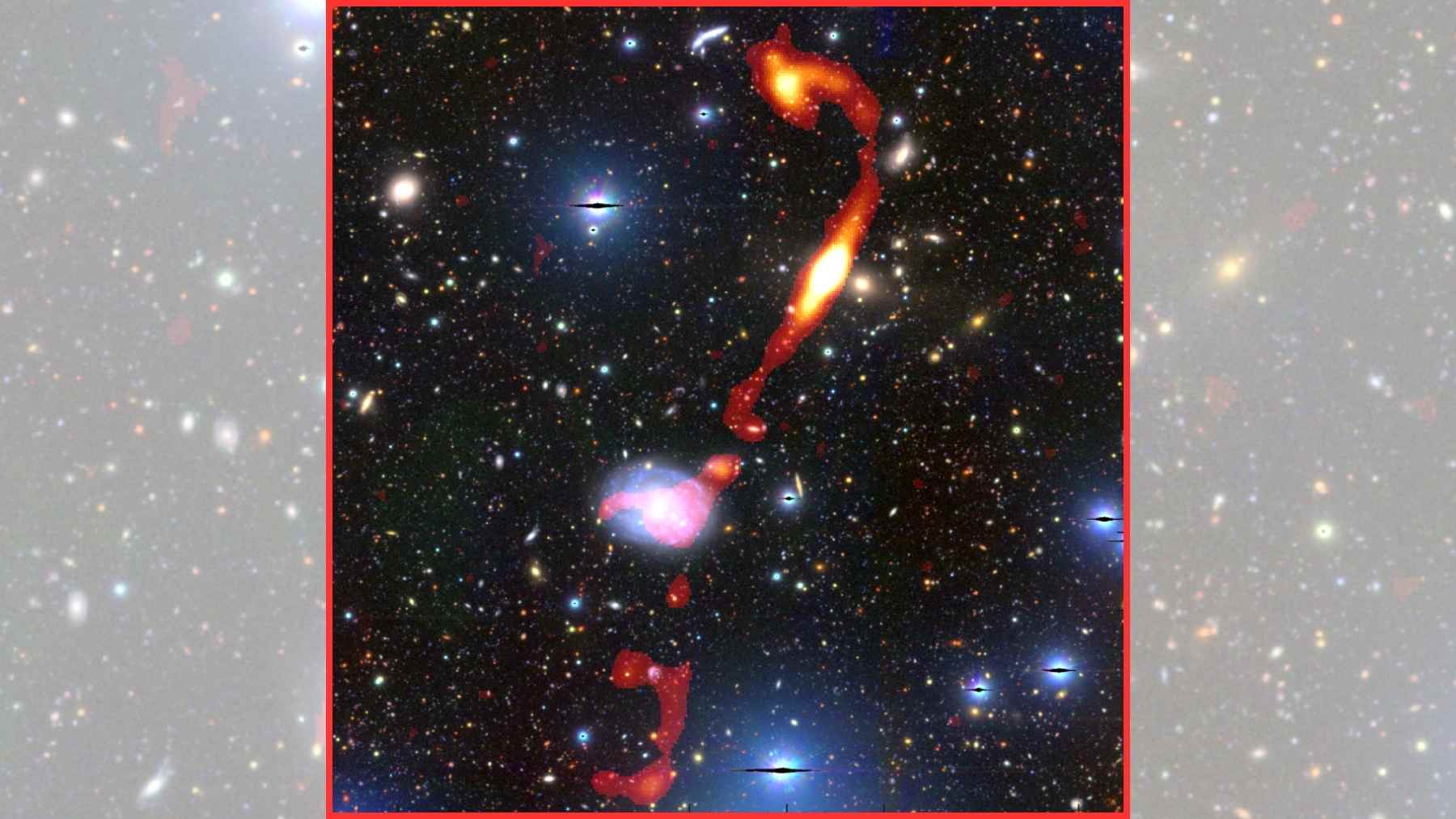
Astronomers using South Africa’s MeerKAT radio telescope have spotted a colossal galaxy whose radio jets span about 3.3 million light years, roughly 32 times the diameter of the Milky Way. The object, nicknamed “Inkathazo” which means “trouble” in isiXhosa and isiZulu, is one of the largest radio galaxies ever seen and is giving scientists a headache in the best possible way.
So what makes this galaxy so troublesome? For a start, its size alone would be remarkable. Inkathazo sits around 1.44 billion light years from Earth, yet its twin streams of plasma still cover a distance that could fit dozens of Milky Way-sized galaxies in a row.
A cosmic giant with a fitting name
Giant radio galaxies are powered by supermassive black holes in their centers that feed on gas and dust, then launch jets of charged particles at nearly light speed into intergalactic space. Those jets glow in radio light and can stretch for millions of light years.
Inkathazo does not behave like the textbook examples. Instead of two straight, symmetric jets, at least one side is bent, as if the flow has been nudged or pushed off course. On top of that, this galaxy does not live in a quiet corner of space. It sits at the crowded core of a galaxy cluster, a region filled with other galaxies and hot, thin gas. In such a busy environment, astronomers usually expect the surrounding material to slow jets down and limit how far they can grow, which makes Inkathazo’s extreme size especially puzzling.
“Finding a giant radio galaxy in a dense cluster raises questions about how much the environment helps or hinders these huge structures,” explained co author Kshitij Thorat of the University of Pretoria.
Reading the age of radio light
To dig deeper into the mystery, the team used MeerKAT’s sensitivity to build some of the most detailed “spectral age” maps ever made for this kind of object. In simple terms, these maps compare radio signals at different frequencies to estimate how long the electrons in the jets have been radiating away their energy. Younger plasma shows up in one range of colors, older plasma in another.
The pattern along Inkathazo’s jets is anything but simple. In several regions, electrons appear to receive fresh boosts of energy, instead of cooling smoothly with distance from the galaxy’s center. The researchers think these jumps may happen when the jets slam into clumps or filaments of hot gas that fill the space between galaxies in the cluster. That kind of collision can compress and re-energize the plasma, a bit like a gust of wind puffing up a flag that had gone limp.
Those details matter because they test how well current computer models describe the life of radio jets. If simulations assume a quiet, uniform environment, they may miss key physics that only shows up in messy, real-world galaxy clusters. Inkathazo is effectively a natural laboratory where theory and observation can be compared pixel by pixel.
From rare curiosities to a growing population
For years, giant radio galaxies were thought to be rare oddities scattered across the sky. New facilities such as MeerKAT are changing that picture. In just one well-studied patch of sky known as COSMOS, an area only about five times the size of the full Moon, astronomers have now found three giant radio galaxies, including Inkathazo.
“The number of giant radio galaxy discoveries has absolutely exploded in the past five years thanks to powerful new telescopes like MeerKAT,” said lead author Kathleen Charlton of the University of Cape Town.
MeerKAT itself sits in the remote Karoo region and is made up of 64 dishes working together. It already delivers images sharp enough to trace the delicate edges of Inkathazo’s jets against a backdrop of thousands of distant galaxies. It is also a pathfinder for the Square Kilometre Array, a much larger international radio observatory scheduled to start operating later this decade.
A new way to think about cosmic environments
For readers more used to thinking about smog, traffic and heat waves than about jets and clusters, there is a familiar thread here. Just as life in a packed city feels different from life in a quiet rural valley, galaxies in crowded clusters grow and evolve in ways that differ from galaxies in isolation. Their surroundings shape them.
Inkathazo shows that even the most powerful black hole engines do not live in a vacuum. Their output is bent, stirred and sometimes recharged by the cosmic weather around them. That is why mapping these giants is not just about distant fireworks. It is about understanding how matter, energy and gravity interact on the largest scales, and how structures in the universe recycle gas that can someday form new stars and planets.
At the end of the day, this troublesome galaxy is a reminder that our cosmic neighborhood is more dynamic and interconnected than it looks on a clear night in the backyard. With MeerKAT already revealing giants hidden in the southern sky and the Square Kilometre Array on the horizon, Inkathazo is likely only the first of many such surprises.
The study was published on Monthly Notices of the Royal Astronomical Society.