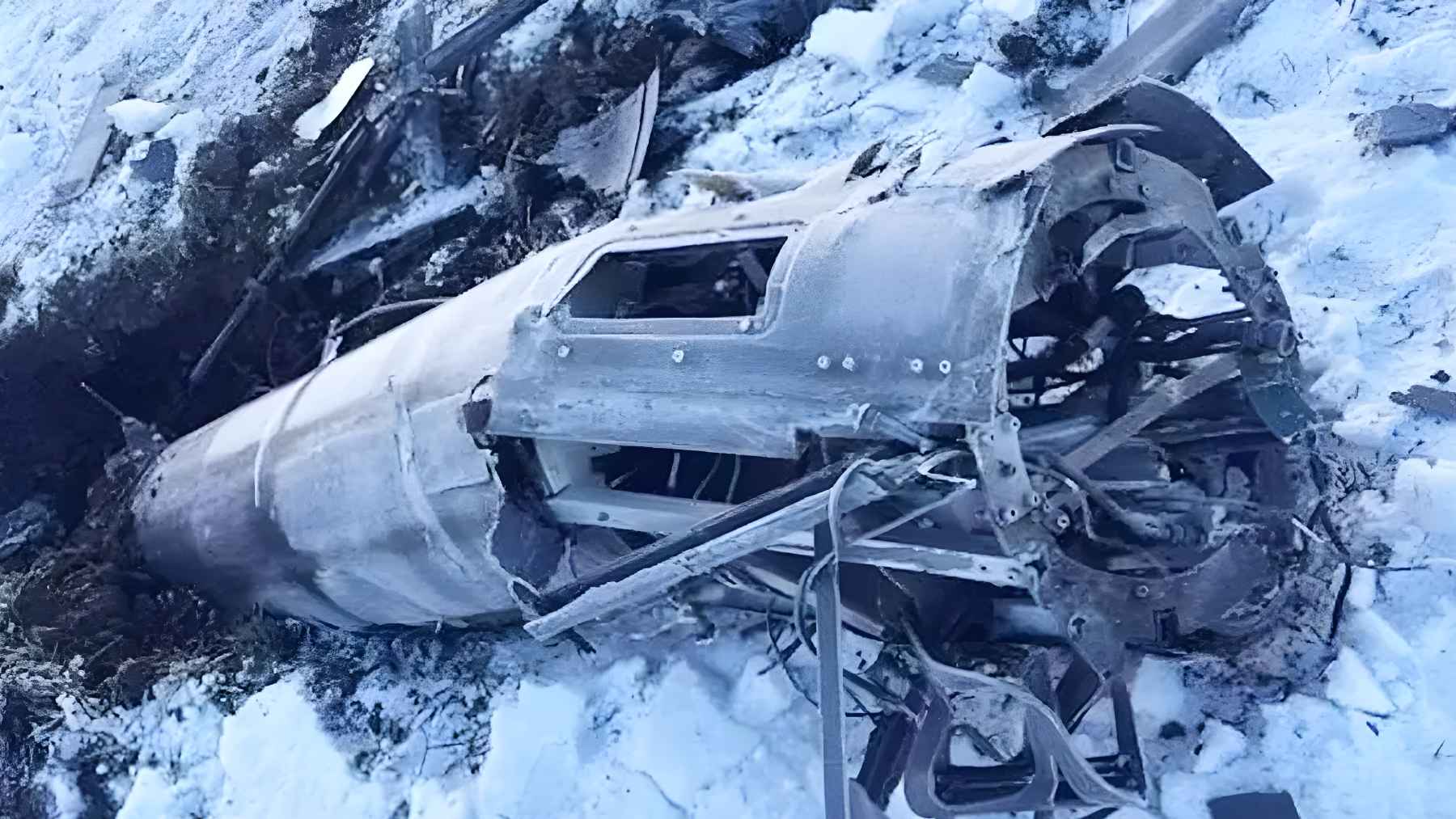
When Ukrainian technicians picked through the wreckage of a newly shot down Geran‑5, they expected to find a Russian long-range drone. What they actually uncovered looked more like a flying lesson in globalization, packed with foreign electronics and a Chinese jet engine.
The discovery confirms what Kyiv has hinted for months. Modern war is not only fought with missiles at the front. It also depends on civilian supply chains that stretch from chip fabs to online marketplaces.
Inside Russia’s new long-range drone
The Geran‑5 is the latest evolution in a family of attack drones that began with designs inspired by Iran’s Shahed series. This new model abandons the delta‑wing profile and instead resembles a small conventional aircraft, with a fixed wing and a rear-mounted turbojet.
Ukrainian military intelligence says the system carries a warhead of about 90 kilograms and can travel close to 950 kilometers at cruising speeds between 450 and 600 kilometers per hour, which leaves air defenses very little reaction time.
According to the same analysis, the airframe skin, wings, and tail are made of carbon fiber over an internal skeleton of aluminum and steel, and the powerplant is a TELEFLY TF‑TJ2000A engine imported from China. In other words, the drone looks Russian on the outside, yet inside it reads like a parts catalog from several countries at once.
Those findings sit in a much wider trend. The Ukrainian battlefield has become a testing ground where drones set the rhythm for both attack and defense, from one‑way explosive “loitering munitions” to cheap quadcopters spotting targets above the trenches.
From consumer electronics to kamikaze drones
Ukrainian intelligence and journalists who examined the recovered Geran‑5 say they identified more than a dozen foreign electronic components on the boards, including at least nine made by American firms, several key modules from Chinese manufacturers, and a transistor traced back to a German company. These pieces are not weapons by themselves.
They are the signal processors, clock generators, transceivers, and mesh modems that keep the drone stable, navigated, and reliable enough to be built in volume.
That mix highlights a structural weakness. Even under sanctions, a determined buyer can route dual-use electronics through gray markets and reexport hubs, then bolt them into a new weapon. Business reports now describe Western companies scrambling to explain how their parts ended up inside the Geran‑5 and similar systems, even though they insist they follow export rules.
The environmental tab nobody is adding up
Most of the public debate about these drones focuses on blast radius and air defense. Yet every circuit board in a Geran‑5 begins life in a factory that already carries a heavy environmental footprint. Research from imec estimates that production of integrated circuits alone accounts for about 185 million tons of CO₂ equivalent each year, once you add up process gases, electricity, and the supply chain behind specialty chemicals and materials.
Water use tells a similar story. Big chip plants rely on huge flows of ultrapure water to rinse wafers. An analysis highlighted by the World Economic Forum notes that a large modern fab can use around ten million gallons of ultrapure water per day, roughly the daily consumption of tens of thousands of households.
That kind of demand quietly competes with farms and cities that are already dealing with drought and higher electric bills in a warming world.
So when a Geran‑5 slams into an electrical substation or a residential block, the climate cost is not only in the immediate fire and smoke. It also sits upstream in the fabs that produced the chips and downstream in the reconstruction that follows.
Articles on China’s massive new nuclear reactor program show how energy choices and security planning now run straight through the same industrial base.
War debris that outlives the headlines
On the ground, Ukraine’s drone war is leaving another kind of footprint that is easier to overlook. To avoid jamming, many front line units use fiber-optic-guided drones that trail kilometers of thin plastic cable over fields, forests, and rivers. Once the mission ends, most of that cable stays where it fell.
Environmental researchers warn that this new waste behaves less like ordinary litter and more like “ghost gear” from the fishing industry. A study from the Conflict and Environment Observatory on plastic pollution from fibre optic drones describes how abandoned cables can entangle wildlife, slice into limbs, or trap animals until they starve.
For rural communities that hope to return to farming once the front moves, that kind of invisible hazard can linger in the soil and hedges for years.
At the same time, engineers are experimenting with more precise and sometimes lighter delivery systems, such as the tiny parachute designs described in this study on kirigami parachutes for drone drops, which might one day help aid groups reduce both missed drops and wasted materials.
Why this matters for climate and sanctions policy
All of this drops into a global climate picture that is already under strain. A joint assessment by the Conflict and Environment Observatory and Scientists for Global Responsibility estimates that militaries worldwide are responsible for roughly 5.5% of global greenhouse gas emissions, a carbon footprint larger than that of many major economies.
Yet most armed forces still face limited pressure to disclose or cut those emissions, even as agencies like NASA warn of rapidly rising sea levels and ocean heat that threaten coastal cities and critical infrastructure.
That is why the Geran‑5 teardown matters beyond the immediate war. Each foreign chip inside it is a clue for export control investigators.
Each meter of fiber optic cable and each extra ton of steel and carbon fiber is part of a broader accounting of how war shifts pollution and resource use onto communities that may never appear in a military briefing. And each new drone design that leans on cheap civilian technology nudges the world toward a future where the line between your phone, your car, and a weapon system grows thinner.
At the end of the day, tracking the parts inside drones like the Geran‑5 is not only about stopping the next attack. It is also about deciding whether climate plans, trade rules, and environmental safeguards will treat the arms industry like a special case or like any other sector that has to live within planetary limits, the same way our power grids and even our space weather forecasts already do.
The official statement was published on War&Sanctions.