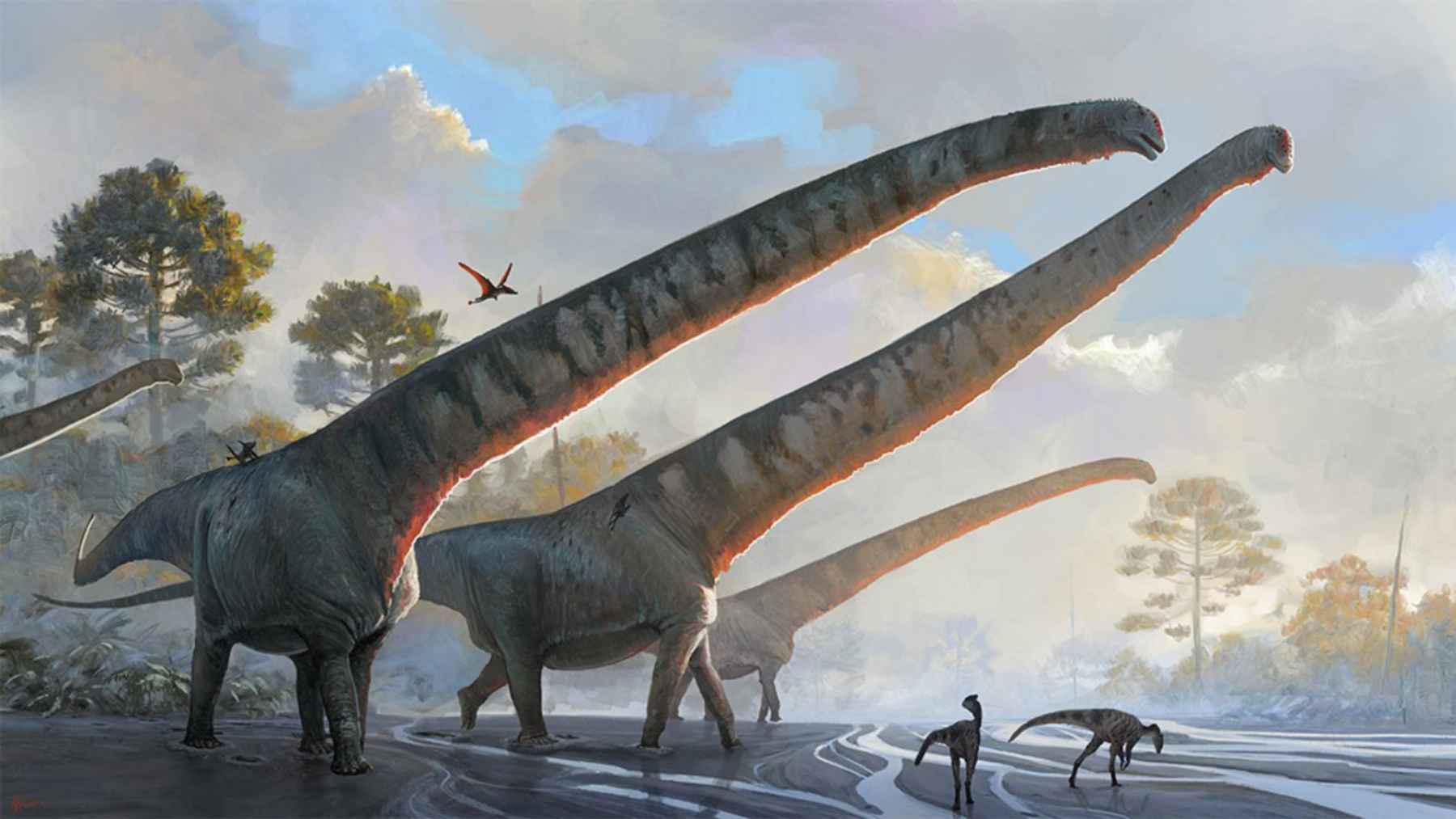
It might sound like something out of Jurassic Park, but the latest discovery from southwestern China is entirely real. Paleontologists have identified a new long-necked dinosaur that likely stretched between about 23 and 28 meters in life, putting it among the biggest land animals ever to walk the planet.
The dinosaur, named Tongnanlong zhimingi, was described by a team led by paleontologist Xuefang Wei at the Chengdu Center of the China Geological Survey. Their work in the journal Scientific Reports shows that this giant herbivore lived in the Suining Formation of the Sichuan Basin during the Late Jurassic and belonged to the long-necked mamenchisaurid family, known for extremely elongated necks.
A giant sauropod hiding under a construction site
The bones of Tongnanlong were first uncovered in 1998 during building work in the Tongnan District of Chongqing, in the eastern part of the Sichuan Basin. Workers noticed unusually large fossils in the ground, and the remains were later collected and prepared by local museums and research teams.
The holotype skeleton includes three back vertebrae, six tail vertebrae, a complete left shoulder girdle, and parts of the hind limbs. Even though the skull and neck are missing, the material is well preserved and still partly articulated, which means the carcass probably did not travel far before it was buried on the shore of a shallow lake.
Sediment around the fossils is made of purplish red sandstone with a rippled texture that points to a lakeside setting in a relatively dry climate. The same rock layer has also produced freshwater clams, tiny crustaceans, fish such as Ceratodus szechuanensis, and turtles related to Plesiochelys tatsuensis, so this was a busy Jurassic shoreline rather than a barren desert.
How big was Tongnanlong really?
To estimate the size of such an incomplete dinosaur, the team focused on bones that usually scale well with total length, especially the massive shoulder blade and the fibula in the lower leg. When they compared these elements with more complete relatives such as Mamenchisaurus youngi, Mamenchisaurus hochuanensis, and Omeisaurus tianfuensis, they found that Tongnanlong probably reached between about 23 and 26 meters from head to tail.
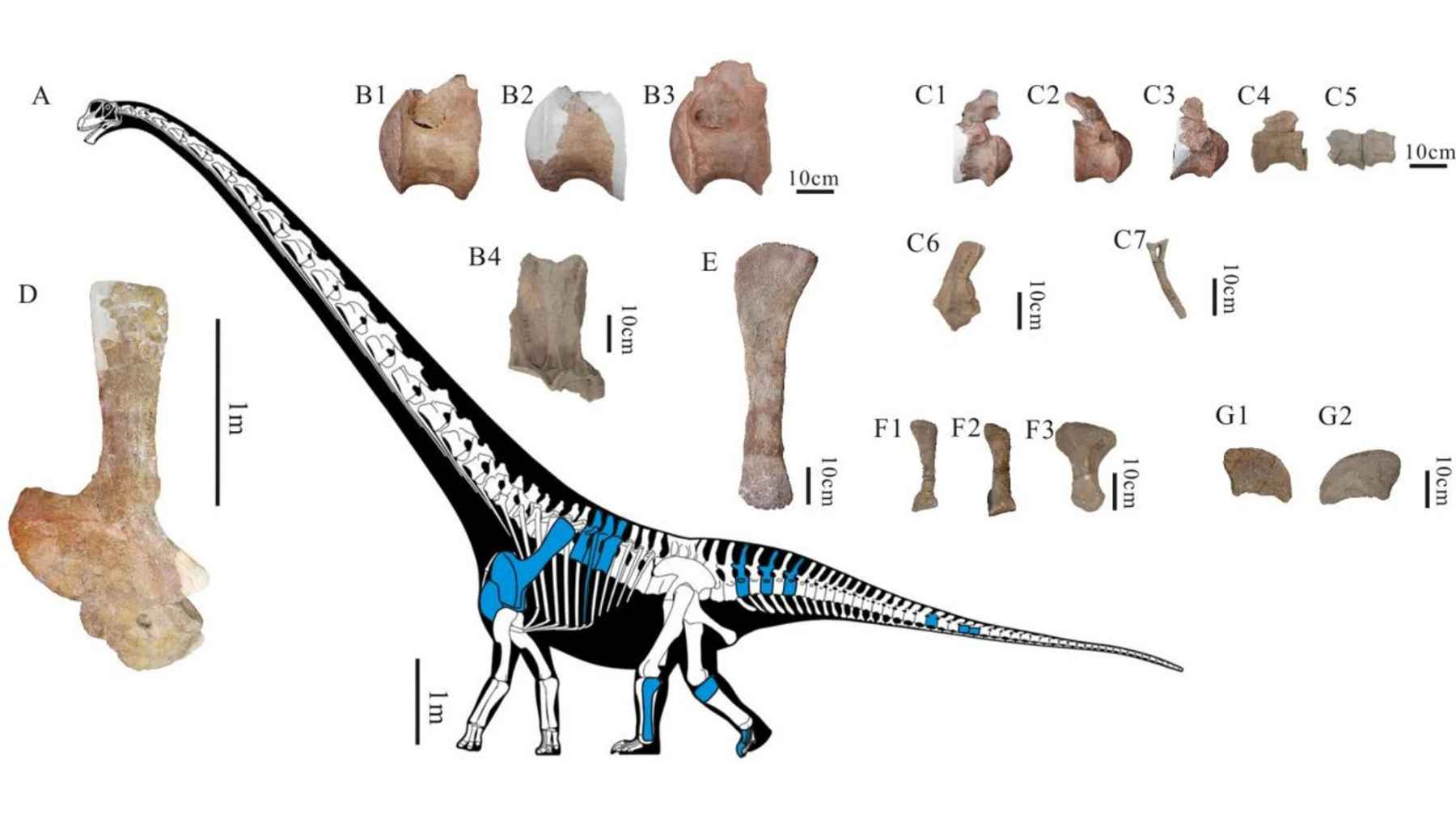
A second method that links shoulder blade length to overall body size pushed the upper limit closer to 28 meters, although the authors treat that value as less certain and favor a conservative range near 25 to 26 meters. Even at the low end, this animal would rank among the largest mamenchisaurids known, roughly the length of two city buses parked in a line.
Part of the uncertainty comes from the neck. A study published in 2022 in the journal PeerJ showed that almost all well-known sauropod necks are incomplete and often distorted, which means that any whole body reconstruction is a careful mix of measurement and informed judgment rather than a simple tape measure exercise.
What makes this long-necked dinosaur special?
Within the sauropod family tree, Tongnanlong belongs to Mamenchisauridae, a group of long-necked herbivores that could reach plants other dinosaurs could not. Its back and tail vertebrae show complex bony ridges and deep air-filled spaces that helped brace the spine and reduce weight at the same time.
In a large family tree analysis that compared 87 dinosaur species using 400 anatomical traits, the researchers placed Tongnanlong as a derived eusauropod more closely related to Mamenchisaurus than to Omeisaurus. That result fits with earlier discoveries of long-necked sauropods in the same region, including Qijianglong guokr from the Suining Formation.
The new fossil also has its own signatures, such as a huge shoulder blade and a distinctive pattern of pits and ridges on the back of the vertebrae. For paleontologists, details like these are crucial clues that help separate look-alike species and track how body plans changed over millions of years.
A wider map for Jurassic giants
For a long time, many experts thought that East Asia had a partly isolated dinosaur fauna in the Middle and Late Jurassic, as if the region formed its own park of strange species. New work on Tongnanlong and research on a mamenchisaurid from Tanzania named Wamweracaudia now suggest that these long-necked giants were more widely spread across the ancient world than that older picture allowed.
A broader spread makes sense when scientists look at the advantages that came with huge size. Very large sauropods were harder to attack, could reach higher leaves, and for the most part may have coped better with droughts and shifting river channels than smaller plant eaters that had to share the same space.
At the end of the day, Tongnanlong shows that even in well-studied regions, there are still surprises hiding under modern streets and construction sites. It also reminds us that our view ofJurassic ecosystems is still a work in progress, shaped a little more each time a new skeleton comes to light.
The main study has been published in Scientific Reports.