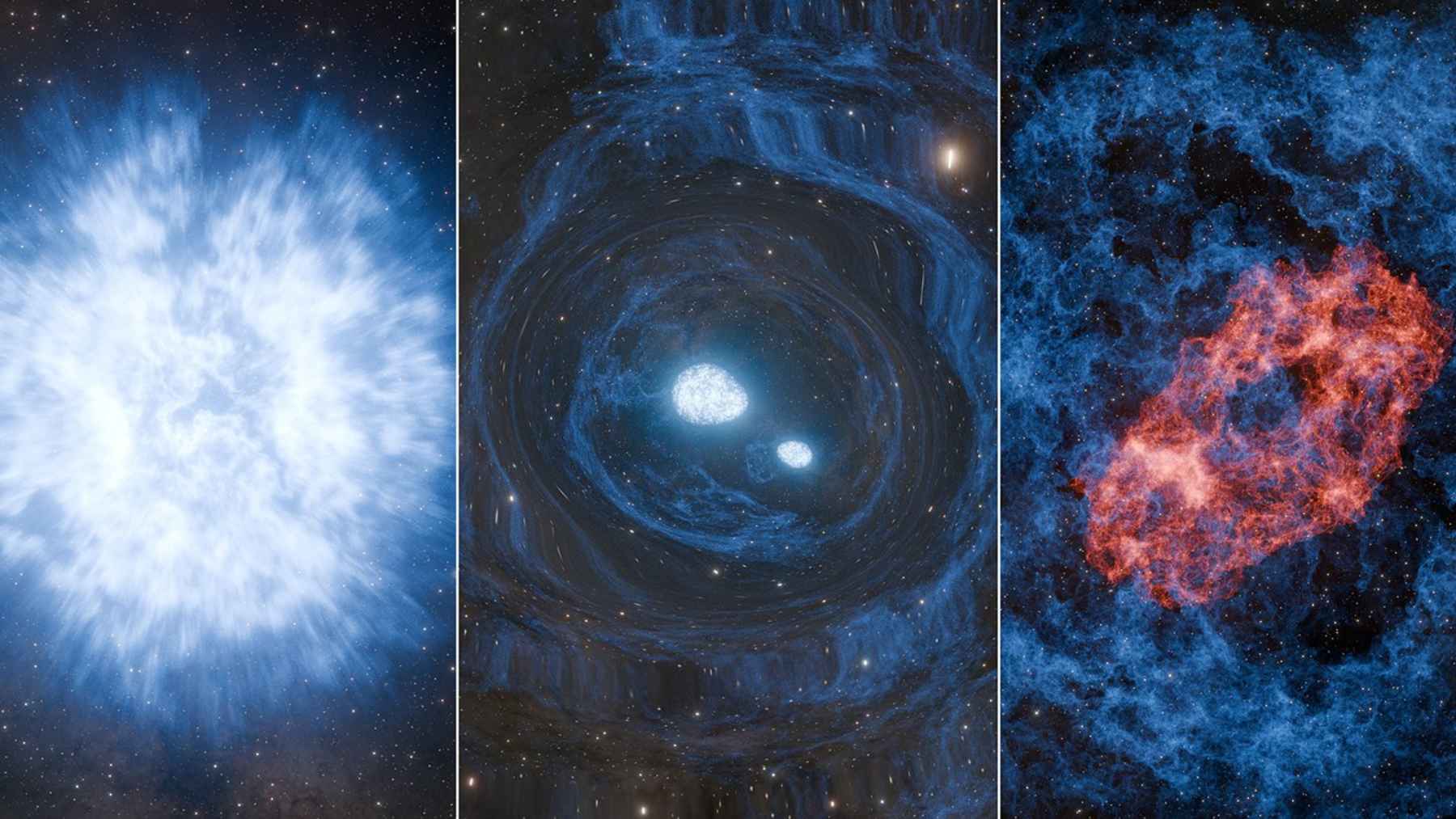
That gold ring on your finger, the tiny metals inside your phone and even parts of future electric car batteries all trace back to violent events in space. Now a strange cosmic blast named AT2025ulz may have given scientists the clearest hint yet that some stars can die in a double act, possibly creating huge amounts of the heaviest elements in the universe.
Researchers from Caltech, Carnegie Mellon University and several European institutes think AT2025ulz could be the first known example of a “superkilonova,” a long-predicted but never confirmed hybrid explosion.
In simple terms, it looks like a classic supernova and a kilonova happening in the same place, in almost the same cosmic breath. The idea is still a candidate, not a done deal, but if it holds up it would reshape how we think about where many of Earth’s rare elements come from.
A star that seems to explode twice
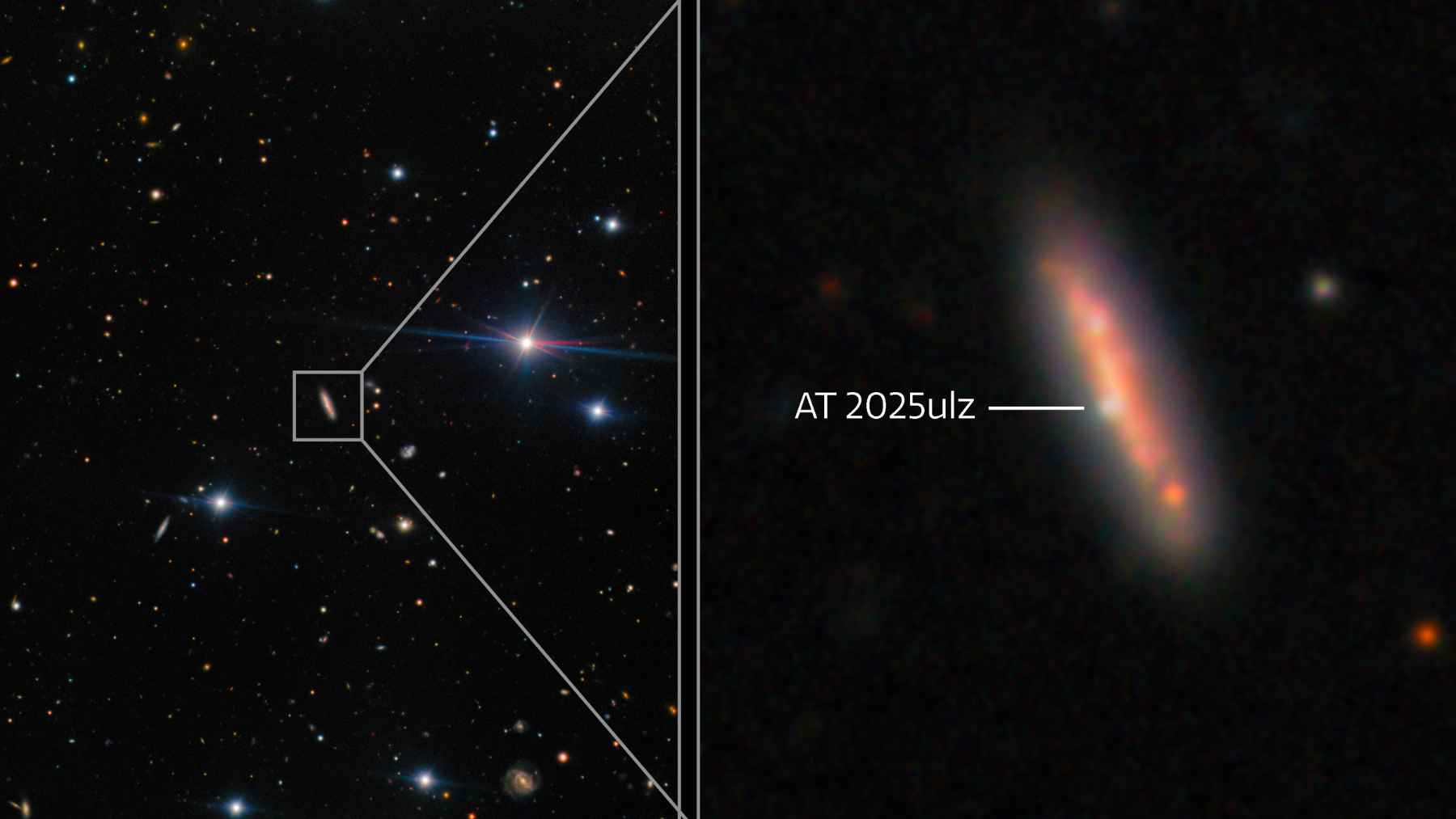
The story began on August 18, 2025, when the LIGO and Virgo gravitational wave detectors picked up a subtle ripple in spacetime that looked like two compact objects colliding. Within hours, the Zwicky Transient Facility in California spotted a rapidly fading red point of light about 1.3 billion light years away in the same region of sky.
For the first few days, the glow behaved a lot like the only firmly confirmed kilonova seen so far, the 2017 event known as GW170817.
Then the script flipped. Instead of fading away, AT2025ulz brightened again, its light turned bluer and its spectrum suddenly showed clear signs of hydrogen and helium.
Those fingerprints are typical of a “stripped envelope” core collapse supernova, where a massive star has already lost most of its outer layers before blowing up. Kilonovae, which come from colliding neutron stars, usually lack that hydrogen signature.
So what happened out there?
One leading explanation is that a very massive, rapidly spinning star collapsed and exploded as a supernova, but its core did not form just one neutron star. Instead, the core may have split into two unusually light neutron stars, each with less mass than our Sun, which is not what standard models expect.
Gravitational wave data suggest that at least one of the colliding objects was in this “sub solar” range. Those two newborn remnants could then have spiraled together and merged within hours, triggering a kilonova hidden inside the supernova debris.
Caltech astronomer Mansi Kasliwal, who leads the main study, summed up the team’s cautious excitement by saying that they do not know with certainty that AT2025ulz is a superkilonova, but that the event is “eye opening.”
Gold, platinum and green technology
Why should anyone stuck in traffic or worrying about the next electric bill care about an odd flash a billion light years away? Because events like this are among the main factories for the universe’s heaviest elements.
Supernovae and kilonovae forge atoms heavier than iron, including gold, platinum and uranium. These elements then mix into future generations of gas clouds, planets and, eventually, technology.
The gold in jewelry, the platinum group metals used in fuel cells and catalytic converters and some of the rare elements inside wind turbines and solar electronics were likely born in explosions of this kind.
For people working on renewable energy and high-efficiency devices, that is a quiet reminder that many key materials started life in extreme cosmic furnaces and are not easily replaced on human timescales. Treating them as disposable comes with a cost.
In practical terms, this does not change how we mine or recycle today, but it does change the story we tell about why careful use of these metals matters. They are not just “resources” in the ground. They are the final products of chain reactions that began long before Earth formed.
Chasing a mixed signal across the sky
To untangle this odd event, astronomers mounted a worldwide observing campaign. Teams used telescopes in Germany, Hawaii and elsewhere to follow AT2025ulz in visible and infrared light and then searched for X-ray and radio signals.
A group led from Carnegie Mellon also analyzed detailed spectra of the host galaxy taken in advance by the Dark Energy Spectroscopic Instrument in Arizona, which helped them confirm that the galaxy sits in the same three-dimensional region as the gravitational wave signal.
Their results point toward a stripped envelope supernova with unusual early behavior that briefly mimicked a kilonova. As graduate student Xander Hall put it, it takes a lot of observing time to tell true kilonovae from “impostors,” especially when the first days of data can be explained by more than one model.
On top of that, the gravitational wave detection itself was a “subthreshold” candidate, weaker than the loudest signals that LIGO and Virgo usually highlight, which makes firm conclusions even harder.
Still only a candidate, but a powerful clue
Could all of this still be a cosmic coincidence, with an unrelated supernova and neutron star merger happening in roughly the same patch of sky at roughly the same time? The researchers admit that possibility is hard to rule out completely.
The only real test is statistics. If future surveys find more events with this same double signature, confidence that superkilonovae are real will grow.
Upcoming facilities such as the Vera C. Rubin Observatory in Chile and NASA’s Nancy Grace Roman Space Telescope are designed to scan large swaths of the sky night after night. They should catch many more short-lived flashes, some of which might follow the same strange pattern as AT2025ulz.
If that happens, astronomers will finally have a firm handle on how common these double explosions are and how big a role they play in seeding galaxies with heavy elements.
Meanwhile, every time you tap a smartphone screen, fasten a piece of jewelry or read about new clean energy devices, you are using atoms that may have been forged in blasts like this. A possible superkilonova is not just a curiosity for astrophysicists.
It is part of the long, messy history behind the materials that modern sustainable technologies depend on.
The study describing AT2025ulz as a candidate superkilonova was published in The Astrophysical Journal Letters.