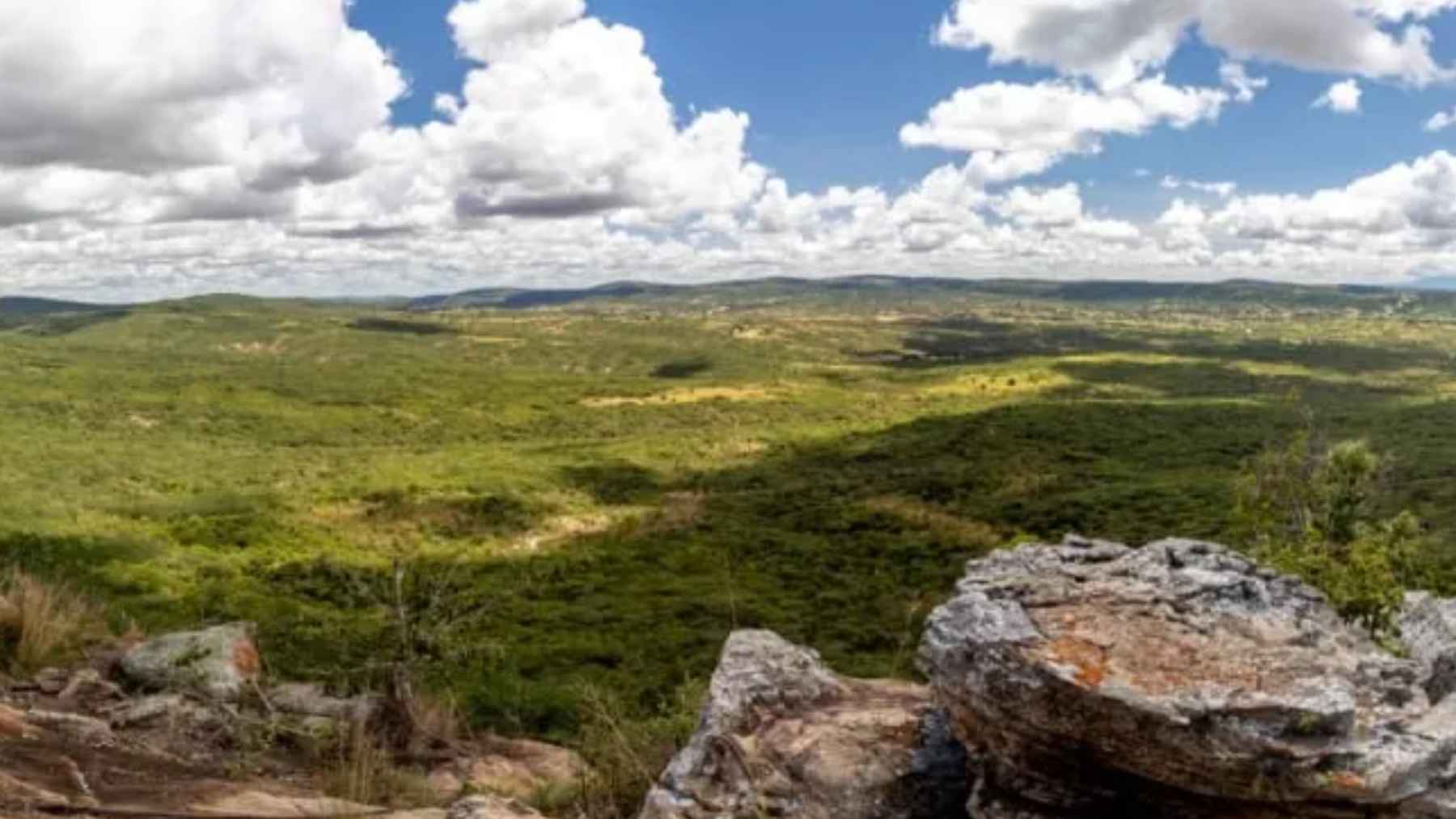
When people picture African landscapes, they often imagine dust, drought, and thinning vegetation. But in central Tanzania, farmers are seeing something that feels almost backwards in the best way. Trees are coming back in places where they were cut down decades ago, and no one is planting new seedlings.
The surprise is not magic. It’s management. Instead of starting from zero, communities are working with an “underground forest” of living roots and stumps that never fully died, using a method called Farmer Managed Natural Regeneration (FMNR), known locally as “Kisiki Hai.”
The forest hiding in plain sight
A cut tree can look finished, especially in drylands where the ground bakes hard and plants struggle. But in many fields, the stump’s root system is still alive, sending up small shoots that resemble weak shrubs.
FMNR works by selecting the strongest shoots and pruning the rest so the plant’s stored energy is focused on fewer stems. Farmers also protect those shoots from grazing animals, which is often the difference between “it tried” and “it returned.”
Why planting trees can disappoint in dry regions
Big tree-planting campaigns can look great in photos, but survival is the hard part. In the Sahel, researchers and practitioners have pointed out that “80 percent or more of planted trees have died,” largely because seedlings need water and long-term care in places where both are scarce.
That’s why regeneration from existing roots can be so compelling. A stump already has a deep, established system underground, giving regrown trees a head start compared with a nursery seedling that still needs years to chase moisture downward.
How “Kisiki Hai” works on real farms
Justdiggit, which works with local partners in Tanzania, describes Kisiki Hai as “living stump” in Swahili, and the approach is meant to be simple enough to repeat season after season. Farmers identify stumps worth saving, prune down to a few strong shoots, and keep protecting the regrowth through the year.
They even teach it as a four-step reminder in Swahili (“CHAPOA TU”), emphasizing selection, pruning, marking, and ongoing protection. That last step matters because if goats or cattle browse the shoots at the wrong time, the “new tree” becomes tomorrow’s firewood again.
What the numbers suggest in Tanzania
Zoom out, and Tanzania’s forests are already largely a story of natural regrowth. A Forest Trends dashboard summarizing national reporting to the FAO describes about 45.8 million hectares of forest area in 2020 (about 113 million acres), including 45.1 million hectares of naturally regenerating forest (about 111 million acres) and about 0.5 million hectares of planted forest (about 1.24 million acres).
In the Dodoma region, where FMNR has been supported since 2015 and scaled more widely since 2018, conditions are tough by design. Annual rainfall is about 400 to 570 millimeters (roughly 16 to 22 inches), most households depend on rainfed farming, and fuelwood remains a main energy source, which can keep pressure on trees.
Project partners also report fast-growing on-the-ground impact. Justdiggit says more than 15.2 million trees have been regenerated in Dodoma, with about 311,000 hectares under restoration (around 768,000 acres), alongside water-focused work like 120 kilometers (about 75 miles) of contour trenches and “5.5 billion liters of water retained in 2024” (about 1.45 billion gallons).
Cooling the farm and changing daily life
What does more tree cover mean when you’re actually living there? A 2024 study in PLOS Climate documents how rural households implementing FMNR in central Tanzanian drylands describe links between natural regeneration and health and well-being, using group discussions across four villages.
Some effects are easy to picture if you’ve ever worked outside in harsh sun. On an AFR100 project profile, a farmer describes how adding tree shade through Kisiki Hai reduced direct sunlight on vegetables and seemed to improve growing conditions and taste. It’s a small detail, but it’s the kind of detail that makes adoption stick.
Then there’s the broader comfort factor. More shade can lower ground heat, and better water retention can mean crops hold on longer through those stressful dry spells, when every cloudy day feels like a lucky break. The catch is that these benefits are strongest when trees are protected long enough to mature.
The real challenge is long-term protection
Here’s the part that doesn’t fit neatly into a one-time campaign. FMNR is not a “plant it and leave” strategy, and it’s not really a “drop off supplies” strategy either. It’s closer to a farming habit that depends on local knowledge, repeated pruning, and community norms around grazing and tree cutting.
That’s why training and follow-through keep showing up in successful programs. On the UN Decade on Restoration hub, the Regreening Dodoma Program reports mobilizing over 110,000 farmers and planning a long sustainability phase so communities keep maintaining restored land after intensive support ends.
So what should readers keep in mind? Natural regeneration is powerful when living roots are still in the soil, but it’s not a shortcut around governance, land pressure, or energy needs like fuelwood. In other words, it can regrow trees quickly, but keeping them standing is the real finish line.
The study was published on PLOS Climate.