Physicists have finally confirmed that “time mirrors” are real. For the first time, an experiment has reversed an electromagnetic wave so that part of it runs backward in time instead of simply bouncing back in space. The work, led by physicist Hady Moussa at the Advanced Science Research Center at the CUNY Graduate Center in New York City, appears in the journal Nature Physics and turns a sixty-year-old idea into a lab reality.
It sounds like something from science fiction, yet the experiment does not rewind a clock or erase yesterday’s homework. Instead, the team found a way to flip the order of a signal inside a special material while the rest of the world keeps ticking forward. So what does it really mean to make a wave run backward in time, and why might that matter for your future phone or WiFi router?
What a time mirror really is
In everyday life, reflections feel simple. Light bounces off a bathroom mirror so you see your face, and sound bounces off walls so you hear an echo in a gym. Physicists call that kind of bounce a spatial reflection because the wave hits a boundary in space and turns around.
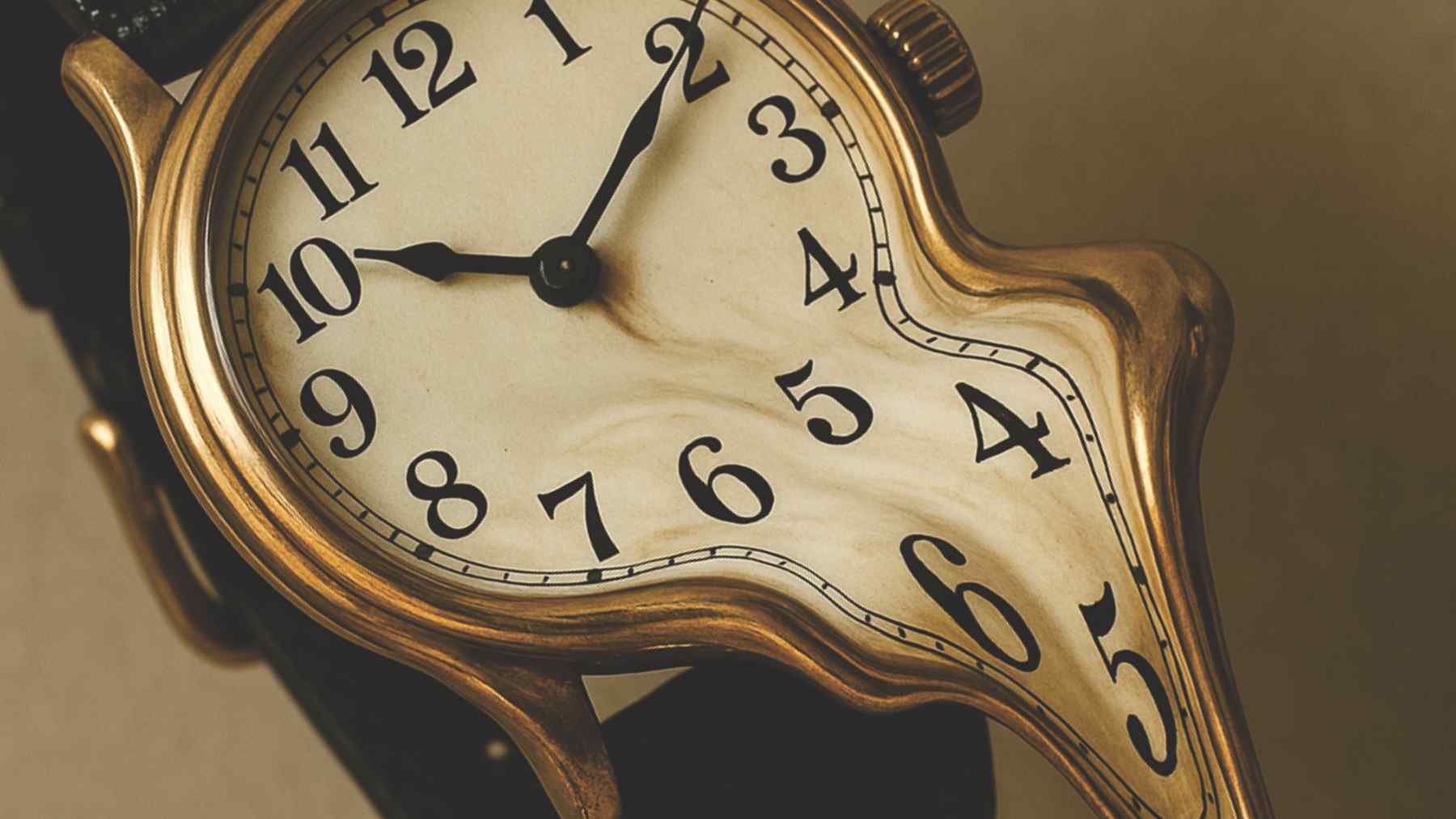
A time reflection works differently. Instead of hitting a wall, the wave travels through a region where the material itself suddenly changes its properties everywhere at once. At that instant, part of the wave flips in time, so the last part of the signal comes out first, a bit like watching a short video clip play backward.
Theory also predicts that this flip should shift the wave’s color or pitch, since changing the medium in time alters its frequency. Earlier experiments had hinted at similar effects in water waves, but electromagnetic waves such as radio signals and light are much harder to control this way. The new work shows a clean, repeatable time reflection of broadband electromagnetic signals, exactly as the equations said should be possible.
How the CUNY team flipped waves in time
To pull this off, the team built a carefully engineered metamaterial, which is a man-made structure that steers waves in unusual ways. They printed a long strip of metal on a circuit board, about six meters in length, then loaded it with a dense row of electronic switches connected to energy-storing capacitors. Broadband signals traveled along this strip the way a radio pulse would run along a wire.
At a chosen moment, all the switches closed at almost exactly the same time. That move doubled the strip’s impedance, a quantity that tells you how strongly a material resists electrical current. In simple terms, the material suddenly became a different kind of road for the wave, and that abrupt global change created a sharp boundary in time.
When the signal hit this boundary, part of it kept going forward, and part of it reversed in time and shifted in frequency, matching long-standing theoretical predictions. Andrea Alù, who leads the Photonics Initiative at the center, said the group succeeded by changing the material “in time both abruptly and with a large contrast,” something earlier teams could not do. The researchers also stitched two such time interfaces together to form a kind of temporal cavity where waves interfere in ways that resemble echoes bouncing between mirrors.
From decades of theory to a working device
Physicists have talked about time reflections since at least the late 1950s, when early work on waves in time changing media suggested the idea was possible. Later studies on so called spacetime metamaterials and time varying photonic media built detailed models of what should happen when a material’s properties jump fast enough. Yet for more than sixty years, the effect stayed mostly on paper because real materials could not be switched quickly and uniformly enough.
Gengyu Xu, a postdoctoral researcher on the project, noted that many experts assumed the energy cost would always be too high to make a true time interface. In his view, the main roadblock was the belief that time reflections would need “large amounts of energy” to appear at all. By redesigning the system so the switches add and remove stored energy instead of changing the base material, the team showed that this barrier was more about clever engineering than impossible physics.
What time mirrors could mean for technology
Being able to flip a wave in time might sound like a party trick, but it could become a powerful tool for communications and computing. The Nature Physics study shows that time reflections naturally shift a signal to new frequencies while preserving its information, a feature that coverage on Earth.com suggested could help engineers pack more data into crowded parts of the spectrum. Researchers involved in the project say similar platforms might one day lead to compact, low energy devices that process information using waves instead of traditional chips.
Other labs have already begun exploring related effects in microwave systems and optical setups, including recent experiments that use ultra-fast optical controls to create time boundaries in different ways. These follow-up studies suggest that time-based wave control is not a one off curiosity but a growing family of techniques. By tuning both space and time, future antennas, sensors, and even wave-based computers could reroute signals almost as easily as you swipe between apps on a phone.
No, this is not a time machine
For anyone picturing a time travel gadget, it is important to keep the effect in perspective. The experiment rewinds patterns in an electromagnetic signal inside a circuit, not events in the outside world. Your school day, your commute, and your electric bill all march on in the usual direction while the wave quietly performs its rewind trick in the lab.
What the CUNY team has really done is add a new knob to the control panel of physics by showing that time interfaces can be built and used on demand. That extra control over how energy moves could make future networks more efficient and flexible, especially as demand for wireless data grows.
The study was published in the journal Nature Physics.