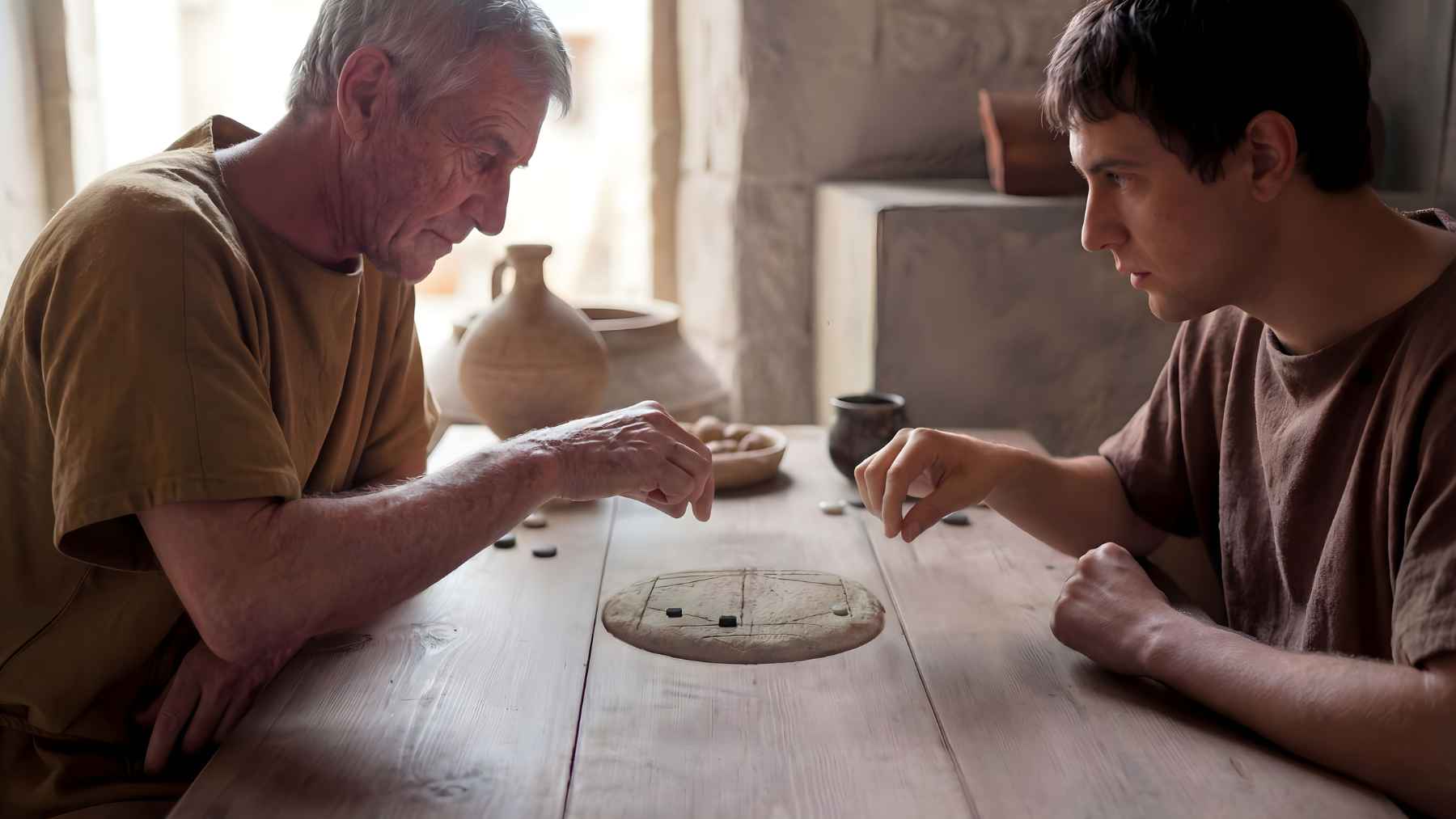
For more than a century, a small carved limestone slab sat in a Dutch museum with an identity crisis. Was it an architectural sketch, a decorative oddity, or something meant for fun?
A new study published online February 11, 2026, says the simplest answer was right in front of us. By pairing microscopic wear analysis with thousands of artificial intelligence simulations, researchers argue the stone was most likely a Roman game board, and one that may push a whole category of European board games back into the Roman era.
A museum object that never quite fit
The artifact is known as “Object 04433” at Het Romeins Museum in Heerlen, the Netherlands. It is roughly 8.35 by 5.71 inches and about 2.80 inches thick (212 by 145 by 71 millimeters), weighing about 7.45 pounds (3.38 kilograms).
Its stone is white Jurassic limestone from the Norroy quarries in northeastern France, a material Romans often used for showy architectural pieces because it could mimic marble’s look while being easier to carve. That background is part of what made the object so confusing, since it is small, carefully shaped on every side, and not the kind of rough block you would expect in a wall.
The carved top surface is even stranger. Four diagonals and one straight line form a pattern that does not match the familiar grids of known Roman board games, which is why scholars kept circling the same question for decades.
Scratches that point to play
When archaeologist Walter Crist saw the stone during a museum visit, one detail stood out. The wear was not random, and it was sitting exactly where a player would slide pieces, not where a builder would grab or chisel.
The team used high-resolution surface mapping, including 3D modeling techniques that reveal tiny dips and smoothed zones. Along one diagonal line, they identified a visibly smoother band whose inner edge ran parallel to the carving at roughly 0.63 to 0.71 inches away (16 to 18 millimeters).
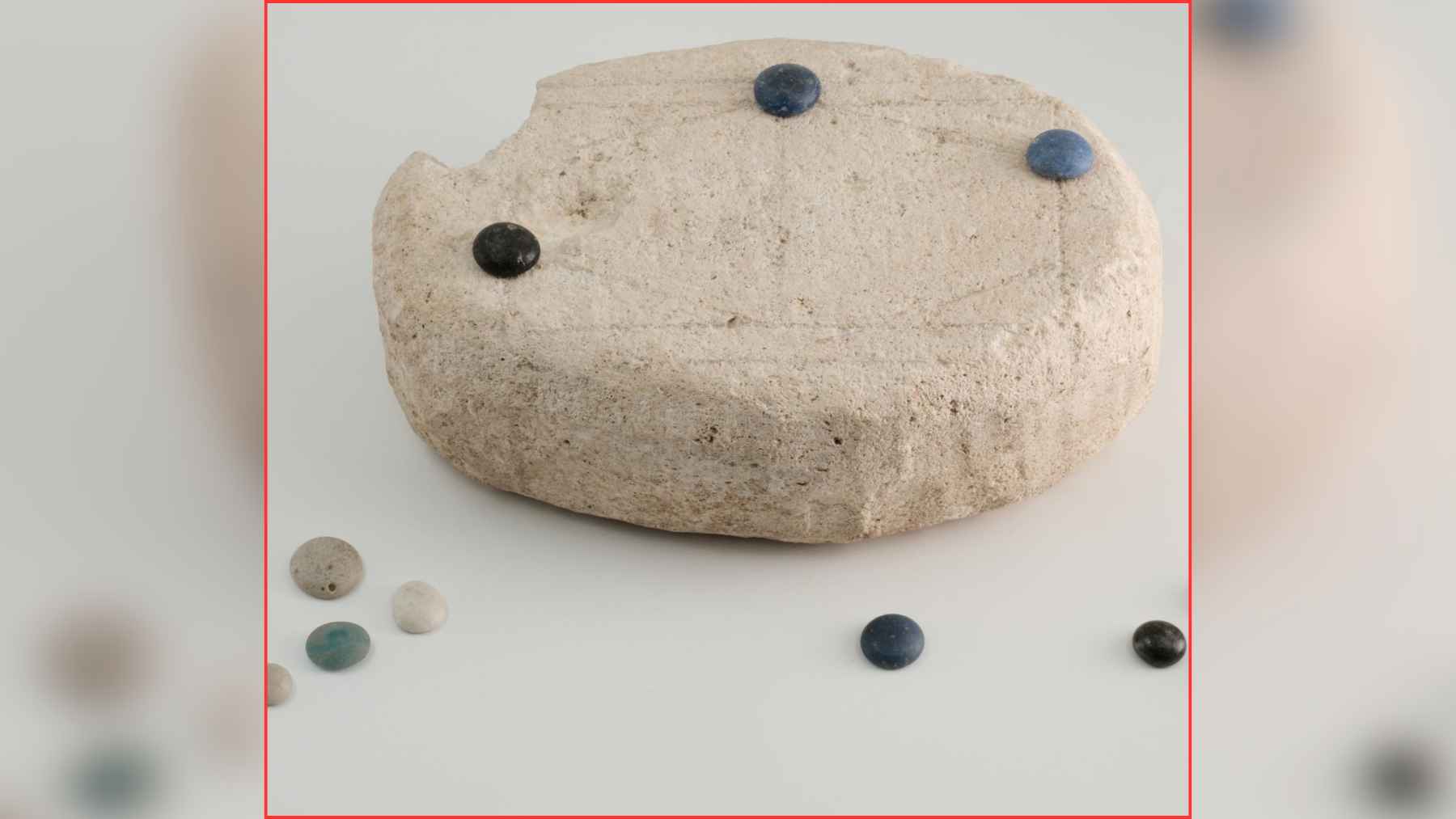
That kind of leveling is consistent with abrasion from something harder rubbing repeatedly across the surface. The researchers also argue that common alternatives like grinding food or pigments do not fit well, because those tasks do not need geometric guide lines and would not concentrate wear neatly along incisions.
Letting AI “play” the past
So how do you go from a set of lines to actual rules? The researchers turned to Ludii, a game system developed by Maastricht University, and researcher Dennis Soemers put it simply when he said, “We developed Ludii, a form of artificial intelligence that can deduce game rules.”
They built 130 candidate configurations by mixing and matching rule elements from documented European games, including several known “blocking games” where the player with more pieces tries to trap the other player. Then they set two computer players loose, running 1,000 rounds for each board and ruleset combination, with about one second of processing time per move.
Think of it as stress-testing a board game app. You do not just ask whether a move is legal, you ask where the action piles up when two competent players try hard to win.
Nine matches and a surprise result
After filtering for patterns that matched the stone’s uneven wear, nine configurations survived. Every one of them fell into the blocking game family, and most of the best matches looked like a four-pieces-versus-two setup, with the heavier side trying to shut down the lighter side’s movement.
The researchers are careful about certainty. In the paper, they write that it was “most likely used as a game board, though other interpretations cannot be entirely ruled out,” and they also note that more than one playable ruleset could have been used on the same carved pattern.
Still, the timing is the headline. Secure evidence for blocking games in Europe has often been linked to the Middle Ages, yet this object comes from a Roman context in Coriovallum, which suggests people were experimenting with these strategies centuries earlier than expected.
Ancient recycling hiding in plain sight
There is also an environmental angle hiding inside the archaeology. The study suggests “Object 04433” may be a repurposed piece of ornamental Norroy limestone reshaped and incised during the late Roman period, roughly AD 250 to 476, when reuse of architectural stone, known as spolia, became common.
In practical terms, that means someone may have taken a fragment that once dressed up a public building and gave it a second life on a tabletop. It is not modern recycling, but it is the same instinct, squeezing more value out of a material that took real effort to quarry and transport.
And in today’s museums, the method itself is a kind of conservation. Using imaging and simulation lets researchers pull information out of objects without cutting samples or scraping surfaces, which matters when you are working with one-of-a-kind artifacts.
What this means for science and for storage rooms
If AI can help identify one odd stone, what about the countless unidentified pieces sitting in drawers and boxes? Tools that can triage objects without invasive testing could make collections far more useful, without pushing archaeologists to dig more just to answer a catalog question.
On the other hand, it is worth remembering what the AI is and is not doing. The simulations depend on the rule sets humans choose to test, and the study even discusses how real players bring quirks like handedness and seating position that can bias wear patterns over time.
Two thousand years ago, people in a busy Roman town were probably arguing over moves the same way we do at the kitchen table, and now careful microscopy plus computation is letting us watch the game again.
The study was published in Antiquity.