A “monster” Milky Way twin is whipping up a cosmic storm 11 billion years ago
Imagine the Milky Way on fast forward, already wearing its neat spiral arms and central bar while the universe is still very young. That is what astronomers have found in a distant galaxy called J0107a, seen as it was 11.1 billion years ago. It looks strikingly like our own barred spiral galaxy, yet it is more than ten times as massive and forms new stars roughly 300 times faster, earning it the nickname “monster galaxy”.
So what makes this discovery more than just a pretty picture in deep space? For scientists, J0107a is a rare chance to watch an orderly, Milky Way-style galaxy behaving in a very unorderly way at a time when most galaxies were still chaotic clumps. Its central bar appears to be acting like a giant funnel for gas, pulling raw material inward and feeding an intense starburst in the core. That combination of a clean spiral shape and extreme activity has not really been seen in one place before.
J0107a sits in the constellation Cetus and was first noticed almost by accident, behind a closer pair of merging galaxies known as VV114. Early work using the James Webb Space Telescope and ground-based radio data showed that J0107a is packed with matter. One study estimated a stellar mass of about 500 billion suns, a molecular gas mass of at least 100 billion suns, and a star formation rate of roughly 500 solar masses each year. That is like building an entire small galaxy every few million years.
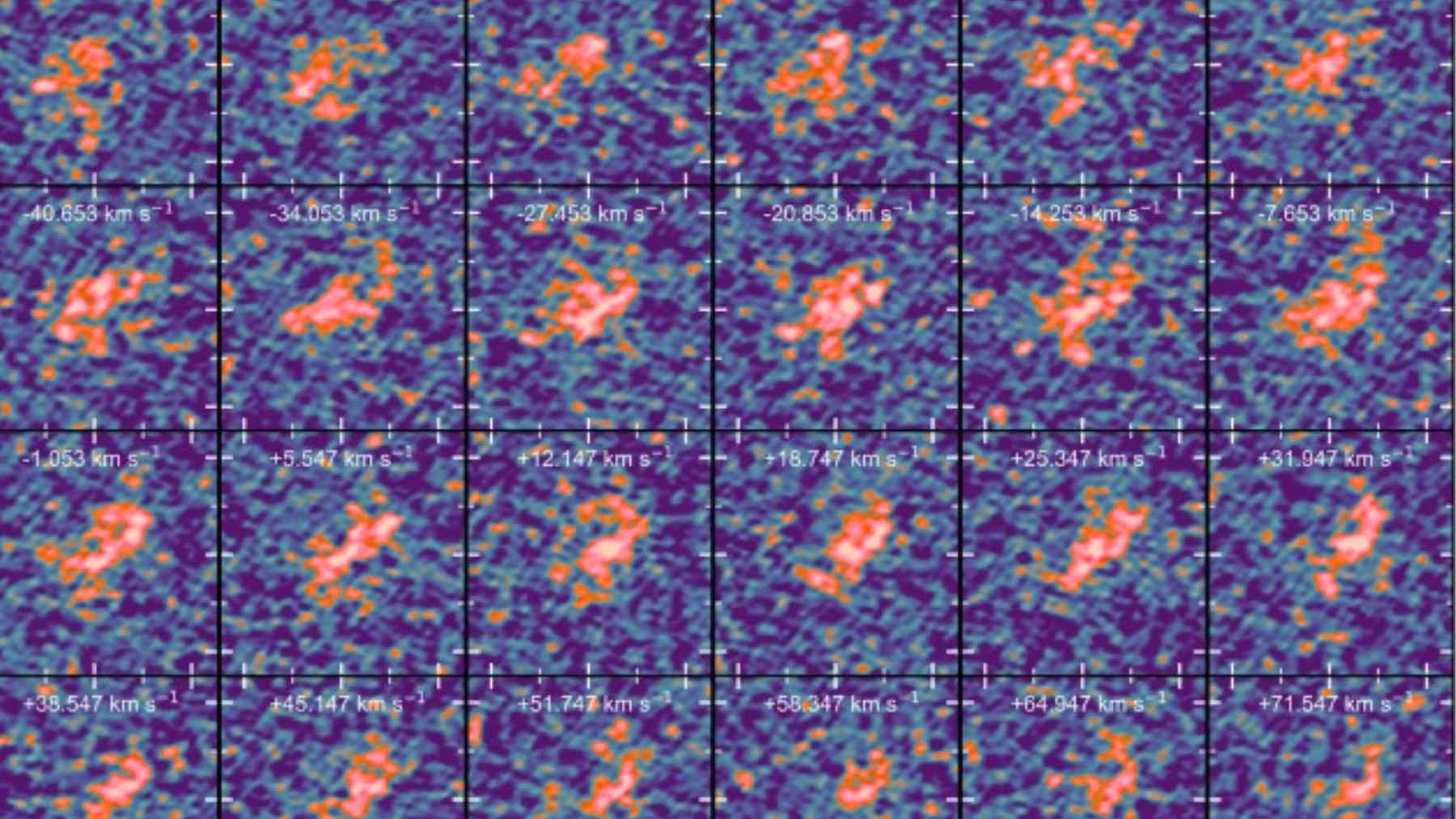
The new step was to watch how the gas actually moves. Using the Atacama Large Millimeter/submillimeter Array (ALMA) in Chile, researchers mapped emission from carbon monoxide and neutral carbon, which trace cold-star-forming gas. They found that the gas in the bar of J0107a follows the same kind of pattern seen in nearby barred spirals, yet the motions are far more violent. Non-circular streaming flows along the bar dominate over the normal rotation of the disk and drive molecular gas into the center at an estimated rate of about 600 solar masses per year.
In present day barred galaxies, gas usually accounts for less than a tenth of the mass in the bar. In J0107a, roughly half of the bar’s mass is gas. That overloaded structure stirs the surrounding disk and sets up a fierce “storm” of material, with gas racing at several hundred kilometers per second across a region about 20,000 light years in radius, similar to the distance from the center of the Milky Way to our Sun. Some of that gas plunges inward and lights up the central starburst. The storm is real.
Read More: Jupiter’s moon could be dead inside
Where does all this fuel come from if there is no obvious companion galaxy crashing into J0107a? Astronomers see a vast outer gas disk around the galaxy, about 120,000 light years wide, roughly twice the extent of the visible stellar disk. Its motion lines up with the inner galaxy, which hints that it may have condensed from a slow, swirling inflow of material from the surrounding cosmic web. The team notes that such large-scale inflows are expected in theory and are often called “cold streams,” although they remain hard to catch directly.
That picture matters because it challenges the standard story for “monster” galaxies in the early universe. Many dusty, hyper-active galaxies have irregular shapes and clear signs of mergers, so models have often assumed that violent collisions drive gas into the center and briefly ignite starbursts before the systems fade into giant elliptical galaxies. J0107a does not fit that mold. It looks like a well-behaved disk that has quietly grown huge, then used its own bar to trigger a dramatic but still organized feeding event in its core.
For our own Milky Way, which also sports a central bar, J0107a acts a bit like a baby picture taken for someone else. Today, about half to two-thirds of spiral galaxies have bars, and these features are thought to help regulate how gas flows, how stars form, and even how central black holes grow. Seeing a massive bar already in place only 2.6 billion years after the Big Bang shows that this slower, more “secular” style of evolution was operating much earlier than many simulations had suggested.
In practical terms, the discovery tells astronomers that they must account for bar-driven gas inflow when they model how the first big galaxies assembled. It also highlights how paired observatories, one in space and one in a high mountain desert, can turn faint smudges on the sky into detailed stories about cosmic weather. Future ALMA and Webb observations of J0107a and similar systems will test whether this monster is an oddball or part of a much bigger population that has simply been hiding behind dust and distance.
The study was published in Nature.