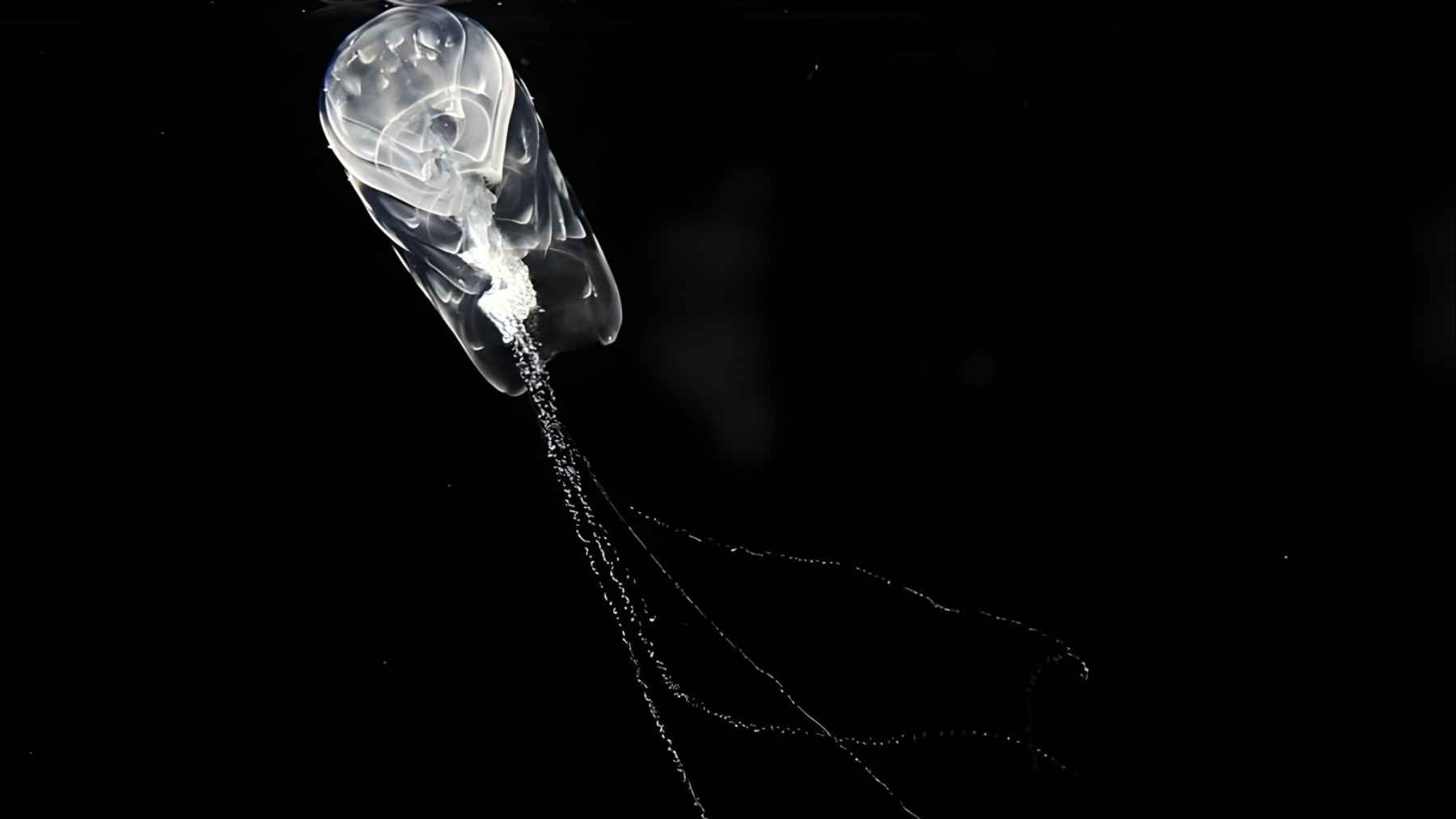
A deep sea robot exploring waters off Australia has filmed a ghostly ribbon about 15 meters long drifting in total darkness roughly 6,000 meters below the surface. The gelatinous creature, identified as a siphonophore, is a colonial animal rather than a single body and it is pushing scientists to rethink what counts as big in the deep ocean.
The footage comes from international expeditions that use remotely operated vehicles to probe steep submarine canyons off Western Australia, the same region where researchers with the Schmidt Ocean Institute reported a spiral siphonophore estimated at about 45 meters in 2020.
Together, these sightings suggest that giant soft-bodied colonies may be far more common in the abyss than anyone expected, in a part of the planet we have barely seen.
A 15-meter colony drifting in the abyss
In recent months outlets in Spain, Portugal and Brazil have highlighted video sequences of a translucent, ribbon-shaped animal sliding through the water column at depths greater than 6,000 meters near Australia and in the Pacific. Marine biologists reviewing the images describe an organism around 15 meters long, suspended like a loose thread in the dark and slowly curling as it moves.
The animal has the long, narrow outline and faint internal glow that researchers associate with siphonophores, a group of colonial predators related to jellyfish and corals. At those depths the pressure is more than six hundred times what we feel at sea level, so the only way to capture scenes like this is through specialized robots that can work for hours with lights and cameras where human divers cannot go.
One of the best known platforms is the remotely operated vehicle SuBastian, run by the nonprofit Schmidt Ocean Institute and used with teams from the Western Australian Museum, Curtin University, Geoscience Australia and Scripps Institution of Oceanography.
During a 2020 expedition in the Ningaloo canyons the same region produced video of a spiral-shaped siphonophore, probably an Apolemia colony, whose outer ring was estimated at roughly 45 meters, making it a candidate for the longest animal ever recorded.
Siphonophores work like living strings of clones
The educators behind the Plankton Chronicles project like to remind people that “Whales are the largest animals in the world, but the longest are siphonophores.” These creatures look like a single jelly, yet they are built from thousands of tiny units called zooids that share the same DNA and join together along a central stem.
Some zooids carry stinging tentacles and act as mouths, others pump water so the colony can swim, and others produce eggs or sperm that give rise to the next generation.
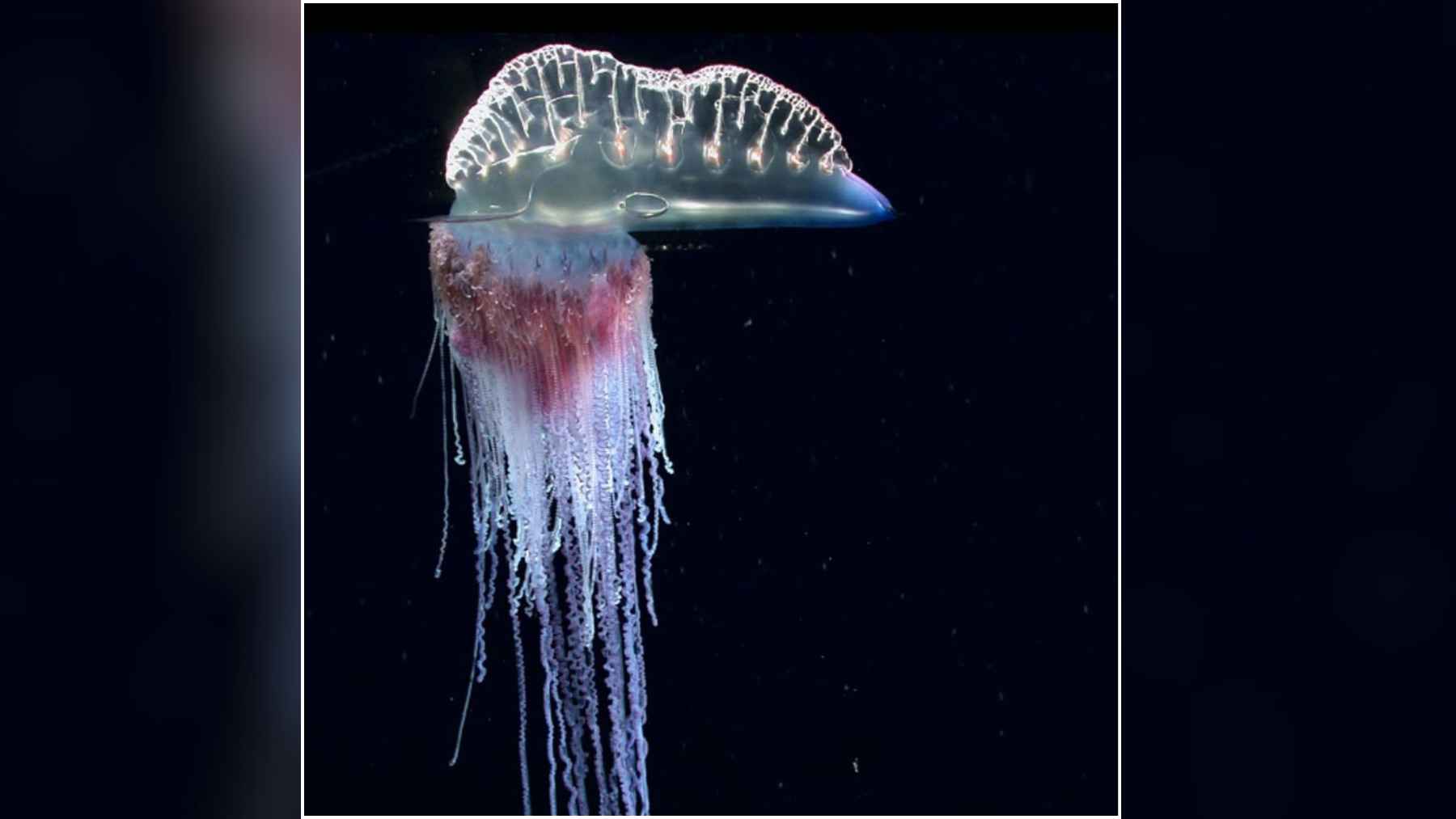
The result is a flexible chain in which each part takes on a job, a bit like rooms in a long train that handle eating, moving or parenting, and the whole colony behaves as one animal to any passing fish or shrimp. Institutes such as Monterey Bay Aquarium Research Institute have spent decades filming these colonies in detail to understand how those different parts work together.
A review of siphonophores in the journal PLOS One counts about 175 valid species worldwide, most of them drifting far from coasts in the open ocean. Researchers have already documented colonies that reach or exceed 40 meters in length, although many are as thin as a broom handle and break apart easily when nets or submersibles touch them.
Marine biologist Gillian Mapstone at the Natural History Museum led that work, which still highlights how many species likely remain undescribed.
Why deep sea giants can grow so long
How can a gelatinous colony remain intact when it extends for tens of meters in near freezing water, with currents tugging on its tentacles?
As the HoyECO team and other science outlets explain, the answer lies in physics as much as biology and it is being probed by vehicles such as ROV Deep Discoverer from NOAA Ocean Exploration that are built to reach around 6,000 meters.
In the deep sea the colony floats in water that almost matches its own density, which means gravity pulls far less on the long stem than it would on land and allows the zooids to spread out their fishing tentacles over huge distances to intercept scarce prey.
Instead of building heavy bones, these animals invest in an efficient layout for catching food in a low-energy world. To a large extent their real limit may be how well nerve signals and nutrients can travel along the shared stem before the colony becomes too fragile or too slow to react when something brushes its traps.
A mostly unseen ecosystem under pressure
The deep ocean covers roughly two thirds of Earth and begins only a couple of hundred meters below the waves, yet projects such as the Seabed 2030 and studies in the journal Science Advances suggest that only a bit more than one quarter of the seafloor has been mapped at high resolution and that less than a thousandth of the deep seafloor has been seen directly with cameras.
That means every new robot dive into an abyssal canyon still has a decent chance of spotting a creature or behavior no one has described before, whether it is a 15-meter siphonophore or something even stranger.
At the same time governments and companies are eyeing those same depths for minerals, energy and new molecules for medicine, even though biologists keep warning that damage to slow-growing deep sea communities could take centuries to repair.
Environmental groups and researchers point out that colonies like the Australian siphonophores are not just curiosities, since many gelatinous predators help move carbon from surface waters into the deep, where it can stay locked away and ease some of the climate pressure we feel during each new heatwave on land.
The main press release describing the giant siphonophore footage has been published by the Schmidt Ocean Institute.