China says it has built a compact high-power microwave device that can fire bursts strong enough to threaten satellites in low Earth orbit.
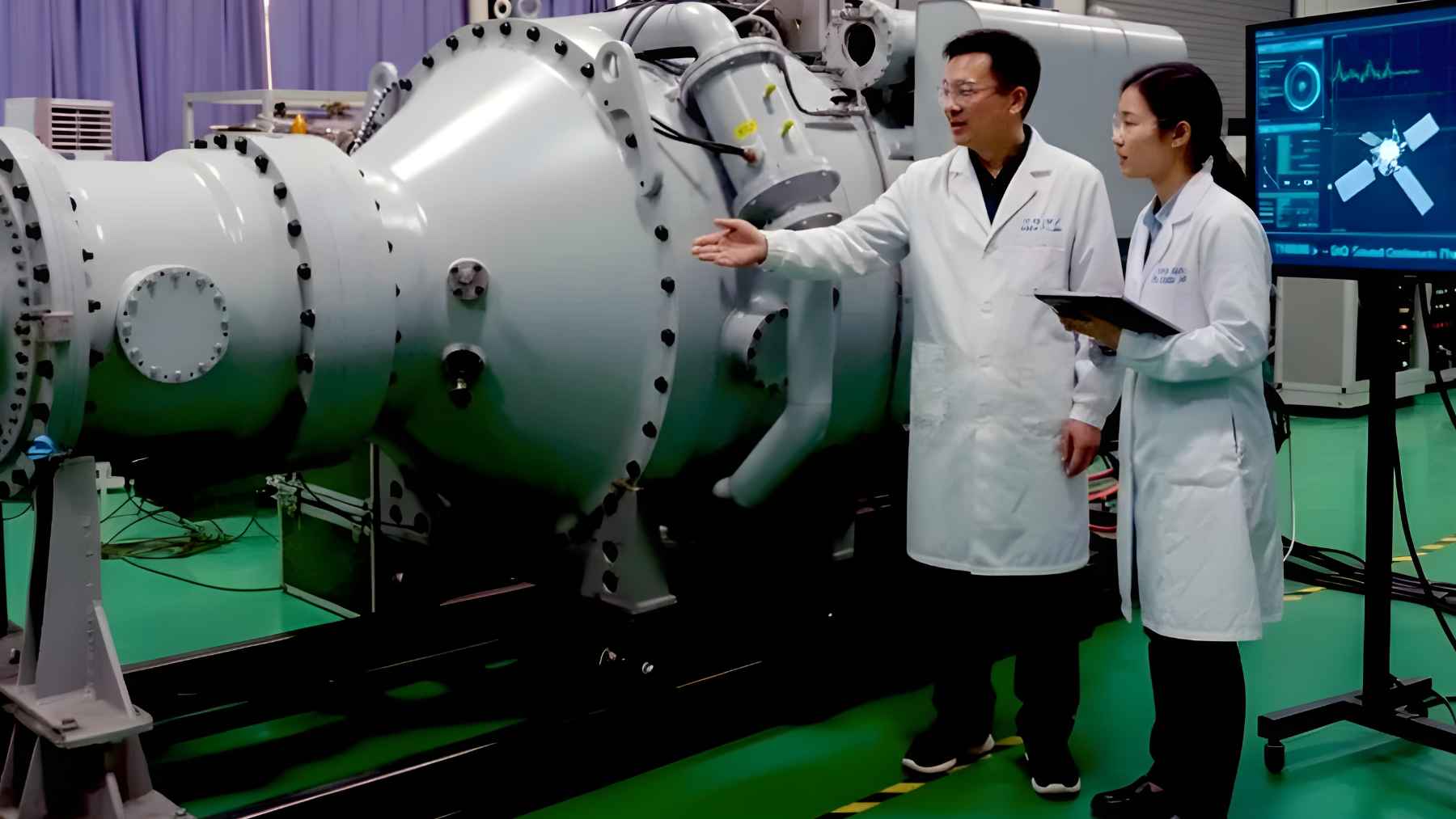
The system, called TPG1000Cs, was developed at the Northwest Institute of Nuclear Technology in the city of Xian and is described as the first of its kind able to deliver about 20 gigawatts of power for up to one minute.
Reports in the South China Morning Post and other outlets say Chinese experts believe that even a system with one gigawatt of output could disrupt or damage satellite constellations such as Starlink, which provide internet access to homes, ships and even war zones.
At the same time, SpaceX is in the middle of lowering roughly 4,500 Starlink satellites from about 550 kilometers to 480 kilometers to improve space safety. That move could also make them more exposed to weapons fired from the ground.
What a high-power microwave weapon actually does
High-power microwave weapons do not punch holes in targets the way missiles do. Instead they use very intense bursts of radio energy to overload electronic components, so that circuits fail and systems shut down.
In simple terms, it is closer to pointing a supercharged version of your kitchen microwave at a device than to firing a bullet. For militaries, that kind of tool can look attractive because each shot runs on electricity rather than a rocket, which can make it cheaper and easier to fire many times in a row.
Inside China’s TPG1000Cs device
According to research led by Wang Gang at the Northwest Institute of Nuclear Technology, TPG1000Cs can deliver about twenty gigawatts of microwave power continuously for nearly a minute, while earlier systems usually managed only a few seconds.
The unit is roughly four meters long, weighs around five tons and is small enough to be mounted on trucks, warships, aircraft or even satellites, at least on paper.
The team reports that the system can fire up to 3,000 high-energy pulses in one operating session and has already undergone more than 200,000 test pulses without serious failures.
To make that possible, engineers redesigned the internal structure into a dual U-shaped layout that lets energy bounce back and forth, reaching similar performance in roughly half the space, and they upgraded the insulating oil so it can store more energy without breaking down.
Why low-Earth orbit satellites are in the spotlight
Chinese experts quoted by South China Morning Post say that a ground-based microwave weapon with more than one gigawatt of output could severely disrupt or even damage low-Earth orbit satellites. In that context, a twenty gigawatt driver looks like a major step toward a real anti-satellite system, even if many technical details remain classified.
Low-Earth orbit satellites such as those in the Starlink constellation circle the planet a few hundred kilometers above the surface, closer than traditional television satellites.
SpaceX is lowering thousands of its spacecraft to about 480 kilometers so that dead satellites fall back to Earth faster and reduce long-term debris, a move that improves safety but also brings them physically closer to ground-based emitters and to otherlow Earth orbit satellites.
Strategic questions that remain open
Chinese officials and analysts have repeatedly framed Starlink, operated by SpaceX under Elon Musk, as a security risk because its internet links have supported Ukrainian forces and could assist Taiwan in a future crisis.
The new microwave system is already being described by some media as a potential “Starlink killer,” although that language comes from commentators rather than the scientific paper itself.
For now TPG1000Cs appears to be a laboratory-proven driver rather than a fully-fielded weapon, and there is no public evidence that it has targeted satellites in space.
Still, experts warn that it signals a wider race to develop non-kinetic anti-satellite tools that can silently blind or cripple orbiting hardware, raising fresh questions about how to protect the space infrastructure behind everything from video calls to credit card payments.
The main study has been published on the journal site High Power Laser and Particle Beams.