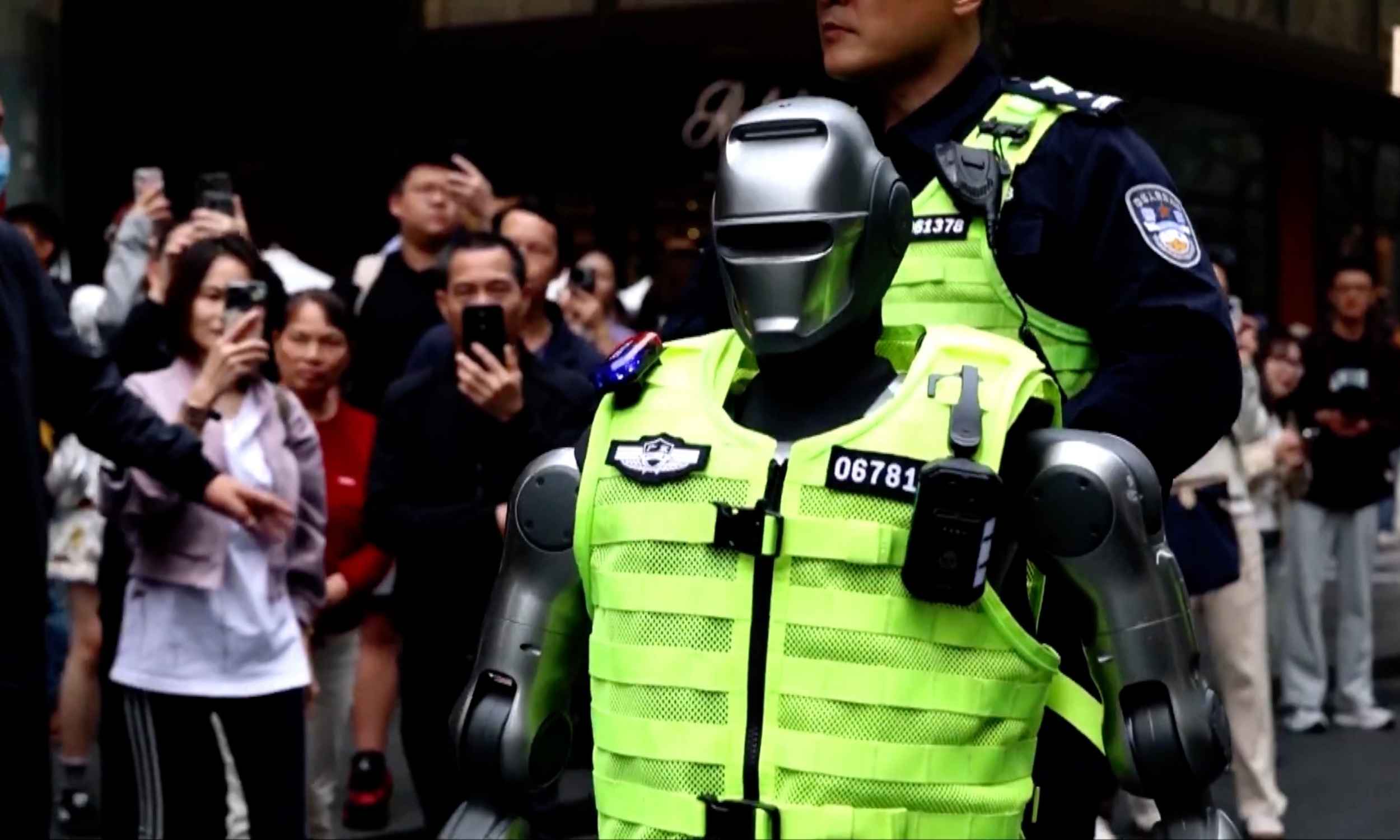
In several big cities across China, drivers and pedestrians are now being directed by full-size robots in police uniforms instead of human officers. These AI-powered “robot police” stand on traffic islands and sidewalks, guiding cars and people through crowded intersections at all hours of the day and night.
Each unit carries high definition cameras, loudspeakers, and sensors that link directly to local traffic lights so the robot can raise an arm, blow a whistle, and call out to anyone breaking the rules.
Behind the futuristic look sits a clear political and economic goal, since Beijing wants citizens to get used to autonomous machines in public spaces while it pushes a long-term national strategy built around robots and an aging population.
How the new RoboCops work on the street
One of the best-documented examples stands in the city of Wuhu, where a humanoid officer called Intelligent Police Unit R001 oversees a busy junction. The robot wears a standard traffic police outfit and white cap, but inside the shell are cameras, speakers, and an AI system that spots cyclists or pedestrians drifting into the wrong lane and issues spoken warnings on the spot.
According to local traffic police quoted by state media, the robot is wired into the traffic signal network so its arm signals match the red and green lights while it records potential violations in real time.
Officers say it can work around the clock and take over during extreme heat or heavy rain, when standing in the middle of the road is especially tough for humans.
Similar robots patrol intersections in Chengdu and Hangzhou, where a model nicknamed Hangxing No. 1 rolls on wheels and flashes hand signals at a major crossing.
In some places, local media report that people already slow down a little earlier at crosswalks when they see the glowing vest of a robot officer ahead of them, a small but telling sign of how quickly habits can shift in everyday traffic.
Part of a long-term robotics strategy
These street trials are not isolated tech stunts. Since 2015, Beijing has treated intelligent robotics as a national priority, starting with the Made in China 2025 plan and a dedicated five-year roadmap for the robotics industry that sets explicit targets for robot density in factories.
Researchers describe this as a whole-of-nation strategy that combines subsidies, cheap loans, and local pilot projects to make the country a leader in humanoid and service robots.
Banks and analysts see the payoff as potentially huge. A research note cited by the South China Morning Post says the country’s overall robotics market could more than double from about $47 billion in 2024 to roughly $108 billion in 2028, according to Morgan Stanley.
At the same time, a report from the Development Research Center of the State Council projects that the embodied intelligence industry, which includes humanoid robots, could exceed one trillion yuan in value by the mid-2030s.
Chinese officials and company executives argue that robots need to leave factory floors to reach those numbers. That is why manufacturers now treat robot police, hotel concierges, and mall patrol units as mobile showrooms that demonstrate to residents and investors that domestic firms can build and operate advanced humanoids in real city streets.
Robots as a response to an aging workforce
The wider push comes as the country faces a shrinking pool of young workers and a rapidly-aging population. Government documents and academic studies note that robots are meant to keep production lines and public services running even as the working age population plateaus or declines.
In practical terms, that means traffic control is only the first step. Officials and analysts expect humanoid machines to spread into elder care facilities, public transit hubs, and warehouses where repetitive tasks are hard to staff, especially in night shifts or during holidays that many people prefer to spend at home.
For commuters stuck in rush hour, the most visible change may simply be that a tireless metal officer keeps the crosswalk moving while human police handle more complex cases nearby.
There is also a social experiment underway. By seeing robot officers every day on their way to work or school, residents gradually get used to sharing sidewalks and intersections with autonomous machines, which lowers the psychological barrier when similar robots later show up in hospitals, shopping centers, or even apartment buildings.
Software reliability and safety still a challenge
Hardware is no longer the main obstacle for many of these companies since building a sturdy humanoid frame is now a relatively-mature business. The harder part lies in the software that lets a machine read a chaotic street scene and make split-second decisions with error rates that experts say need to stay well below one percent.
A traffic robot must pick out bikes, baby strollers, and cars from video feeds, track their motion, and decide when to step in, often in a fraction of a second.
That is why developers are racing to improve sensors, control algorithms, and safety checks while gathering real-world data from pilots like Intelligent Police Unit R001 in Wuhu, whose maker AiMOGA Robotics says its robots already work in more than one hundred scenarios including security patrols and public reception.
For now, these RoboCops mostly support rather than replace human police, taking over routine signaling and basic warnings so officers can focus on accidents, disputes, and investigations. How far that balance shifts in the coming decade will depend on whether citizens trust the machines to stay safe, fair, and reliable in the messy reality of city life.
The official press release was published in AiMOGA’s Intelligent Police Unit R001 Makes Official Debut, Ushering in a New Era of Smart Traffic Management.