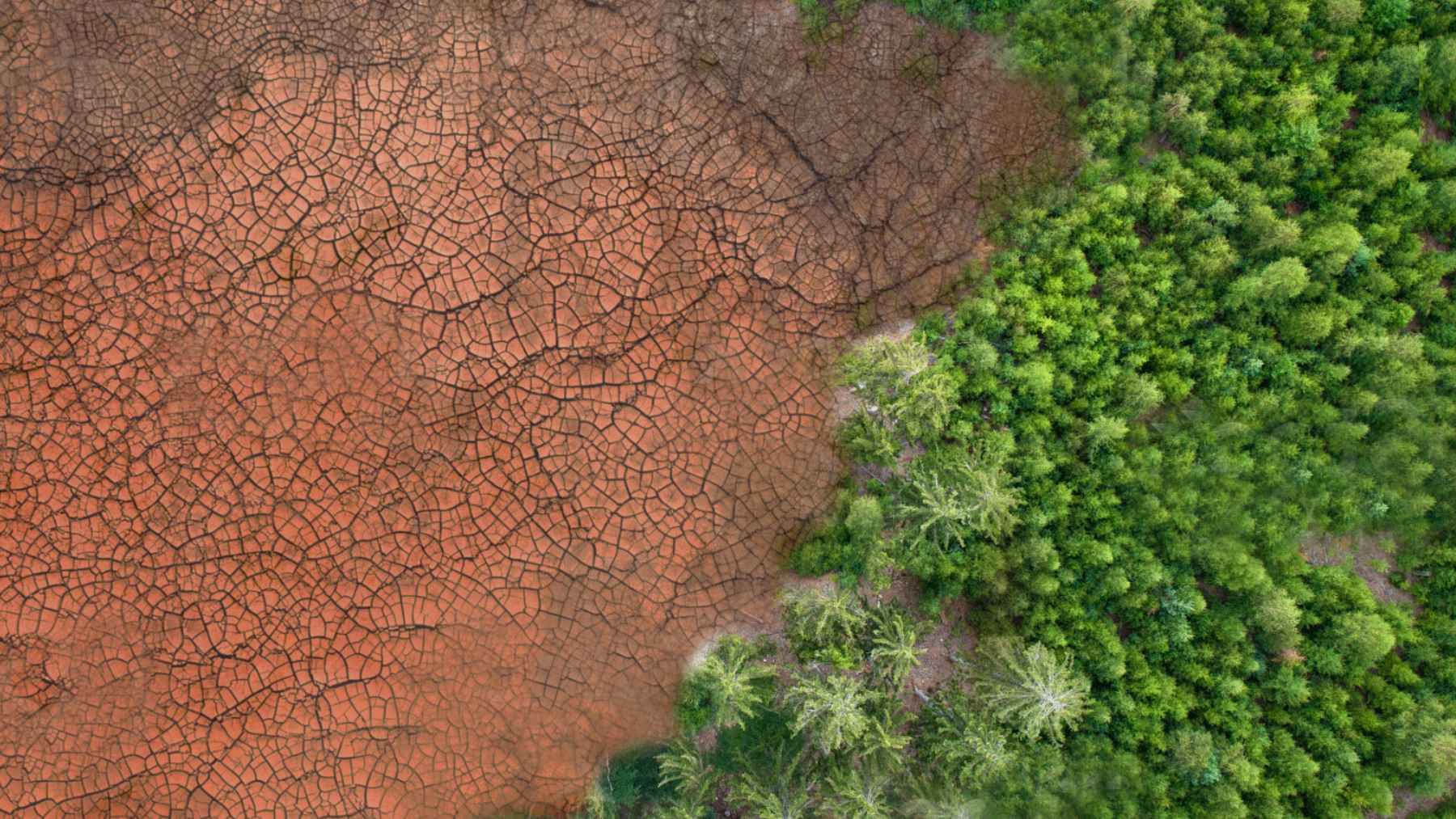
Can a place once written off as a “biological void” start cleaning the air? New research suggests it can. A 2026 study found that restoration work around China’s Taklamakan Desert is now pulling in more carbon than it releases in restored fringe zones, turning part of one of the driest places on Earth into a measurable carbon sink.
That is a remarkable shift for a landscape long associated with moving dunes, dust, and very little life at all.
The timing is hard to ignore. In November 2024, Chinese authorities said they had completed a 3,046-kilometer (about 1,900 miles) green belt around the Taklamakan, the largest desert in China and the world’s second largest shifting desert.
The belt is part of the Three-North Shelterbelt Program, launched in 1978, and built with hardy species such as desert poplar, sacsaoul, and red willow. Officials say the goal is to slow desertification and protect settlements, farmland, and transport routes around a desert that spans about 337,600 square kilometers (roughly 130,350 square miles).
A desert that is starting to breathe
The new study gets to the heart of the story. Using satellite and ground-based observations, researchers found that during the July to September wet season, rainfall in the Taklamakan reaches about 16.3 millimeters a month. That is still a tiny amount by everyday standards, but in a hyperarid desert it is enough to lift vegetation cover and photosynthesis.
The study says that seasonal greening lowers atmospheric CO2 over the area by about 3 parts per million compared with dry-season levels. Co-author King-Fai Li put it simply when he said, “This is not like a rainforest in the Amazon or Congo,” but the drawdown is still something “we can measure and verify from space.”
That helps explain why the findings matter beyond western China. Carbon sinks are valuable in climate policy, of course, but life on the ground matters too. For communities living near advancing deserts, less land degradation can mean fewer dust-choked days, less pressure on farms, and a better chance of keeping roads and towns from being swallowed by sand.
Over the broader life of the shelterbelt program, official figures say afforestation has expanded by roughly 30 to 32 million hectares, and China’s national forest coverage has risen from around 10% in 1949 to above 25% by the end of 2023.
The hard part starts now
Still, this is not a neat victory lap. Scientists have been warning for years that giant planting campaigns in drylands can come with tradeoffs. Nature reported that some researchers fear China’s push to hold back deserts could strain already scarce water resources.
And a 2026 Scientific Reports paper on the wider Three-North program said ecosystem services have generally improved over the past four decades, but it also flagged aging forest stands, species homogenization, and declining ecological functions as growing concerns.
That nuance matters. A green belt can look like a clear win from space, and to a large extent it is. But deserts do not stop being deserts just because enough shrubs and trees are planted around them. Water is still the main limit. Biodiversity still counts.
And long-term success will depend less on eye-catching planting totals and more on whether the right species can survive without draining the very system they are supposed to protect. That is where this story gets interesting.
For now, the Taklamakan offers something climate reporting does not always get to show. A huge restoration effort appears to be delivering measurable carbon gains in one of the harshest environments on Earth. Not perfect. Not settled. But real enough to make the rest of the world pay attention.
The study was published in PNAS.