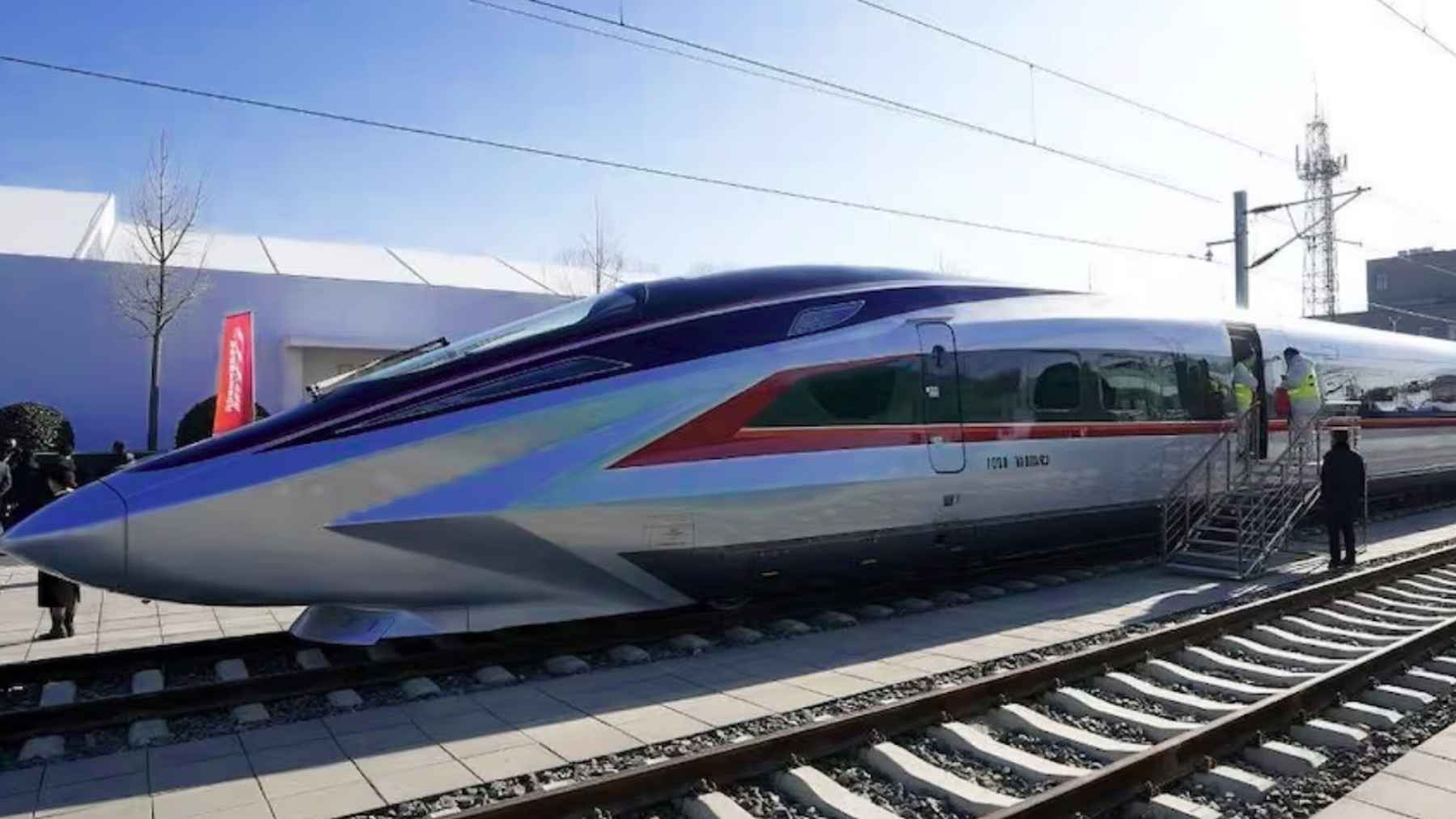
China has unveiled prototypes of a new CR450 bullet train that could soon become the fastest passenger train on rails. In tests, the sleek electric train has reached 450 kilometers per hour, and railway officials say the goal is to run it at 400 kilometers per hour in normal service, well ahead of today’s Japanese and European high-speed trains. If those numbers hold in real-world operations, they would mark a major shift in how quickly people and goods can move across the country.
For anyone who has stared at a departure board while a flight is delayed again, the idea of boarding a train that rivals planes on busy routes is easy to imagine. Right now, the CR450 is still a prototype running test laps in Beijing and on dedicated trial sections, but it already represents the next step in China’s long push to dominate high-speed rail. The bigger question is what this new train means for the global race in rail technology and for everyday travelers watching their time and their electric bill.
A new benchmark for high-speed Rail
The CR450 series is the successor to the CR400 Fuxing trains that currently run at 350 kilometers per hour on China’s busiest high-speed lines. Two new models, named CR450AF and CR450BF, use an eight-car setup with four powered cars and four trailers, packed with updated electronics and control systems from train maker CRRC Corporation Limited. According to China State Railway Group, the state operator, the design targets routine operation at 400 kilometers per hour while keeping safety margins similar to the older fleet.
Engineers have shaved about 10% off the train’s total weight and cut overall running resistance by 22% compared with earlier models, improvements that match details shared in CRRC’s own testing updates. That may sound like technical fine print, yet less weight and lower air drag mean the motors need less power to push the train through the air at extreme speed, which can help control operating costs and, in the end, ticket prices. The streamlined nose, enclosed equipment under the floor, and carefully smoothed surfaces are all part of that fight against invisible air resistance.
How the CR450 squeezes out more speed
Under the skin, the CR450 uses a water-cooled permanent magnet traction system instead of older motor designs, paired with a new high-stability bogie, the wheeled frame that sits under each car. This setup improves how efficiently the train turns electrical power into movement and keeps it steady even when it is racing along at many times highway speed.
More than 4,000 onboard sensors watch key parts such as the car bodies, pantographs that collect power from overhead wires, train control systems, and fire detection equipment in real time, feeding data into multi-level emergency braking and monitoring systems.
Comfort has also been upgraded, since riding at 400 kilometers per hour is only appealing if the trip is quiet and smooth enough to answer messages or nap. Noise inside the cars has been reduced by about 2 decibels and passenger service space has increased by roughly 4%, helped by lightweight materials and improved sound insulation along the walls and windows.
One project executive put it simply, saying that designers are committed to providing passengers “diverse, convenient, and personalized services” to enhance the travel experience.
Ahead of Japan and Germany for now
Right now, many of the world’s best known high-speed trains operate at around 300 to 320 kilometers per hour, including leading Shinkansen services in Japan and ICE 3 sets in Germany. If the CR450 reaches its planned commercial speed of 400 kilometers per hour, it would sit a clear step above those systems in day to day operation, not just in short record runs. That level of speed could make rail trips between major Chinese cities faster door to door than flying when you factor in airport transfers and security lines.
China’s current flagship, the Fuxing family, already runs faster than most of its rivals at 350 kilometers per hour, so the CR450 is meant as another jump rather than a first entry into high-speed rail. Engineers and regulators will still need to balance raw speed with track limits, maintenance schedules, and safety margins, and several briefings suggest some routes may start closer to 350 kilometers per hour before stepping up as upgrades are completed. In other words, the headline number tells only part of the story, but it signals where the technology is headed.
Part of a much bigger rail strategy
China now operates about 47,000 kilometers of high-speed railway, by far the largest such network in the world and still growing. That mesh of lines links nearly every major city, turning once-long trips into routine same-day journeys for commuters, students, and families visiting relatives. The CR450 fits into long-term plans to push that network to even higher speeds while also improving energy efficiency and capacity on the busiest corridors.
Chinese companies are also exporting this know-how through international projects, including the Jakarta-Bandung high-speed railway in Indonesia, which has carried millions of passengers since it opened for commercial service in October 2023. In Europe, the Belgrade-Novi Sad high-speed railway in Serbia marked its second anniversary in 2024 after carrying well over six million passenger trips, showing how quickly high-speed links can become part of daily life between cities. These projects show how the same technology that powers the CR450 at home can reshape travel abroad, cutting journey times and changing how people plan weekend trips or business meetings.
What happens next for the CR450
Before passengers see CR450 trains on regular timetables, prototypes are undergoing type tests on special ring lines and new routes, where engineers measure acceleration, braking, stability, and energy use at different speeds.
Media reports and industry briefings suggest that China Railway aims to start commercial deployment around 2026, once the train has completed extensive test running and key routes have been upgraded. How quickly that rollout happens will depend on testing results and on how much infrastructure can be made ready for 400 kilometer per hour operation.
The new train has already been a showcase piece at the World Congress on High Speed Rail in Beijing, organized by the International Union of Railways and China Railway, a sign that global industry leaders are watching its progress closely. At the end of the day, the CR450 is not just about setting a speed record, it is about convincing travelers to choose fast electric trains over short-haul flights and long highway drives when they plan their next trip.
For now, the silver prototype circling test tracks is a preview of that future, where crossing a country at 400 kilometers per hour feels as normal as catching a commuter train into downtown.