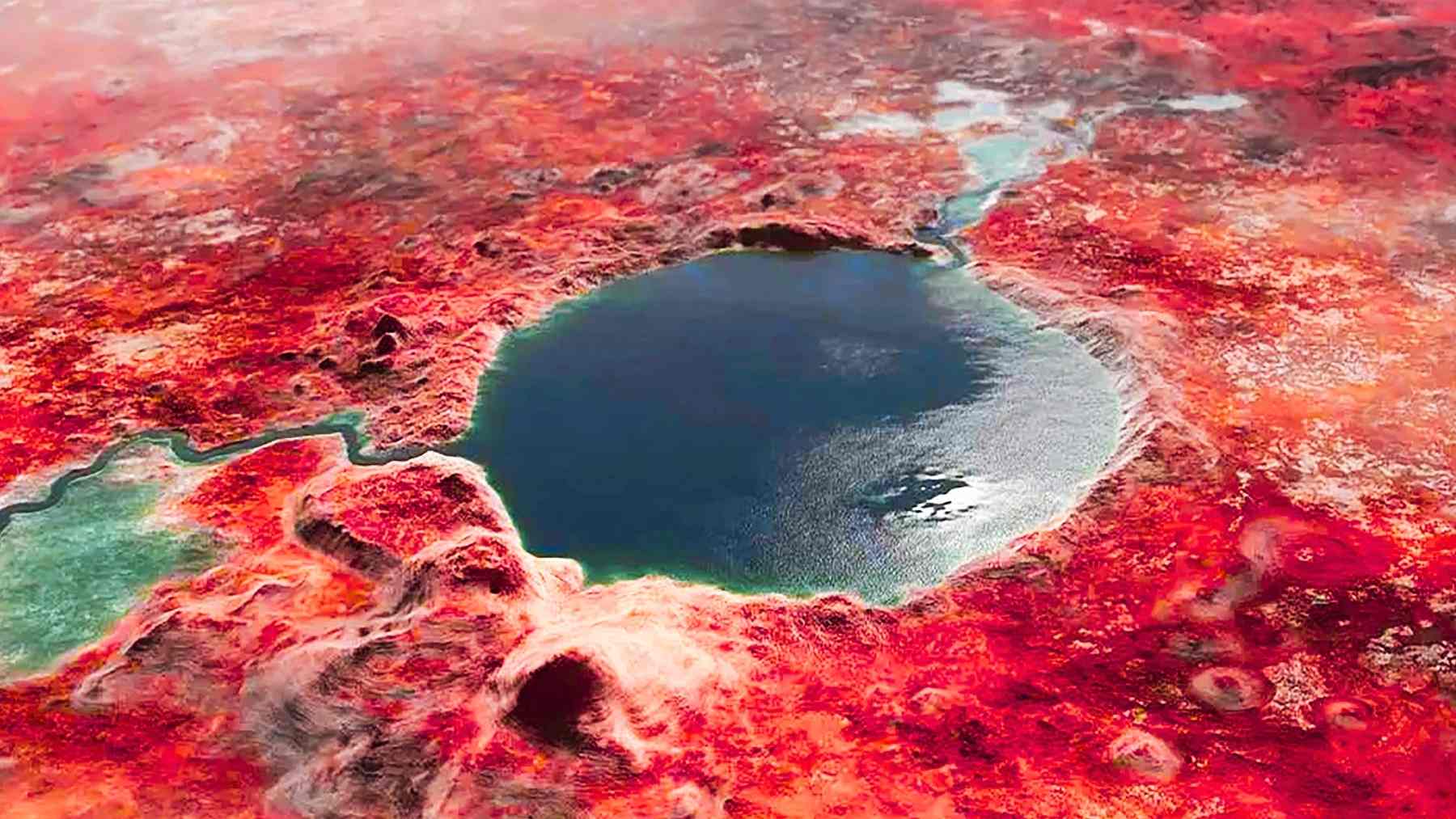
For years, scientists have argued over whether early Mars was mostly frozen or home to real lakes where water moved in the open air. A new study now tips the balance. Tiny ripple patterns carved into Martian rocks show that shallow, ice-free lakes once rippled in the wind about 3.7 billion years ago.
The evidence comes from two sets of “wave ripples” spotted by NASA’s Curiosity rover in Gale Crater, a basin near the Martian equator that has been the rover’s home since 2012. These undulating patterns are familiar to anyone who has walked along a lake shore on Earth. They form when wind-driven waves push water back and forth over sandy bottoms, leaving a repeating pattern in the sediment that later turns to rock.
Ripples that read like a lake diary
Researchers led by Caltech geologist Claire Mondro describe the findings as the clearest sign yet of a standing body of water on Mars that was open to the atmosphere. “The shape of the ripples could only have been formed under water that was open to the atmosphere and acted upon by wind,” Mondro explains.
The ripples themselves are tiny. They stand only about six millimeters high and are spaced four to five centimeters apart. Those dimensions are crucial. On Earth, such fine ripples in sand appear where waves are modest and water is shallow. Using computer models, coauthor Michael Lamb estimated that the ancient Martian lake was less than about two meters deep, roughly the height of a person.
Curiosity first photographed one set of ripples in 2022 in a rock ledge nicknamed the Prow, in an area that once held wind-blown dunes. A second set turned up nearby in a band of rock known as the Amapari Marker Band. Together, they point to at least two episodes when liquid water pooled in Gale Crater’s landscape rather than staying locked up as ice.
A warmer, thicker Martian climate
Today, Mars is cold, dry, and wrapped in a thin atmosphere that cannot keep surface water from freezing or boiling away. These wave ripples tell a different story for the planet’s distant past. To keep shallow lakes from icing over, the atmosphere must once have been thicker and the climate warmer, at least for stretches of time.
That detail matters for more than just curiosity about alien weather. Climate models have debated whether early Mars was mostly icy with brief melt events or more consistently mild with open water. Symmetrical wave ripples like the ones in Gale Crater can only form where liquid water, wind, and sediment interact at the same time. That turns them into a precise climate clue and, in the words of the study, “the most definitive examples of wave ripples on another planet.”
Extending the window for possible life
Water is not a guarantee of life, but it is a basic requirement for it as we currently understand biology. Mondro notes that “extending the length of time that liquid water was present extends the possibilities for microbial habitability later into Mars’s history.” If lakes in Gale Crater remained ice free longer than expected, microbes would have had more time and more stable settings in which to emerge or survive.
Other missions are already chasing that possibility. NASA’s Perseverance rover, working in a different ancient crater, is collecting samples of sediment thought to have formed in a river delta. Future sample return missions could allow scientists on Earth to look for organic molecules or subtle chemical fingerprints of past microbes, including in rocks that record former lakes like the one now identified in Gale Crater.
A guide for future explorers
Even for future astronauts, the story does not end with ancient ripples frozen in stone. Knowing where water once gathered helps planners pinpoint regions where buried ice or hydrated minerals may still be present. Those resources could one day supply drinking water, help produce oxygen, or even support rocket fuel production instead of shipping everything from Earth at great cost.
Lessons from a lost lake world
At the end of the day, these delicate patterns in Martian rock are more than pretty textures on a rover image. They are a reminder that planets can shift from watery and possibly habitable to dry and hostile as their atmospheres thin and climates change. For researchers who study Earth’s own climate system, Mars provides a stark natural experiment on what happens when a planet loses its protection.
For now, Curiosity keeps climbing the layered rocks of Gale Crater, reading the red planet’s past one outcrop at a time. The new study in Science Advances turns a few centimeters of rippled sandstone into a powerful record of a vanished lake and the climate that kept it alive billions of years ago.
The study was published in the journal Science Advances on the Science.org website.