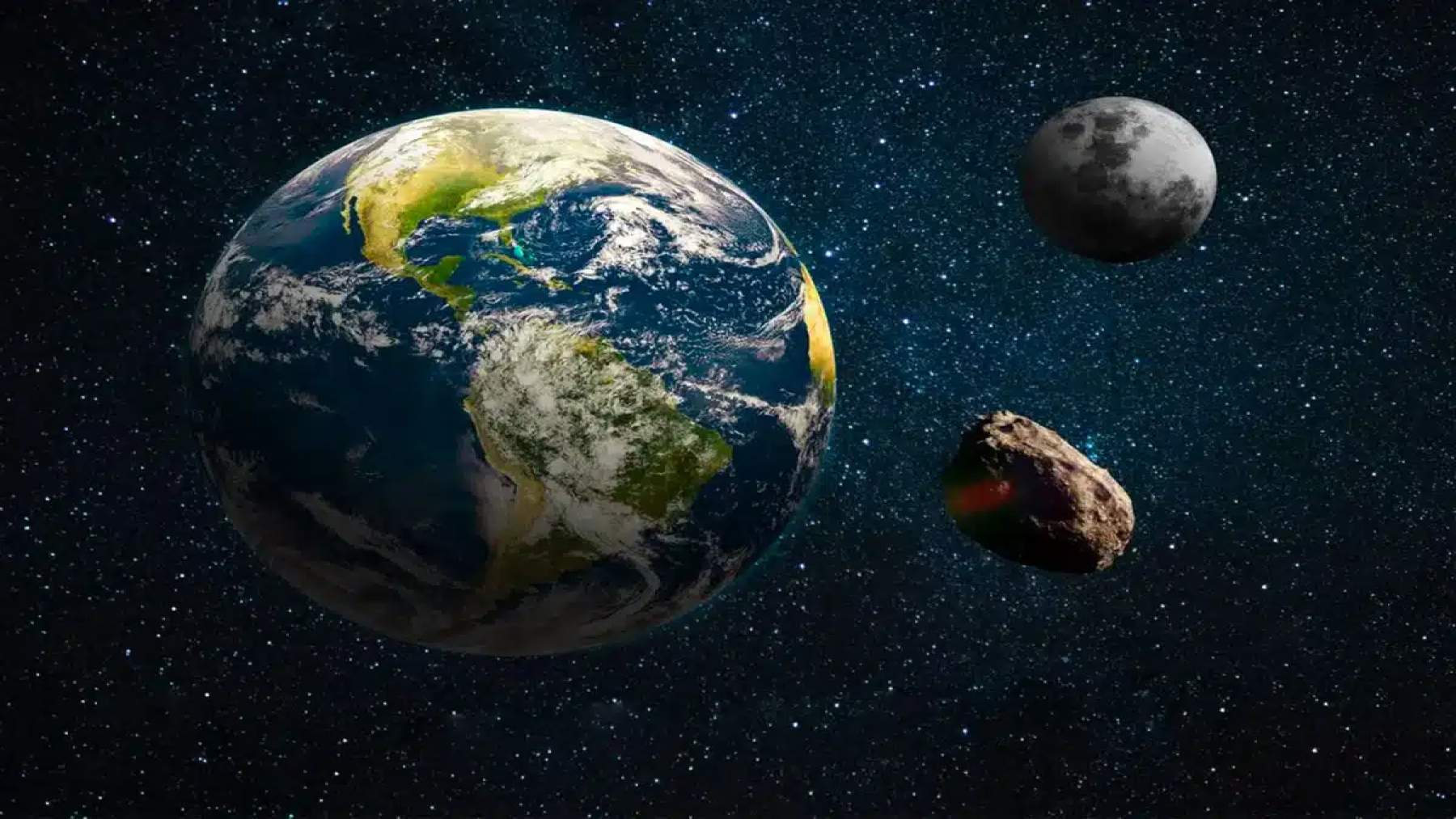
From time to time, asteroids enter the orbit of planet Earth and remain as mini moons for a while before carrying on with their journeys through space. Such events are interesting as they help develop the knowledge about the dynamics of the solar system and its components. Recently two such celestial guests asteroid 2023 NT1 and asteroid 2024 PT5 have become popular both among astronomers and sky lovers. Their ephemeral presence allows for scientific pursuits and entertainment in equal measure.
Goodbye to Earth’s ‘second moon’: A phenomenon that will not be observed until 2055
Asteroid 2023 NT1, the one which is called Earth’s “second moon” by many, has gained attention of people all over the world. This was the temporary satellite of the Earth for a few months; the 31-foot asteroid put a unique display in the outer space.
Thanks to the sturdy orbit of this small rock, anyone under the cloudless sky would have been able to see it moving as a light speck even without a telescope, with its naked eye under the best conditions. But this visitor of the cosmos is almost done.
The scientists forecast this object will soon exit from the Earth trajectory and will stay hidden from the view until the year 2055. Fortunately for those amateur astronomers who have caught the darts departure of the heavens, screening apps and open skies were two crucial elements of success. These “second moons’ remind us of wonderful everlasting events that happen, but only for a short period of time in this ever-changing universe.
Asteroid 2024 PT5: A short visit to Earth’s little temporary moon
On September 29 of the year 2024, scientists encounter an asteroid 2024 PT5, which is yet another mini moon temporarily encircled by Earth. This asteroid, measuring 37 feet wide, is from the Arjuna asteroid belt that is known for its proximity to the Earth.
In opposition to a conventional moon, 2024 PT5 shall not complete an entire orbit, but shall instead simply ‘window shop’ within proximity before leaving on the 25th of November 2024. Amateurs would fail to spot it however even through a construction telescope. Thanks to such telescopes however, the structure and motion of the asteroid under study was properly observed by astronomers.
Astronomers believe that 2024 PT5 is a natural cosmic laboratory which is helpful in the study of near-earth objects and their motion. This helps deepen the knowledge of the solar system and suggests how to deal with potential dangers from asteroids.
Investigating mini moons: Revealing the mysteries of asteroids’ movements
Mini moons such as 2023 NT1 and 2024 PT5 are not just astronomical phenomena. They are also avenues for scientific growth. As they orbit Earth for some time, scientists get to study their motions and internal structures, allowing them to develop better and more accurate asteroid models, which will come in handy in case ever an asteroid comes to threaten planet Earth.
Such temporary satellites also facilitate future enterprises. Use of min-moons as simulators of spacecraft construction could be one way of utilizing them or even will be in search of some useful minerals. It helps to learn a lot about our planet and the surrounding universe.
The Earth’s temporary satellites, though short term, underscore the dynamic character of the solar system. From the intriguing last look of 2023 NT1 to the scientific potential of 2024 PT5, these guests teach us about the possibilities of exploration that await us. As the search for answers beyond our atmosphere continues, every new piece of information brings us a step closer to finding out the answers to the questions that plague mankind regarding the cosmos.